
Overview
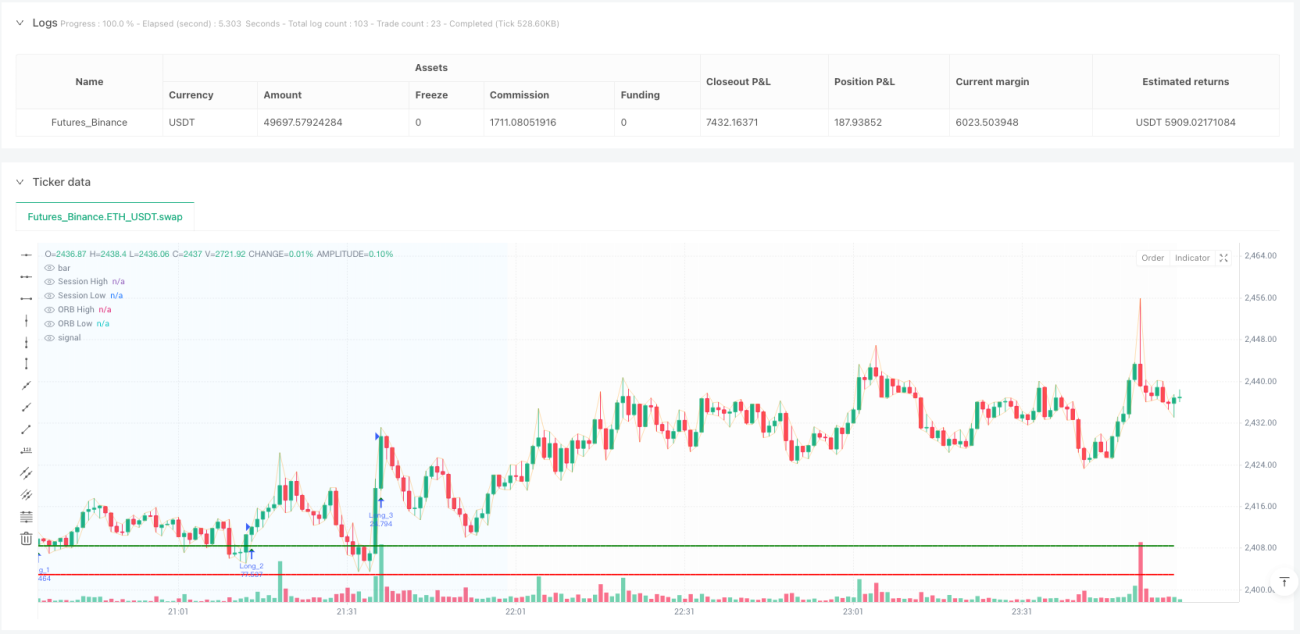
The Opening Range Breakout with Fair Value Gap Integration Strategy is a quantitative trading approach that combines Opening Range Breakout (ORB) with Fair Value Gap (FVG) concepts from Smart Money Concepts (SMC). This strategy first defines a price range during the initial period of the trading day (typically the first 5 minutes after market open), then looks for trading signals when price breaks through this range boundary while intersecting with a Fair Value Gap. The strategy is designed for intraday trading within specific timeframes, particularly during regular trading hours in the US market, and incorporates risk management mechanisms to control exposure for each trade.
Strategy Principles
The core principles of this strategy are based on two key technical analysis concepts:
-
Opening Range Breakout (ORB) - The strategy first identifies the highest and lowest prices within a specific timeframe after market open (default is 5 minutes), forming a price range. This range is viewed as the initial judgment of market participants regarding the day's price movement, and a breakout from this range may indicate the formation of a short-term trend.
-
Fair Value Gap (FVG) - An analytical method from Smart Money Concepts (SMC), a bullish FVG forms when the current high is lower than the low of the candle before the previous one, and a bearish FVG forms when the current low is higher than the high of the candle before the previous one. These gaps are considered areas where price may potentially return to fill, representing imbalances in market structure.
Trading signals are generated under the following conditions:
- A long signal is triggered when a bullish FVG intersects with the upper ORB boundary (the previous candle's opening price is below the ORB high, and its closing price is above the ORB high)
- A short signal is triggered when a bearish FVG intersects with the lower ORB boundary (the previous candle's opening price is above the ORB low, and its closing price is below the ORB low)
During trade execution, the strategy employs a risk-based position sizing method, calculating the specific position size for each trade based on the stop-loss distance to ensure consistent risk exposure. Stop-loss is set at the previous candle's low for long trades or the previous candle's high for short trades, while the profit target is based on a preset risk-reward ratio (default is 2.0). All open positions are automatically closed at the end of the trading session, ensuring no overnight exposure.
Strategy Advantages
-
Integration of Multiple Technical Analysis Methods - By combining ORB and FVG technical analysis methods, the strategy can filter out false signals that might be generated by a single indicator, improving the quality of trading signals.
-
Clear Trading Timeframe - The strategy clearly defines the trading timeframe (signal period and trading period), helping traders focus on the most active market periods with the highest signal quality, avoiding ineffective trades during low-activity periods.
-
Risk-Based Position Sizing - The strategy uses a risk-based position calculation method, ensuring that each trade risks a consistent percentage of the total account capital (default is 1%), which is beneficial for long-term capital management and risk control.
-
Flexible Parameter Configuration - The strategy offers multiple adjustable parameters, including trading session settings, ORB duration, signal period duration, risk percentage, and risk-reward ratio, allowing traders to optimize according to different markets and personal risk preferences.
-
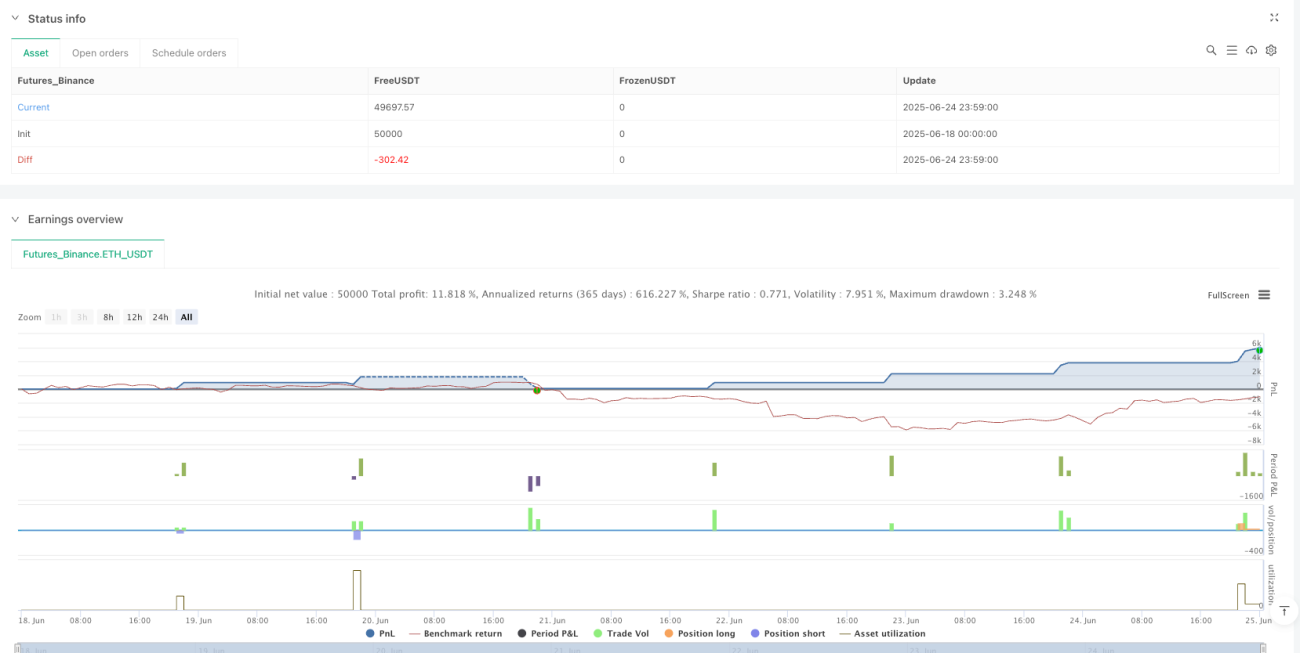
Visual Aids - The strategy provides rich visualization elements, including ORB horizontal lines, trade signal markers, background highlights for different trading periods, and a real-time statistics table, facilitating monitoring and analysis of strategy execution.
-
Support for Multiple Positions - The strategy design supports holding multiple trading positions simultaneously (controlled by the pyramiding parameter), allowing the capture of multiple trading opportunities within the same trading day, improving capital utilization efficiency.
Strategy Risks
-
Market Specificity - The strategy is primarily designed for regular trading hours in the US stock market and may not perform well in other markets or trading sessions. Opening characteristics and volatility patterns vary significantly across different markets, requiring targeted parameter adjustments.
-
Parameter Sensitivity - Strategy performance is sensitive to several key parameters, such as ORB duration, signal period length, and risk-reward ratio. Inappropriate parameter settings may lead to overtrading or missing important trading opportunities.
-
Market State Dependency - Strategy performance may be inconsistent in high-volatility or low-volatility market environments. Particularly in low-volatility markets, the ORB range may be too narrow, leading to frequent false breakout signals.
-
Stop-Loss Placement Risk - The strategy uses the previous candle's high/low as stop-loss positions, which in fast markets may result in overly wide stop-loss distances, reducing the risk-reward ratio or leading to excessively small position sizes.
-
Reliance on Historical Price Patterns - The strategy assumes that FVG areas and ORB breakouts have predictive significance, but increased market efficiency or changes in trading environments may weaken the effectiveness of these patterns.
-
Technical Execution Risk - In actual trading, issues such as slippage and order execution delays may affect the consistency between actual trading results and backtesting results.
Strategy Optimization Directions
-
Dynamic ORB Duration - Consider automatically adjusting the ORB duration based on market volatility, such as using a longer ORB time in high-volatility market environments to avoid false breakouts, and shortening ORB time in low-volatility environments to capture more trading opportunities.
-
Add Filtering Conditions - Introduce additional filtering conditions to improve signal quality, such as aligning with the overall market trend direction (only going long in uptrends, short in downtrends), or adding volume confirmation (only trading when breakouts are accompanied by increased volume).
-
Optimize Stop-Loss Placement - Consider using dynamic stop-loss settings based on ATR or volatility, replacing the current fixed stop-loss method based on previous candle high/low points, which may provide more reasonable risk control.
-
Add Partial Profit-Taking Mechanism - Implement a tiered profit-taking strategy, such as closing part of the position when reaching a 1:1 risk-reward ratio, with the remaining portion set with a trailing stop or a more distant profit target, balancing the need to lock in profits and follow trends.
-
Time Filtering - Add time filters to avoid known low-quality trading periods, such as low-volatility lunch hours or high-volatility periods before and after important economic data releases.
-
Increase Adaptive Parameters - Introduce self-adaptive parameters allowing the strategy to automatically adjust based on recent market performance, such as dynamically adjusting the risk-reward ratio or adjusting the risk percentage based on recent win rates.
Summary
The Opening Range Breakout with Fair Value Gap Integration Strategy is a meticulously designed intraday trading system that seeks high-probability trading opportunities by combining ORB and FVG technical analysis methods. The strategy operates within clearly defined trading sessions, employs risk-based position sizing, and provides rich visualization and statistical tools to aid trading decisions.
The main advantages of the strategy lie in its clear trading logic, flexible parameter settings, and comprehensive risk management mechanisms. However, the strategy also faces risks such as market dependency, parameter sensitivity, and market state dependency. To enhance strategy robustness, it is recommended to consider dynamic parameter adjustments, additional filtering conditions, optimized stop-loss methods, and tiered profit-taking mechanisms.
It should be noted that this strategy is not suitable for all market environments and all trading instruments. Traders should conduct thorough backtesting and forward testing before actual application to ensure the strategy aligns with their risk preferences and trading objectives. Through continuous optimization and adaptation to market changes, this strategy has the potential to become an effective tool in the intraday trader's toolkit.
/*backtest
start: 2025-06-18 00:00:00
end: 2025-06-25 00:00:00
period: 1m
basePeriod: 1m
exchanges: [{"eid":"Futures_Binance","currency":"ETH_USDT"}]
*/

// Based on https://www.youtube.com/watch?v=mzFXoK2pbNE

//@version=5
strategy("[Myth Busting] [ORB] Casper SMC - 16 Jun", overlay=true, default_qty_type=strategy.percent_of_equity, default_qty_value=100, initial_capital=10000, pyramiding = 10)- 1