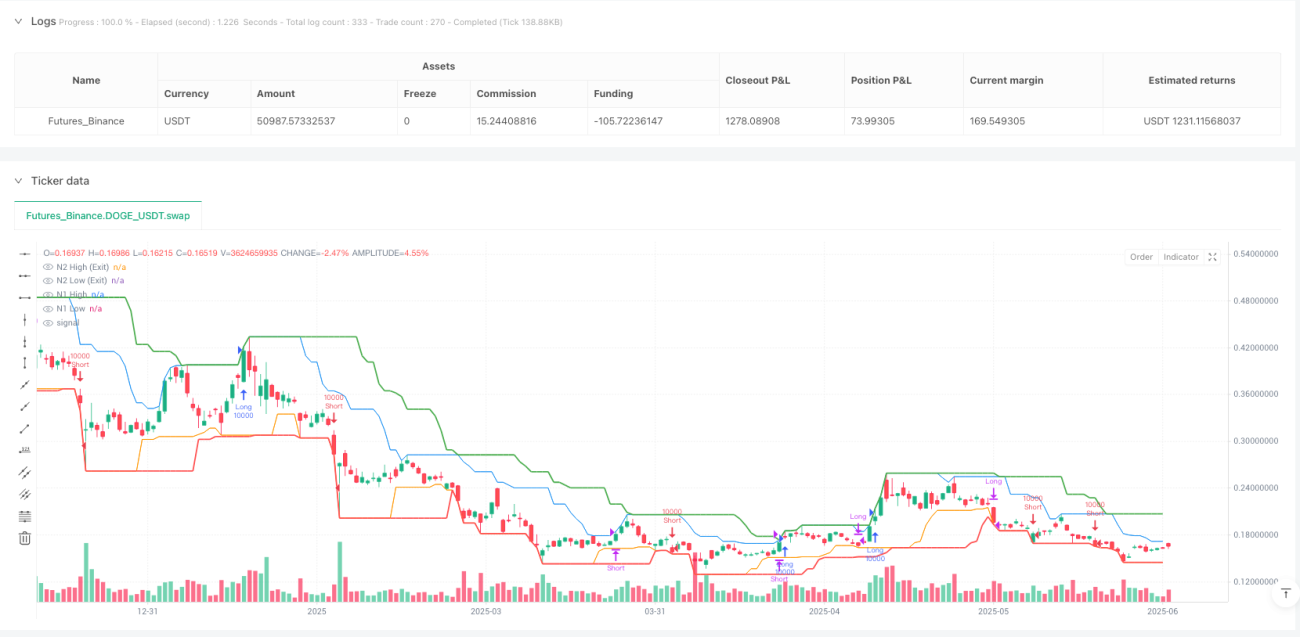
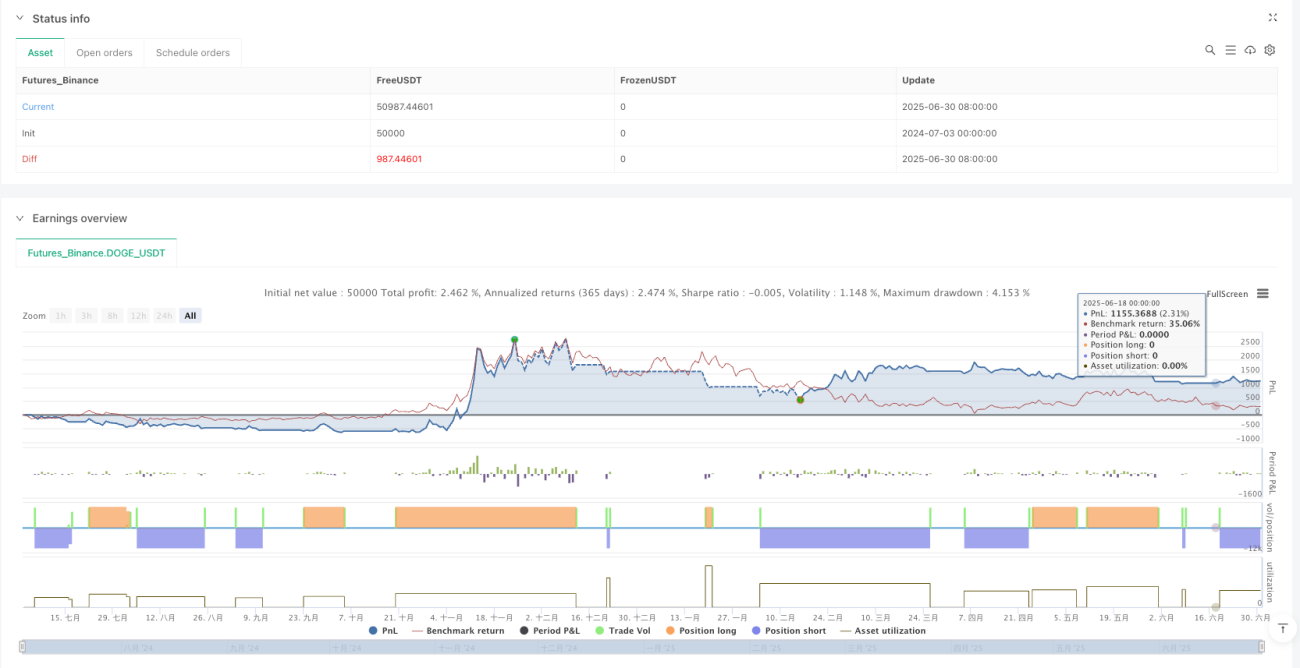
多指标突破趋势跟踪策略是一种基于经典海龟交易系统的量化交易策略,该策略通过多周期突破信号捕捉市场中的强势趋势。策略核心在于利用不同时间周期的价格突破作为入场和出场信号,同时结合ATR(平均真实波幅)进行风险控制和仓位管理。该策略既可作为指标用于识别市场突破信号,也可作为完整的自动化交易系统执行交易。策略的优势在于系统化捕捉趋势性机会,并通过严格的风险控制提高资金管理效率。
该策略的核心原理是通过识别价格突破历史高点或低点来捕捉潜在的趋势运动。具体实现逻辑如下:
入场机制:策略使用N1周期(默认20个周期)的历史最高价和最低价作为突破参考。当价格向上突破前N1周期的最高价时,生成多头入场信号;当价格向下突破前N1周期的最低价时,生成空头入场信号。
出场机制:策略采用双重出场机制:
仓位管理:策略基于波动率(ATR)和风险比例计算交易单位大小,确保每笔交易风险控制在账户资金的固定比例(默认1%)内。计算公式为:
交易单位 = 风险金额 / (ATR * 每点价值)
其中风险金额为初始资金乘以风险比例。
交易执行:策略仅在无持仓时执行新的入场信号,避免重复入场,同时记录入场价格用于计算止损位置。
趋势跟踪能力:策略设计专注于捕捉大趋势,通过突破信号识别潜在的趋势起点,有效利用市场的趋势性走势。
动态风险控制:通过ATR计算止损位置,根据市场实际波动情况动态调整止损距离,既避免了固定止损过近导致的频繁止损,又防止了止损距离过远带来的过大损失。
仓位自适应:基于市场波动率和账户风险比例动态调整仓位大小,在高波动市场自动减小仓位,在低波动市场适当增加仓位,实现风险敞口的均衡控制。
参数可调整性:策略提供多个关键参数(N1、N2、ATR周期、风险比例等)的调整接口,使用者可根据不同市场环境和个人风险偏好进行优化。
系统化交易:完全系统化的交易规则消除了情绪干扰,严格遵循预设的入场、出场和资金管理规则,提高交易纪律性。
震荡市场表现不佳:作为趋势跟踪策略,在横盘震荡市场中容易产生频繁的假突破信号,导致连续止损。解决方法可以增加波动率过滤条件,仅在波动率超过一定阈值时才考虑入场。
滑点和佣金影响:在高频交易或流动性不足的市场中,滑点和佣金可能显著影响策略表现。可通过降低交易频率或增加信号确认机制来减轻这一问题。
参数敏感性:策略表现对N1、N2参数设置较为敏感,不同市场和时间框架下最优参数可能差异较大。建议通过历史回测寻找稳健的参数组合,避免过度优化导致的曲线拟合。
大幅缺口风险:在突发性重大事件导致的价格跳空中,止损单可能无法按预期价格执行,造成超预期损失。可考虑增加最大损失限制或引入波动率调整因子。
资金管理风险:尽管策略包含风险控制机制,但在极端市场条件下,连续止损仍可能导致资金曲线大幅回撤。建议设置最大连续亏损次数限制或引入总体风险敞口控制。
多时间框架确认:可引入更长周期的趋势确认机制,只在多个时间框架趋势一致时才考虑入场,提高信号质量。例如,可增加检查日线趋势方向与当前交易周期趋势方向是否一致的条件。
波动率过滤:引入波动率过滤条件,仅在市场波动率处于合理范围内才执行交易信号,避免在过度平静或过度波动的市场中入场。可使用ATR相对值(如ATR/价格比率)作为过滤指标。
信号确认机制:增加突破确认机制,如要求价格在突破后保持一定时间或幅度才确认信号有效,减少假突破带来的损失。
动态参数调整:基于市场状态动态调整N1、N2参数,在不同波动率环境下使用不同的参数组合,提高策略对市场环境的适应性。
加入趋势强度评估:结合趋势强度指标(如ADX、线性回归斜率等)评估当前趋势强度,仅在趋势强度达到一定阈值时才考虑入场,提高趋势捕捉的准确性。
优化止损机制:可考虑引入移动止损或基于支撑/阻力位的止损方法,在保留风险控制功能的同时,给予趋势更多发展空间。
多指标突破趋势跟踪策略是一种结合了经典海龟交易理念与现代风险管理技术的系统化交易策略。通过多周期价格突破判断趋势方向,结合ATR进行动态止损和仓位控制,该策略能够有效捕捉市场中的显著趋势性机会。
策略的核心优势在于系统化的交易规则和严格的风险控制,避免了情绪干扰,同时通过参数调整提供了较高的灵活性。然而,作为一种趋势跟踪策略,它在震荡市场中表现可能不佳,需要使用者理解其适用场景并进行适当的参数优化。
通过引入多时间框架确认、波动率过滤、信号确认机制等优化方向,该策略有望进一步提高信号质量和稳定性,适应更多样化的市场环境。最终,多指标突破趋势跟踪策略为交易者提供了一种可靠、系统化的方法来捕捉市场趋势,同时控制风险,实现长期稳健的交易表现。
/*backtest
start: 2024-07-03 00:00:00
end: 2025-07-01 08:00:00
period: 1d
basePeriod: 1d
exchanges: [{"eid":"Futures_Binance","currency":"DOGE_USDT"}]
*/
//@version=5
strategy("Turtle Trading Strategy (Simplified)", overlay=true, initial_capital=10000, default_qty_type=strategy.cash, default_qty_value=1000, commission_type=strategy.commission.cash_per_order, commission_value=1)
// --- Strategy Inputs ---
n1_entry_period = input.int(20, title="Entry Lookback Period (N1)", minval=1)
n2_exit_period = input.int(10, title="Exit Lookback Period (N2)", minval=1)
atr_period = input.int(20, title="ATR Period", minval=1)
atr_multiplier = input.float(2.0, title="ATR Stop Multiplier", minval=0.1)
risk_per_trade_percent = input.float(1.0, title="Risk Per Trade (%)", minval=0.1, maxval=10.0)
// --- Calculate Channels ---
highest_high_n1 = ta.highest(high, n1_entry_period)
lowest_low_n1 = ta.lowest(low, n1_entry_period)
highest_high_n2 = ta.highest(high, n2_exit_period)
lowest_low_n2 = ta.lowest(low, n2_exit_period)
// --- Calculate ATR (Average True Range) ---
atr_value = ta.atr(atr_period)
// --- Position Sizing (Simplified) ---
// This aims to calculate units based on a fixed percentage risk per trade.
// 1 Unit = 1 ATR worth of movement. Risk 1% of equity per trade.
risk_amount = strategy.initial_capital * (risk_per_trade_percent / 100)
dollar_per_point = syminfo.mintick // Or your instrument's specific dollar per point value
unit_size = atr_value * dollar_per_point > 0 ? math.round(risk_amount / (atr_value * dollar_per_point)) : 0
// Ensure unit_size is at least 1 if risk allows, and cap it for realism
if unit_size == 0 and risk_amount > 0
unit_size := 1 // Minimum 1 unit if risk allows any trade
if unit_size > 10000 // Cap unit size to prevent excessively large positions in backtesting
unit_size := 10000
// --- Entry Logic ---
long_condition = ta.crossover(close, highest_high_n1[1]) // Break above previous N1 high
short_condition = ta.crossunder(close, lowest_low_n1[1]) // Break below previous N1 low
// Variables to store entry information only for the *current* bar
var float current_entry_price = na
var int current_entry_type = 0 // 1 for long, -1 for short, 0 for no entry
if long_condition and strategy.opentrades == 0 // Only enter if no open positions
strategy.entry("Long", strategy.long, qty=unit_size, comment="Turtle Long Entry")
// Store entry details for the current bar
current_entry_price := close // Or strategy.opentrades[0].entry_price if you prefer but close on entry bar is often same
current_entry_type := 1
if short_condition and strategy.opentrades == 0 // Only enter if no open positions
strategy.entry("Short", strategy.short, qty=unit_size, comment="Turtle Short Entry")
// Store entry details for the current bar
current_entry_price := close // Or strategy.opentrades[0].entry_price
current_entry_type := -1
// --- Exit Logic ---
// Declare persistent variables to store stop prices
var float long_stop_price = na
var float short_stop_price = na
// Calculate and store stop price on the bar *after* an entry
if current_entry_type[1] == 1 // If a long entry occurred on the previous bar
long_stop_price := current_entry_price[1] - (atr_value[1] * atr_multiplier) // Use values from previous bar
short_stop_price := na // Reset short stop
if current_entry_type[1] == -1 // If a short entry occurred on the previous bar
short_stop_price := current_entry_price[1] + (atr_value[1] * atr_multiplier) // Use values from previous bar
long_stop_price := na // Reset long stop
// Stop Loss for Long Positions
if strategy.position_size > 0 // We have a long position
strategy.exit("Long Exit SL", from_entry="Long", stop=long_stop_price, comment="Long Stop Loss")
// Stop Loss for Short Positions
if strategy.position_size < 0 // We have a short position
strategy.exit("Short Exit SL", from_entry="Short", stop=short_stop_price, comment="Short Stop Loss")
// N2 Exit for Long Positions
if strategy.position_size > 0 and ta.crossunder(close, lowest_low_n2[1])
strategy.close("Long", comment="Turtle Long N2 Exit")
// N2 Exit for Short Positions
if strategy.position_size < 0 and ta.crossover(close, highest_high_n2[1])
strategy.close("Short", comment="Turtle Short N2 Exit")
// --- Plotting for Visualization ---
plot(highest_high_n1, "N1 High", color=color.green, linewidth=2, style=plot.style_linebr)
plot(lowest_low_n1, "N1 Low", color=color.red, linewidth=2, style=plot.style_linebr)
plot(highest_high_n2, "N2 High (Exit)", color=color.blue, linewidth=1, style=plot.style_linebr)
plot(lowest_low_n2, "N2 Low (Exit)", color=color.orange, linewidth=1, style=plot.style_linebr)