Multi-Indicator Hybrid RSI Scalping Strategy

Overview
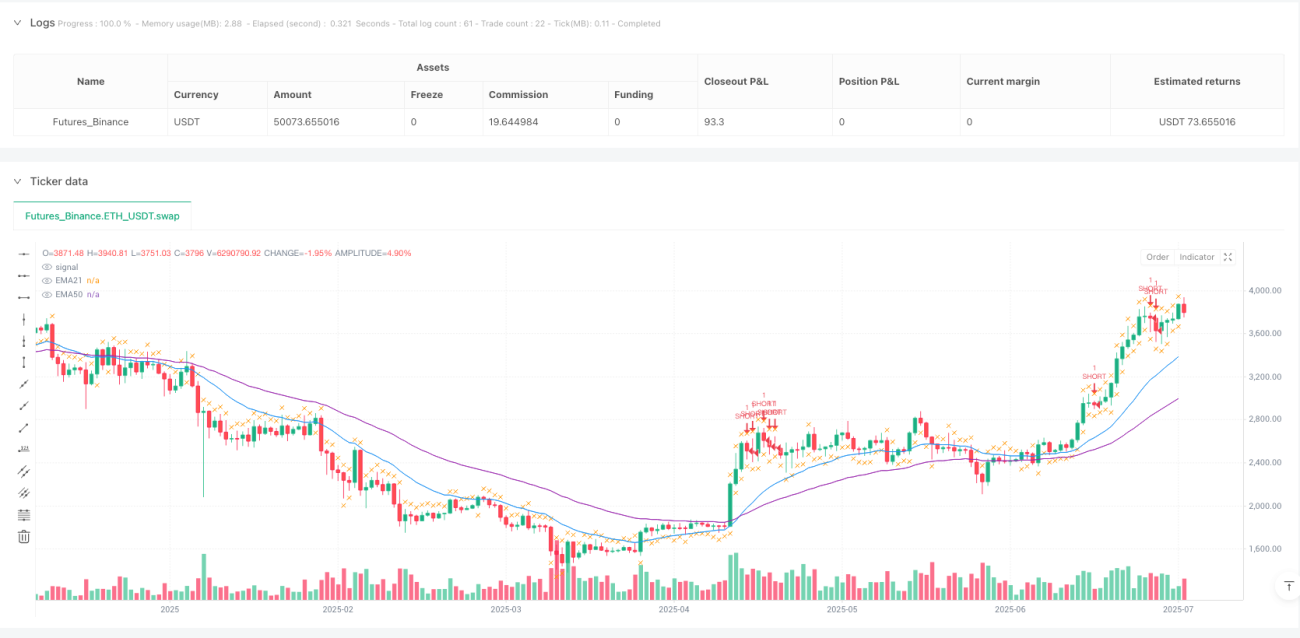
The Multi-Indicator Hybrid RSI Scalping Strategy is a comprehensive trading system that combines multiple technical indicators designed specifically for short-term traders. This strategy integrates RSI indicators, moving averages, volume analysis, and price action patterns to form a multidimensional trading decision framework. At its core, the strategy employs a signal filtering mechanism with different sensitivity levels, allowing traders to adjust trading frequency and signal quality according to their risk preferences and market conditions. The strategy particularly emphasizes quick entries and precise exits, effectively controlling risk while securing profits through multiple exit mechanisms including take profit, stop loss, trailing stop, and quick exit functionalities.
Strategy Principles
The core principles of this strategy are based on the synergistic action of several key technical elements:
-
RSI Overbought/Oversold Signals: Uses the 14-period RSI indicator to identify overbought (>70) and oversold (<30) regions as the primary conditions for triggering trading signals.
-
Moving Average Trend Confirmation: The strategy incorporates 9, 21, and 50-period EMA moving averages to build a trend identification system. Market trend direction and strength are determined by observing the relationships between these moving averages. When EMA9>EMA21>EMA50, a strong uptrend is confirmed; when EMA9<EMA21<EMA50, a strong downtrend is confirmed.
-
Volume Verification: Compares current volume with the 10-period average volume to ensure trades occur in sufficiently active market environments, improving signal quality.
-
Price Action Patterns: Analyzes candlestick patterns, particularly strong bullish and bearish candles, by calculating the ratio of body to shadow to measure price momentum.
-
Multi-level Signal Sensitivity: The strategy features four different levels of signal sensitivity ("Very Easy", "Easy", "Medium", "Strong"), allowing traders to adjust trading frequency and precision based on market conditions and risk preferences.
-
Intelligent Exit Mechanisms: The strategy implements multiple exit mechanisms, including fixed take profit and stop loss, RSI reversal quick exit signals, and trailing stop functionality that dynamically adjusts stop prices to lock in profits.
-
Daily Trade Limit: Built-in daily trade count limit function to prevent overtrading while maintaining the short-term trading style characteristics.
Strategy Advantages
-
Flexible Signal Sensitivity Adjustment: The strategy's greatest advantage lies in its adjustable signal sensitivity system, where traders can choose from four levels ranging from "Very Easy" to "Strong," finding a balance between trading frequency and signal quality. This allows the strategy to adapt to different market environments and personal trading styles.
-
Multiple Risk Management Mechanisms: The strategy integrates various risk control methods including fixed stop loss, trailing stop, and RSI-based quick exit, providing a comprehensive risk management framework. The trailing stop feature is particularly valuable as it progressively locks in gained profits while maintaining room for profit growth.
-
Comprehensive Technical Indicator Integration: By combining RSI, EMA, volume, and price action analysis, the strategy can assess market conditions from multiple dimensions, reducing false signals and improving trading accuracy.
-
Automated Trading Execution: The strategy is fully automated from signal generation and entry decisions to exit management, reducing emotional interference and ensuring trading discipline execution.
-
Real-time Visual Feedback: Through the built-in dashboard display function, traders can intuitively monitor strategy performance, current market conditions, and trading status, facilitating real-time decision adjustments.
-
Communication Integration Capability: The strategy supports Telegram message push functionality, enabling remote trade monitoring and signal notifications, enhancing operational convenience.
Strategy Risks
-
RSI Indicator Limitations: As the main signal source, RSI has inherent lag and false signal risks, especially in oscillating markets where frequent erroneous signals may occur. The solution is to combine trend filters and price action confirmation, or increase signal sensitivity requirements in sideways markets.
-
Overfitting Risk: The strategy contains numerous parameters, including RSI thresholds, EMA periods, and take profit/stop loss percentages, which can easily lead to overfitting. It is recommended to validate parameter robustness through historical data backtesting and forward testing, avoiding parameter combinations that only fit historical data.
-
Rapid Market Risk: In high volatility or market gap scenarios, fixed stop losses may not execute effectively, resulting in actual losses exceeding expectations. Consider using volatility-adjusted stop loss levels or adding market volatility filtering conditions to address this risk.
-
Trading Frequency Risk: Especially under low sensitivity settings, the strategy may generate too many trading signals, increasing transaction costs. Control trading frequency by reasonably setting daily trade limits and adjusting signal sensitivity.
-
Delayed Trend Reversal Response: Relying on EMA for trend judgment may not react quickly enough during the initial stages of trend reversals. Consider incorporating other trend confirmation indicators such as ADX or Parabolic SAR to enhance trend identification capabilities.
Strategy Optimization Directions
-
Adaptive Parameter Adjustment: The current strategy uses fixed RSI thresholds and EMA periods; an adaptive parameter system based on market volatility could be introduced. For example, automatically adjusting RSI overbought/oversold thresholds in high-volatility markets, or dynamically adjusting EMA period lengths based on different timeframes, improving the strategy's adaptability to various market environments.
-
Enhanced Signal Filtering Mechanism: More dimensional market environment identification indicators could be introduced, such as ATR (Average True Range) for volatility assessment, ADX (Average Directional Index) for trend strength confirmation, or multi-timeframe analysis to improve signal quality. These additional filters can reduce false signals and increase trading success rates.
-
Optimized Capital Management System: The current position management is relatively simple; dynamic position adjustment based on account equity percentage or Kelly criterion-based fund allocation methods could be introduced. This would automatically adjust risk exposure for each trade based on historical trading performance and current market conditions.
-
Machine Learning Integration: Machine learning algorithms could be utilized to analyze historical trading data and automatically identify optimal parameter combinations for different market environments. Through supervised learning or reinforcement learning methods, models that can predict signal reliability could be established, further enhancing trading decision quality.
-
Expanded Market State Classification: A more detailed market state classification system could be developed, such as trending, range-bound oscillation, high volatility, etc., with customized trading rules and parameters for each market state. This layered strategy framework would better respond to different market environments.
Conclusion
The Multi-Indicator Hybrid RSI Scalping Strategy is a comprehensive and flexible short-term trading system that builds a multidimensional trading decision framework by integrating RSI, moving averages, volume, and price action analysis. Its greatest strengths lie in the flexible and adjustable signal sensitivity system and multiple risk management mechanisms, allowing traders to customize their trading strategy based on market environment and personal risk preferences.
Despite potential risks such as RSI indicator limitations and parameter optimization challenges, these risks can be effectively controlled through appropriate risk management and continuous optimization. Future optimization directions should focus on parameter adaptability, signal filtering enhancement, capital management optimization, and the introduction of advanced technologies such as machine learning to further improve the strategy's robustness and adaptability.
Overall, this is a well-designed, structurally complete quantitative trading strategy with high practical value and flexibility. For traders seeking short-term trading opportunities with a focus on risk control, this system provides an excellent starting point that can be developed into a stable and reliable trading tool through continuous testing and adjustment.
/*backtest
start: 2024-07-31 00:00:00
end: 2025-07-29 08:00:00
period: 1d
basePeriod: 1d
exchanges: [{"eid":"Futures_Binance","currency":"ETH_USDT"}]
*/

//@version=5
strategy("🔥 HYBRID SCALPING Bot - เข้าง่าย ออกแม่น", overlay=true, max_labels_count=50, calc_on_order_fills=false, process_orders_on_close=true, pyramiding=0)

// ═══════════════════════════════════════════════════════════════════════════════════════════════════════════════════- 1