EMA and Bollinger Bands Breakout Strategy

Overview
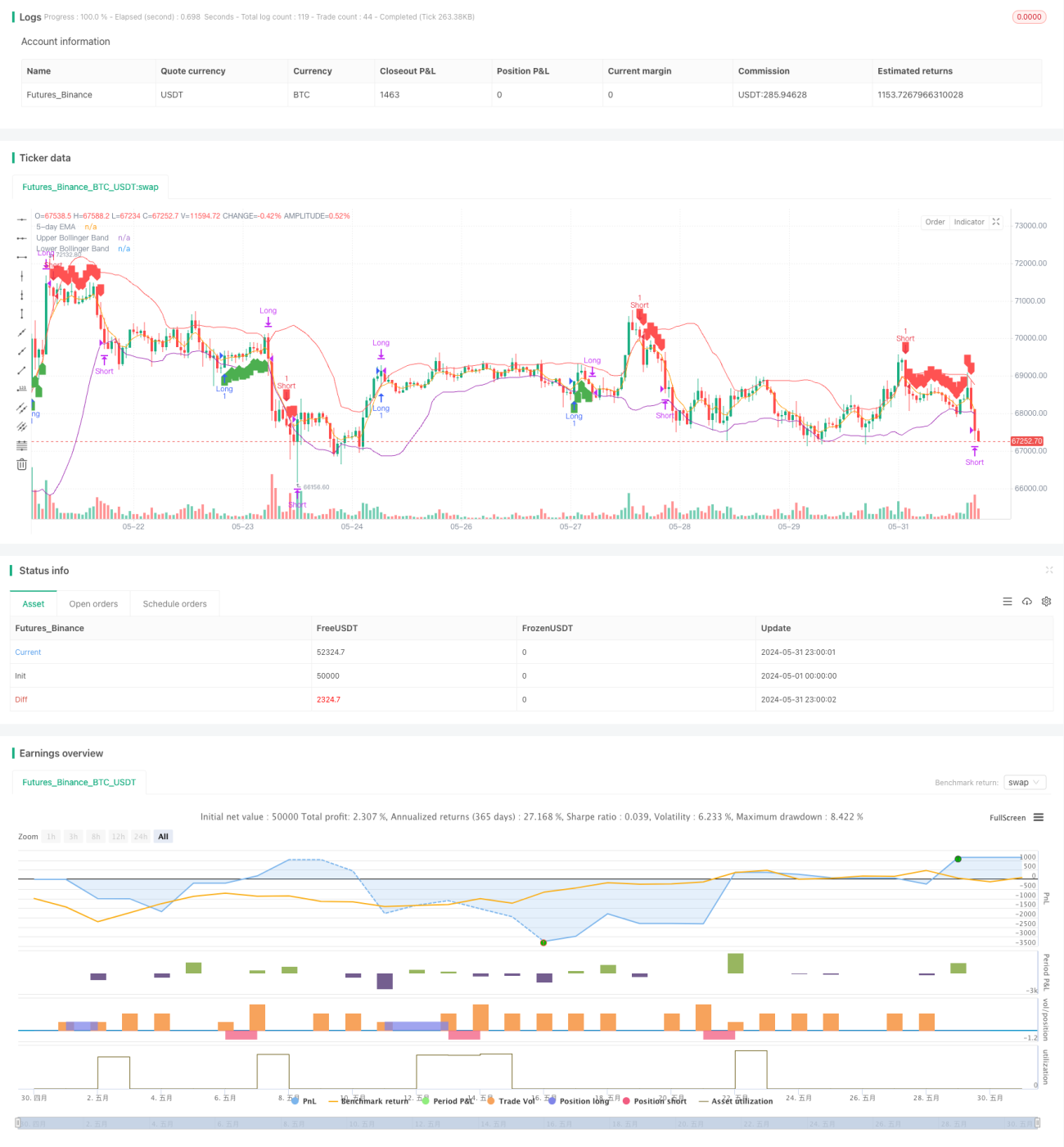
This strategy utilizes the 5-day Exponential Moving Average (EMA) and Bollinger Bands (BB) to identify potential trading opportunities in the market. When the price breaks out above the upper Bollinger Band or below the lower Bollinger Band, and specific conditions are met, the strategy generates buy or sell signals. The strategy aims to capture significant price movements in the market while using stop loss and target price levels to manage risk and maximize returns.
Strategy Principles
The core of this strategy is to use the 5-day EMA and Bollinger Bands to determine market trends and volatility. When the price breaks above the upper Bollinger Band, and the previous candle's high is above the 5-day EMA, the strategy generates a sell signal. Conversely, when the price breaks below the lower Bollinger Band, and the previous candle's low is below the 5-day EMA, the strategy generates a buy signal. This approach helps identify potential trend reversals or breakout points.
Once a trade is entered, the strategy sets a stop loss level and a target price level. The stop loss is placed in the opposite direction of the entry price to limit potential losses. The target price level is calculated based on a fixed number of points (e.g., 1000 points) to lock in expected profits. If the price reaches the stop loss level or the target price level, the strategy closes the trade and exits the position.
Strategy Advantages
- By using both EMA and Bollinger Bands, the strategy provides a more comprehensive assessment of market trends and volatility.
- Clear entry conditions help identify high-probability trading opportunities.
- Setting stop loss and target price levels effectively manages risk and locks in profits.
- The strategy logic is straightforward and easy to understand and implement.
Strategy Risks
- During periods of increased market volatility, Bollinger Bands may generate frequent trading signals, leading to over-trading and increased transaction costs.
- In choppy or trendless markets, the strategy may generate false signals, resulting in losses.
- Fixed stop loss and target price levels may not adapt well to different market conditions, limiting the strategy's flexibility.
Strategy Optimization Directions
- Consider using adaptive stop loss and target price levels that dynamically adjust based on market volatility and trend strength to improve the strategy's adaptability.
- Introduce additional technical indicators or signal filtering mechanisms, such as the Relative Strength Index (RSI) or Average True Range (ATR), to confirm trends and reduce false signals.
- Optimize the parameters, such as adjusting the EMA period, Bollinger Bands' standard deviation multiplier, etc., to suit different market characteristics and trading instruments.
Summary
The EMA and Bollinger Bands Breakout Strategy leverages two commonly used technical indicators to capture significant price movements in the market. The strategy has clear entry conditions, risk management measures, and profit targets, making it easy to understand and implement. However, the strategy's performance may be influenced by market volatility and trendless conditions. By introducing adaptive parameters, signal filtering mechanisms, and parameter optimization, the strategy's robustness and profitability can be further enhanced.
- 1