EMA RSI MACD Dynamic Take Profit and Stop Loss Trading Strategy

Overview
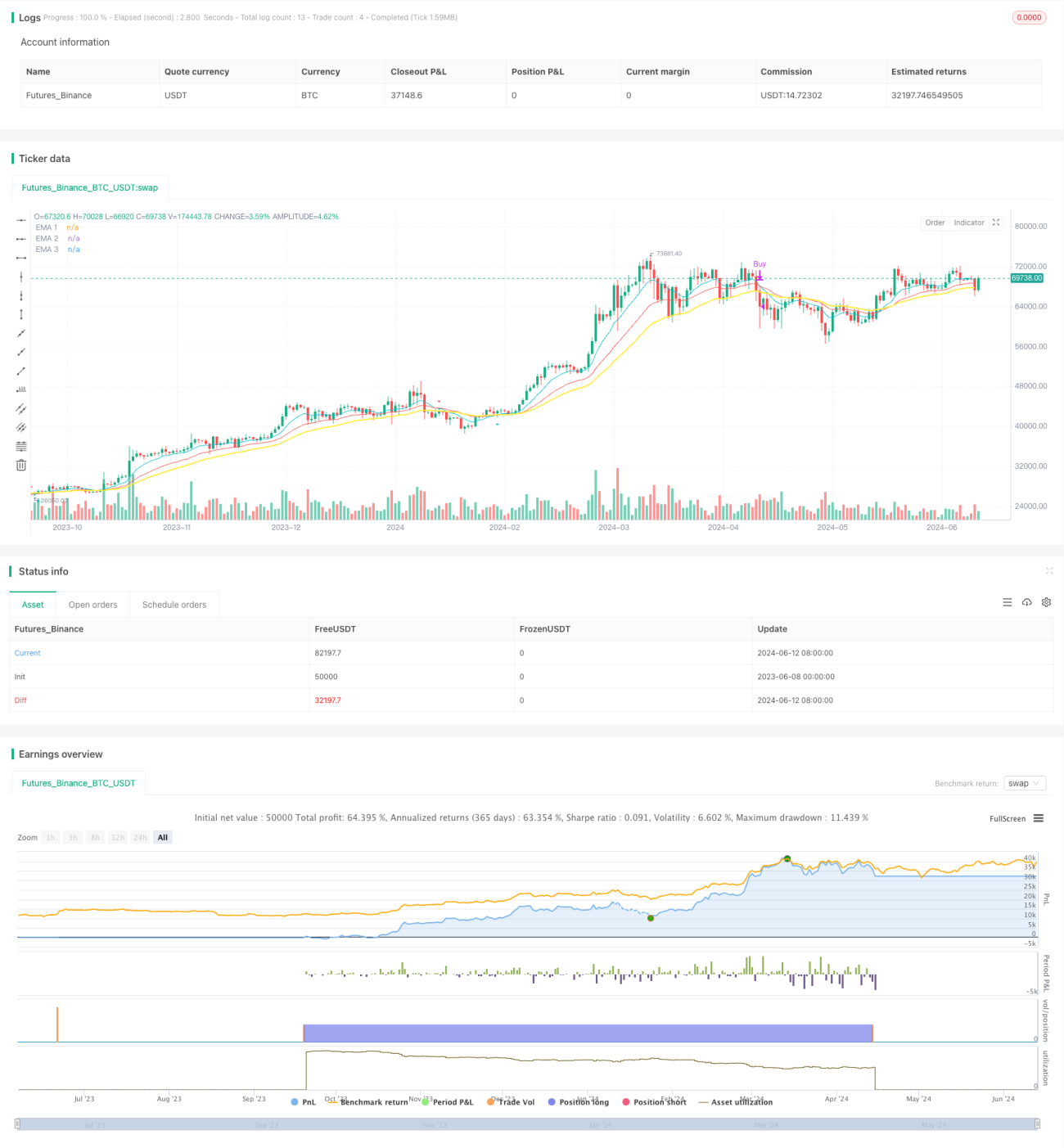
This trading strategy combines three technical indicators: Exponential Moving Average (EMA), Relative Strength Index (RSI), and Moving Average Convergence Divergence (MACD). By analyzing their crossovers and value relationships, it generates buy and sell signals when prices meet certain conditions. Additionally, the strategy incorporates dynamic take profit and stop loss to manage trading risks.
Strategy Principle
- Calculate the average of high, low, and close prices (HLCC4) as the base data for the strategy.
- Calculate three EMAs with different periods and RSI based on HLCC4.
- Calculate the value of the MACD histogram.
- Determine the crossover conditions of EMA1 and EMA2:
- When EMA1 crosses above EMA2, it generates a bullish signal.
- When EMA1 crosses below EMA2, it generates a bearish signal.
- Comprehensively consider the values of EMA, RSI, and MACD indicators to determine whether the conditions for buying or selling are met:
- Buy condition: EMA1 crosses above EMA2, HLCC4 is higher than EMA3, RSI is above the threshold, closing price is higher than the opening price, and the MACD histogram is positive.
- Sell condition: EMA1 crosses below EMA2, HLCC4 is lower than EMA3, RSI is below the threshold, closing price is lower than the opening price, and the MACD histogram is negative.
- If an opposite signal appears while holding a position, close the current position before opening a new one.
- When buying or selling, set the take profit and stop loss prices based on the specified number of pips.
Strategy Advantages
- Combines multiple technical indicators for comprehensive judgment, improving the reliability of signals.
- Introduces a dynamic take profit and stop loss mechanism to effectively control risks.
- Closes the current position before opening a new one when an opposite signal appears, avoiding the issue of duplicate positions.
- Adjustable parameters, strong adaptability, and can be optimized according to different market environments.
Strategy Risks
- In a sideways market, frequent crossovers may lead to excessive trading, increasing transaction costs.
- Fixed-pip take profit and stop loss may not adapt to market fluctuations, resulting in premature stop loss or delayed take profit.
- The strategy relies on historical data and may not react in a timely manner to sudden events or abnormal market conditions.
Strategy Optimization Directions
- Consider introducing more technical indicators or market sentiment indicators, such as Bollinger Bands and ATR, to improve signal accuracy.
- For take profit and stop loss, adopt a more dynamic approach, such as trailing stop loss or adjusting the take profit and stop loss distance based on volatility.
- Combine fundamental analysis, such as major news events and economic data releases, to filter trading signals and avoid trading during special periods.
- For parameter settings, use machine learning or optimization algorithms to find the optimal parameter combination.
Summary
This strategy forms a complete trading system by combining multiple technical indicators such as EMA, RSI, and MACD. In trending markets, the strategy can effectively capture trends and control risks through dynamic take profit and stop loss. However, in sideways markets, frequent trading may affect profitability. In the future, the strategy can be refined in terms of signal optimization, risk control optimization, and parameter optimization to improve its stability and profitability.
- 1