Dynamic Moving Average Trend Following with RSI Confirmation Trading Strategy

Overview
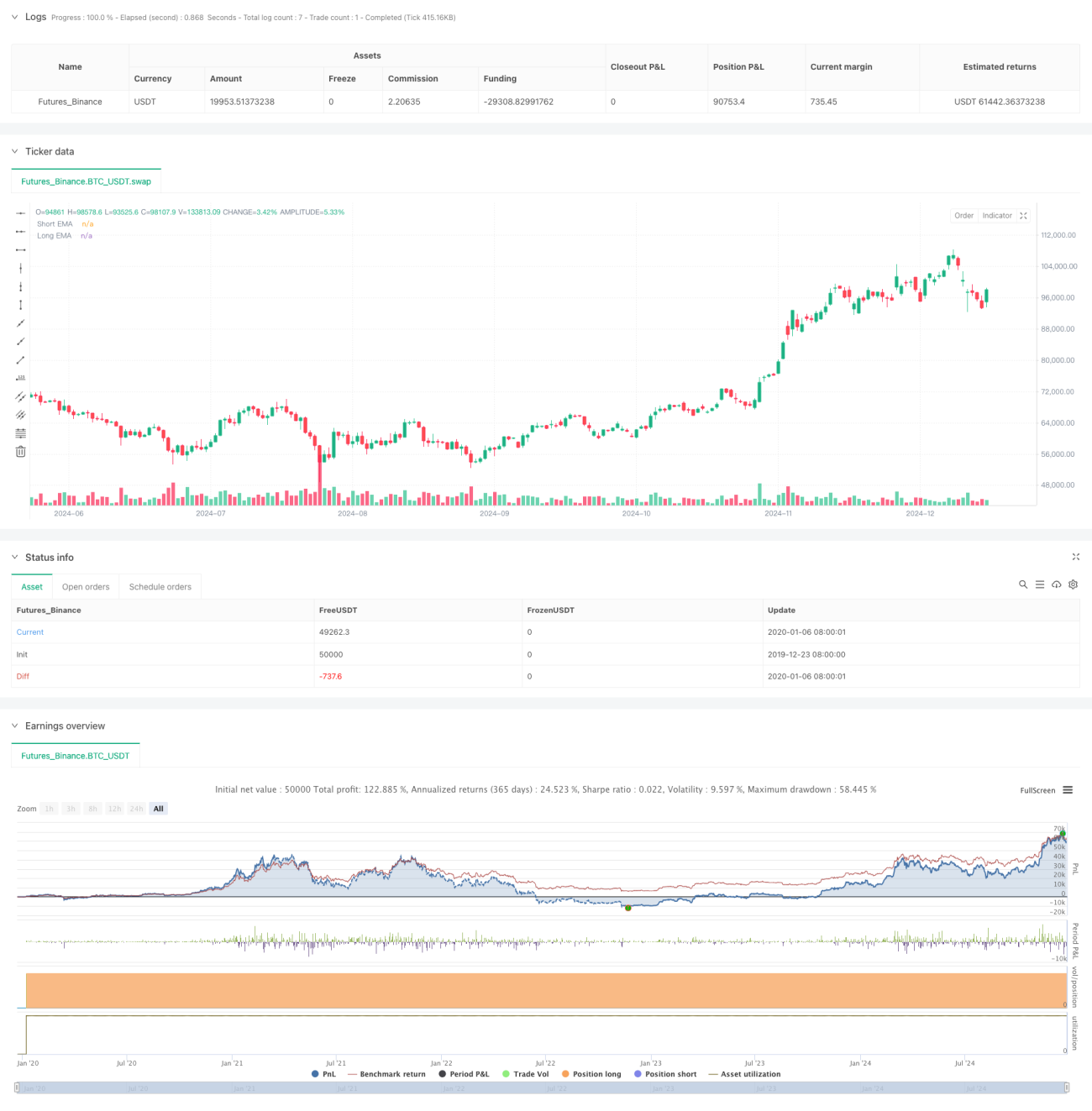
This is a trend-following strategy based on Exponential Moving Average (EMA) crossovers and Relative Strength Index (RSI) confirmation. The strategy combines signals from short-term and long-term EMA crossovers with RSI momentum confirmation, while incorporating a percentage-based stop-loss mechanism. It aims to capture significant market trend reversals while maintaining risk control through the synergistic effect of technical indicators.
Strategy Principles
The strategy employs a dual technical indicator filtering mechanism: First, it identifies potential trend reversal points through the crossover of short-term EMA (9 periods) and long-term EMA (21 periods). Buy signals are generated when the short-term EMA crosses above the long-term EMA and the RSI value is above the specified level. Sell signals occur when the short-term EMA crosses below the long-term EMA and the RSI value is below the specified level. Additionally, the strategy incorporates a percentage-based stop-loss mechanism, setting dynamic stop-loss levels for each trade to effectively control downside risk.
Strategy Advantages
- Dual technical indicator confirmation mechanism significantly improves trade signal reliability and reduces false signals
- Dynamic stop-loss mechanism effectively controls risk exposure for each trade
- Strong parameter adjustability allows traders to adapt to different market environments
- Clear strategy logic that is easy to understand and execute
- Visualized signal display and stop-loss lines make trading decisions more intuitive
Strategy Risks
- May generate frequent trading signals in ranging markets, increasing transaction costs
- EMAs as lagging indicators may not respond quickly enough in highly volatile markets
- RSI confirmation mechanism might miss important trend beginnings under certain market conditions
- Fixed percentage stop-loss may be too strict or loose in markets with varying volatility
Strategy Optimization Directions
- Introduce volatility indicators to dynamically adjust stop-loss percentages for more adaptive risk control
- Add trend strength filters to avoid frequent trading in weak trend markets
- Integrate volume indicators as additional confirmation mechanisms to improve signal quality
- Add trailing stop-loss mechanism to better protect accumulated profits
- Consider incorporating market environment classification to use different parameters in different market states
Summary
This strategy constructs a complete trend-following trading system through the combination of moving averages and momentum indicators. Its main advantages lie in its reliable signal confirmation mechanism and comprehensive risk control system. While there are some inherent limitations, the strategy's overall performance can be further enhanced through the proposed optimization directions. This is a robust strategy framework suitable for medium to long-term trend traders.
- 1