
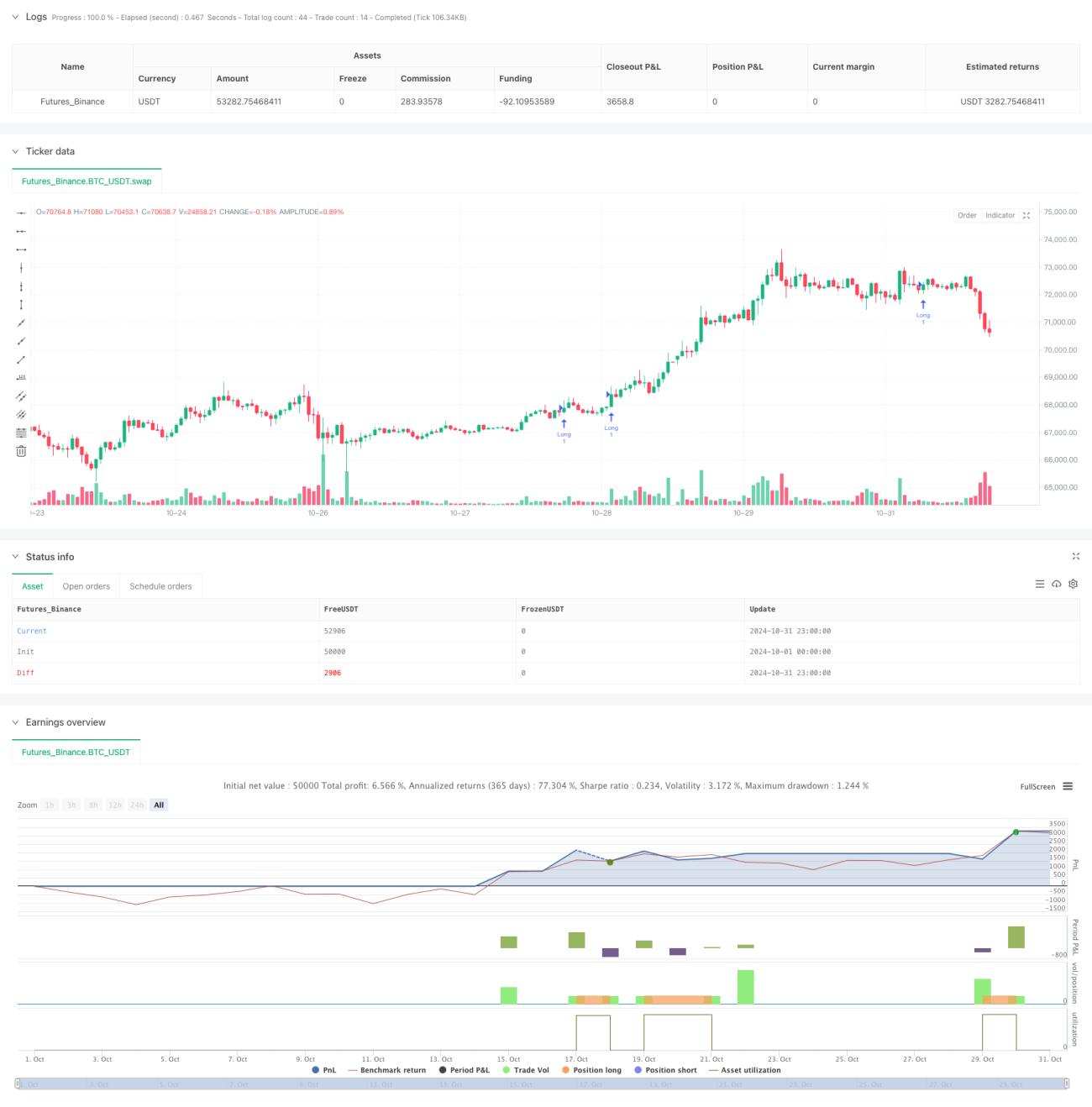
Overview
This is a quantitative trading strategy that combines multi-timeframe EMA trend following with momentum analysis. The strategy primarily analyzes the alignment of 20, 50, 100, and 200-day exponential moving averages (EMA) combined with momentum indicators on both daily and weekly timeframes. It employs ATR-based stop losses and enters trades when EMAs are aligned and momentum conditions are met, managing risk through ATR-multiple stop-loss and profit targets.
Strategy Principles
The core logic includes several key components:
- EMA Alignment System: Requires 20-day EMA above 50-day EMA, which is above 100-day EMA, which is above 200-day EMA, forming a perfect bullish alignment.
- Momentum Confirmation System: Calculates custom momentum indicators based on linear regression on both daily and weekly timeframes. This momentum is measured through linear regression of price deviation from the Keltner Channel midline.
- Pullback Entry System: Price must pull back within a specified percentage range of the 20-day EMA for entry, avoiding chase-buying.
- Risk Management System: Uses ATR multiples to set stop-loss and profit targets, defaulting to 1.5x ATR for stop-loss and 3x ATR for profit target.
Strategy Advantages
- Multiple Confirmation Mechanism: Reduces false signals through multiple conditions including EMA alignment, multi-timeframe momentum, and price pullback.
- Scientific Risk Management: Uses ATR to dynamically adjust stop-loss and profit targets, adapting to market volatility changes.
- Trend Following with Momentum: Captures major trends while optimizing entry timing within trends.
- High Customizability: All strategy parameters can be optimized for different market characteristics.
- Multi-timeframe Analysis: Improves signal reliability through daily and weekly timeframe coordination.
Strategy Risks
- EMA Lag: EMAs as lagging indicators may result in delayed entries. Consider incorporating leading indicators.
- Poor Performance in Ranging Markets: Strategy may generate frequent false signals in sideways markets. Consider adding market environment filters.
- Drawdown Risk: Despite ATR stops, significant drawdowns possible in extreme conditions. Consider implementing maximum drawdown limits.
- Parameter Sensitivity: Strategy performance is sensitive to parameter settings. Thorough parameter optimization testing recommended.
Optimization Directions
- Market Environment Recognition: Add volatility or trend strength indicators to use different parameter sets in different market conditions.
- Entry Optimization: Add oscillators like RSI for more precise entry points within pullback zones.
- Dynamic Parameter Adjustment: Automatically adjust ATR multiples and pullback ranges based on market volatility.
- Volume Analysis Integration: Confirm trend strength through volume analysis to improve signal reliability.
- Machine Learning Implementation: Use machine learning algorithms to dynamically optimize parameters and improve strategy adaptability.
Summary
This is a well-designed, logically rigorous trend-following strategy. Through the combination of multiple technical indicators, it ensures both strategy robustness and effective risk management. The strategy's high customizability allows optimization for different market characteristics. While inherent risks exist, the suggested optimization directions can further enhance strategy performance. Overall, this is a quantitative trading strategy worth experimenting with and studying in depth.
- 1