Overview
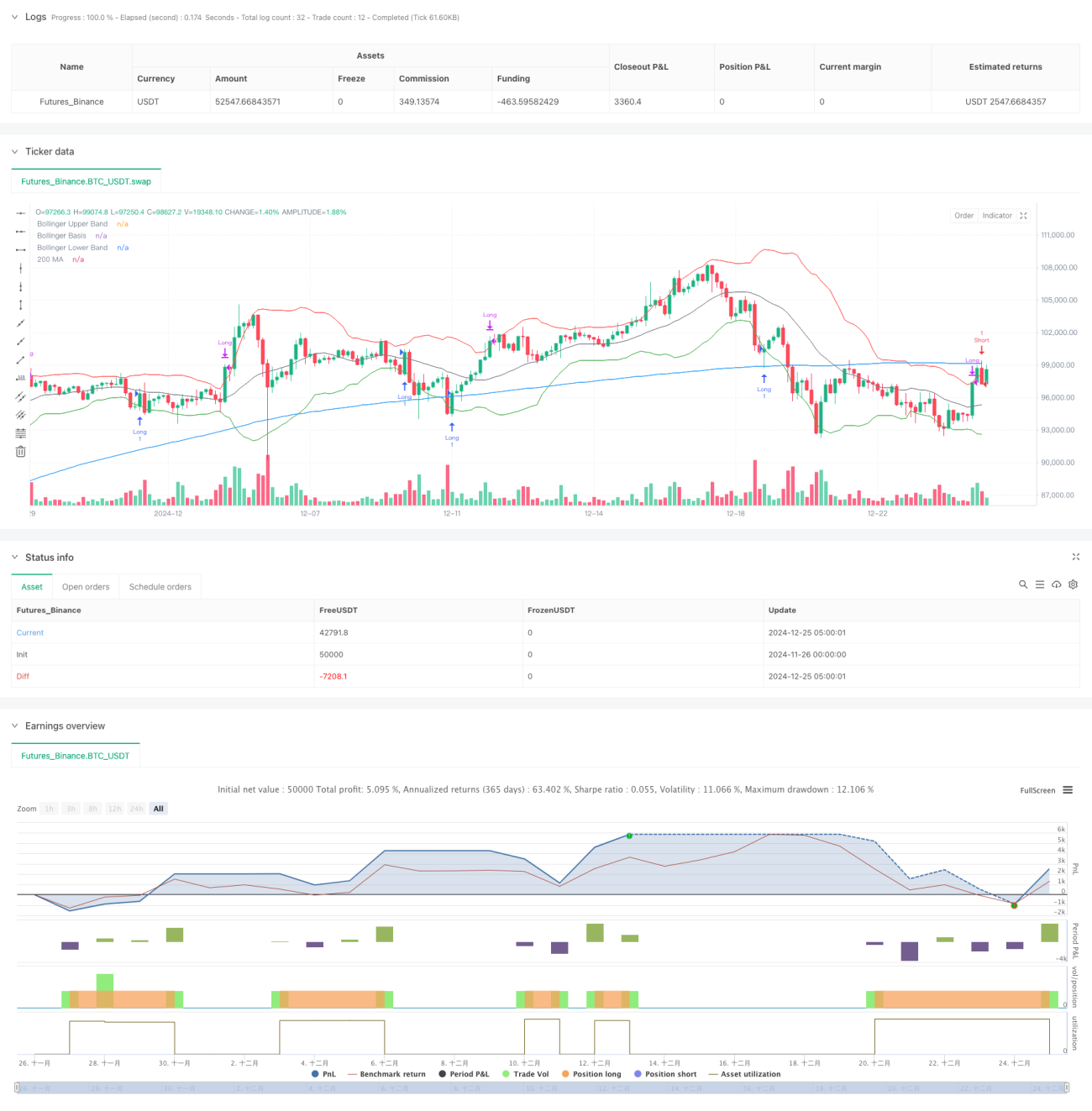
This strategy is a trend-following trading system that combines Moving Average (MA) and Bollinger Bands indicators. It identifies market trends by analyzing price relationships with the 200-period moving average and Bollinger Bands position, while incorporating a fixed percentage stop-loss mechanism for risk control. The strategy employs a 2.86% position management, compatible with 35x leverage, demonstrating prudent fund management principles.
Strategy Principles
The core logic of the strategy is based on the following key elements:
- Uses 200-period moving average as the primary trend indicator
- Combines 20-period Bollinger Bands' upper and lower channels for volatility range assessment
- Opens long positions when:
- Price is above the 200 MA
- Bollinger Bands middle band is above 200 MA
- Price crosses above the lower Bollinger Band
- Opens short positions when:
- Price is below the 200 MA
- Bollinger Bands middle band is below 200 MA
- Price crosses below the upper Bollinger Band
- Implements 3% fixed stop-loss percentage for risk control
- Closes long positions at upper Bollinger Band, shorts at lower band
Strategy Advantages
- Strong Trend Following Capability
- Effectively identifies long-term trends using 200 MA
- Bollinger Bands assist in detecting medium-short term trend changes
- Comprehensive Risk Control
- Fixed stop-loss mechanism effectively controls per-trade risk
- Dynamic take-profit design enhances profit opportunities
- Flexible Parameter Optimization
- MA period and Bollinger Bands parameters adjustable to market characteristics
- Stop-loss percentage adjustable to risk tolerance
- High Systematization
- Clear trading signals without subjective judgment
- Suitable for automated trading execution
Strategy Risks
- Sideways Market Risk
- False breakout signals may occur frequently in ranging markets
- Recommended to trade only in clear trending markets
- Slippage Risk
- Significant slippage possible during volatile periods
- Recommend setting reasonable slippage protection
- Systematic Risk
- Market events may cause stop-loss failure
- Recommend combining with other risk control measures
- Parameter Optimization Risk
- Over-optimization may lead to overfitting
- Recommend backtesting across different timeframes
Strategy Optimization Directions
- Dynamic Stop-Loss Optimization
- Introduce ATR indicator for dynamic stop-loss adjustment
- Adjust stop-loss percentage based on market volatility
- Entry Signal Optimization
- Add volume confirmation indicators
- Implement trend strength filters
- Position Management Optimization
- Implement dynamic position sizing
- Adjust leverage based on market volatility
- Trading Timing Optimization
- Add market sentiment indicators
- Implement time filters
Summary
This strategy builds a complete trading system by combining classic technical indicators, demonstrating good trend capture ability and risk control effects. The core advantages lie in its high systematization and parameter adjustability, while achieving effective risk control through fixed stop-loss mechanisms. Although performance may be suboptimal in ranging markets, implementing the suggested optimizations can further enhance strategy stability and profitability. Traders are advised to consider market conditions when implementing live trading and adjust parameters according to their risk tolerance.
- 1

