
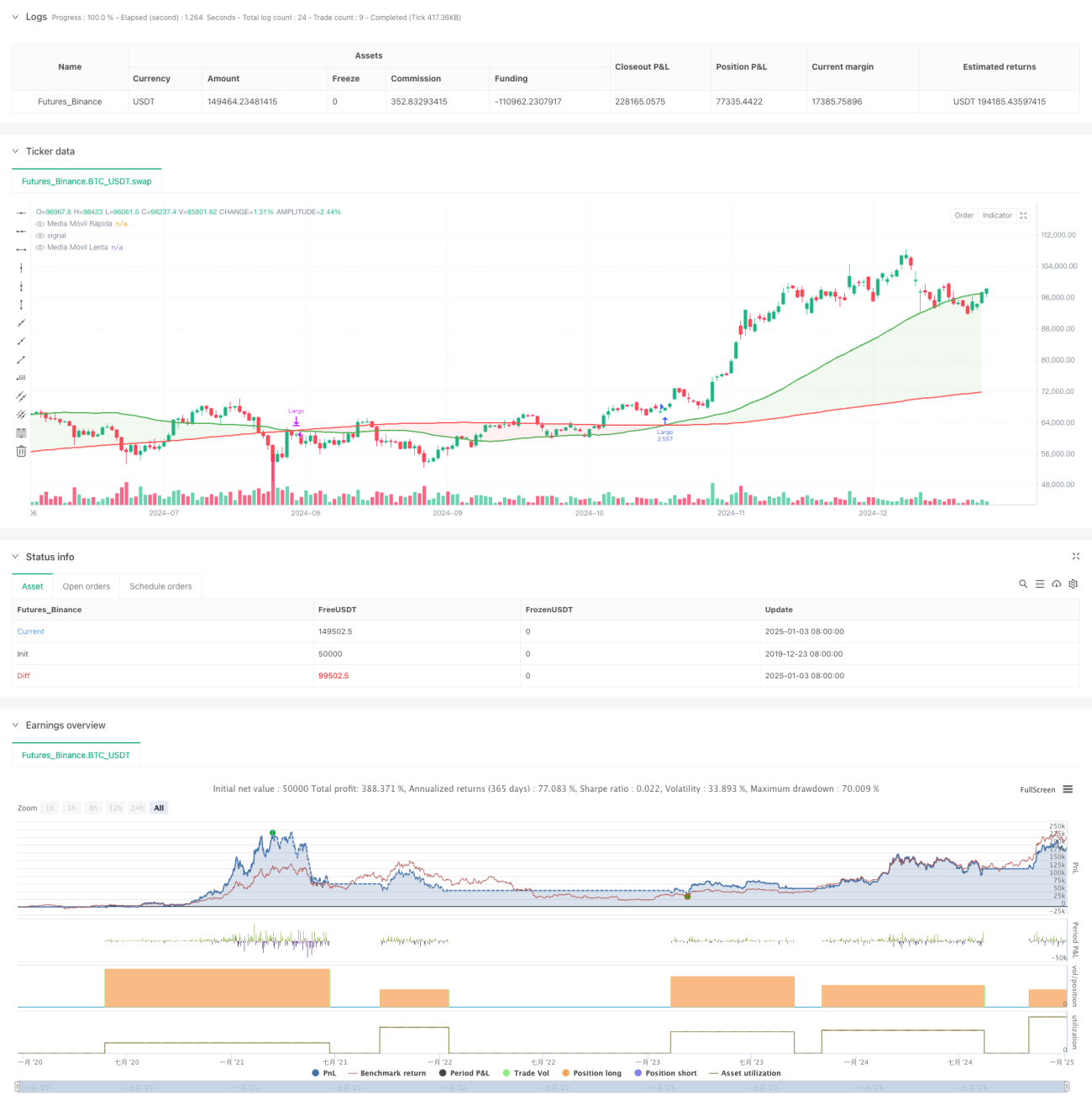
Overview
This strategy is a quantitative trading system based on multiple moving average crossover signals. It integrates seven different types of moving averages, including Simple Moving Average (SMA), Exponential Moving Average (EMA), Weighted Moving Average (WMA), Volume Weighted Moving Average (VWMA), Hull Moving Average (HMA), Smoothed Moving Average (RMA), and Arnaud Legoux Moving Average (ALMA). The strategy supports both two-line and three-line crossover systems and offers flexible long and short trading options.
Strategy Principle
The core logic of the strategy is to determine market trends by observing the crossover relationships between moving averages of different periods. A long signal is generated when the fast moving average crosses above the slow moving average, and vice versa for short signals. The system provides two entry methods: one based on direct moving average crossovers, and another based on the closing price's position relative to the moving averages. The three-line system introduces a medium-term moving average to enhance signal reliability and stability.
Strategy Advantages
- High Adaptability: Integration of seven different moving averages allows the strategy to adapt to various market environments and trading instruments
- Signal Stability: Multiple confirmation mechanisms help avoid false signals
- Flexible Parameters: Supports customizable period settings for optimization and backtesting
- Risk Control: Includes short-selling mechanism for capturing bilateral trading opportunities
- Clear Visualization: Strategy provides intuitive graphical interface with visual aids like trend area filling
Strategy Risks
- Lag Effect: Moving averages are inherently lagging indicators, potentially missing optimal entry points in volatile markets
- Poor Performance in Ranging Markets: May generate frequent false signals in sideways markets
- Parameter Dependency: Performance varies significantly with different parameter combinations, requiring continuous optimization
- Systematic Risk: May not respond quickly enough to sudden market events for stop-loss
Strategy Optimization Directions
- Incorporate Volatility Indicators: Suggest integrating ATR or similar indicators for dynamic position sizing
- Add Market Environment Filters: Can include trend strength indicators to filter out signals in ranging markets
- Optimize Stop-Loss Mechanism: Recommend adding trailing stop-loss functionality to improve risk control
- Enhanced Volume Analysis: Suggest incorporating volume changes to confirm trend validity
Summary
This strategy is a comprehensive trend-following system that provides a reliable quantitative trading framework through the integration of multiple moving average indicators and flexible parameter settings. While it has some inherent lag, the strategy maintains practical value through proper parameter optimization and risk control measures. Traders are advised to optimize the strategy based on specific market characteristics in live trading.
/*backtest
start: 2019-12-23 08:00:00
end: 2025-01-04 08:00:00
period: 1d
basePeriod: 1d
exchanges: [{"eid":"Futures_Binance","currency":"BTC_USDT"}]
*/

//@version=5
strategy("Cruce de Medias Total", overlay=true, default_qty_type=strategy.percent_of_equity, default_qty_value=100,max_bars_back=1000)

// Parámetros de entrada- 1