Multi-EMA and CCI Crossover Trend Following Strategy

Overview
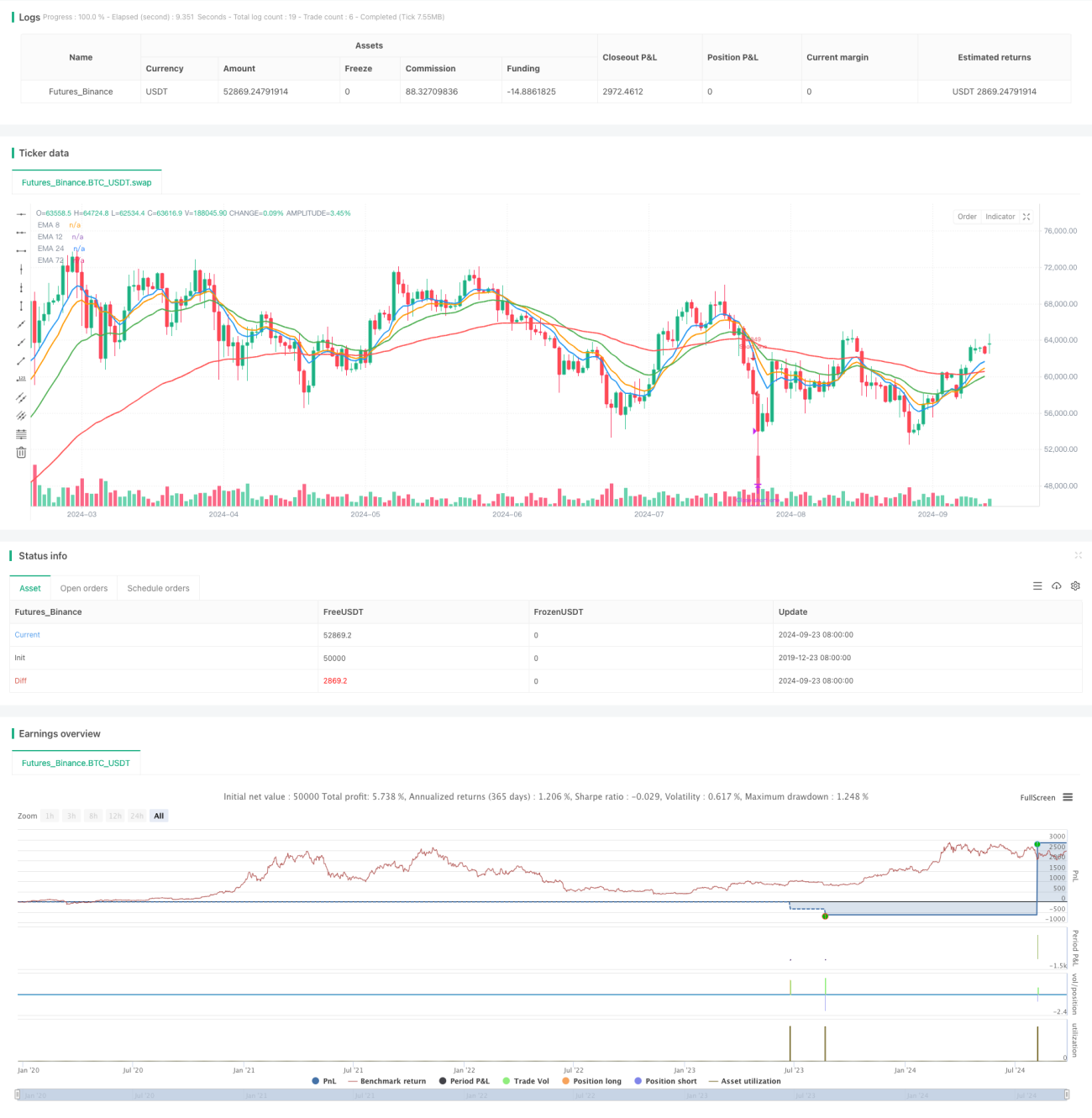
This is a trend-following strategy based on multiple Exponential Moving Averages (EMA) and the Commodity Channel Index (CCI). The strategy utilizes EMA crossovers from multiple time periods to identify potential trend changes, combined with the CCI indicator to confirm overbought or oversold market conditions, thereby improving the accuracy of entry timing. The strategy also includes dynamic take-profit and stop-loss mechanisms based on time and price to manage risk and lock in profits.
Strategy Principles
The strategy is primarily based on the following key elements:
-
Multiple EMA Crossovers: Uses 8, 12, 24, and 72-period EMAs. When shorter-period EMAs (8, 12, 24) simultaneously cross above the 72-period EMA, it's considered a potential long signal; the opposite is true for short signals.
-
CCI Indicator Confirmation: Uses a 20-period CCI indicator, confirming overbought conditions when CCI is above 150 and oversold conditions when below -150.
-
Entry Conditions:
- Long: Shorter-period EMAs simultaneously cross above the 72-period EMA, CCI is above 150, and price is above the 72-period EMA.
- Short: Shorter-period EMAs simultaneously cross below the 72-period EMA, CCI is below -150, and price is below the 72-period EMA.
-
Dynamic Take-Profit and Stop-Loss:
- Sets two entry modes: one-time crossover and crossover within a time window.
- Different take-profit and stop-loss percentages are set based on different entry modes.
-
Position Management: The strategy employs full position trading, using 100% of the account funds for trading.
Strategy Advantages
-
Multiple Confirmation Mechanism: The combination of multiple EMA crossovers and the CCI indicator effectively reduces the impact of false signals, improving entry accuracy.
-
Flexible Entry Mechanism: The strategy considers both one-time crossovers and crossovers within a time window, adapting to different market environments.
-
Dynamic Risk Management: Different take-profit and stop-loss ratios are set based on different entry modes, better balancing returns and risks.
-
Trend Following Capability: Utilizes multiple EMA crossovers to effectively capture medium to long-term trend changes.
-
Filtering Choppy Markets: The overbought and oversold judgments of the CCI indicator help avoid frequent trading in sideways, choppy markets.
Strategy Risks
-
Lag: Both EMA and CCI are lagging indicators, which may not react quickly enough in volatile markets.
-
Frequent Trading: In choppy markets, it may generate many false breakout signals, leading to frequent trading and increased transaction costs.
-
Full Position Risk: Using 100% position trading may bring significant drawdown risks.
-
Fixed Percentage Stop-Loss: In highly volatile markets, fixed percentage stop-losses may exit favorable trends too early.
-
Dependence on Historical Data: Strategy performance may be influenced by historical data and may need parameter re-optimization when future market conditions change.
Strategy Optimization Directions
-
Introduce Volatility Indicators: Consider adding the ATR (Average True Range) indicator to adjust take-profit and stop-loss levels based on market volatility, adapting to different market environments.
-
Optimize Position Management: Introduce dynamic position management mechanisms to adjust position size based on trend strength and account risk tolerance.
-
Add Filtering Conditions: Consider adding indicators such as volume and trend strength to further filter trading signals and improve win rates.
-
Parameter Optimization: Use genetic algorithms or grid search methods to optimize parameters such as EMA periods and CCI thresholds to improve strategy adaptability in different market environments.
-
Add Market Regime Recognition: Develop a market state (trend, choppy, high volatility) recognition module to adjust strategy parameters or pause trading based on different market states.
Summary
The Multi-EMA and CCI Crossover Trend Following Strategy is a quantitative trading system that combines technical analysis with dynamic risk management. Through the combination of multiple EMA crossovers and the CCI indicator, this strategy can effectively capture market trends while managing risk through flexible entry mechanisms and dynamic take-profit and stop-loss settings. Although the strategy has some inherent risks, such as lag and potential high drawdowns from full position trading, it can significantly improve stability and adaptability through further optimization and improvements, such as introducing volatility adjustments, dynamic position management, and market regime recognition. Overall, this is a strategy framework with a solid foundation and potential to generate stable returns in different market environments.
- 1