
Overview
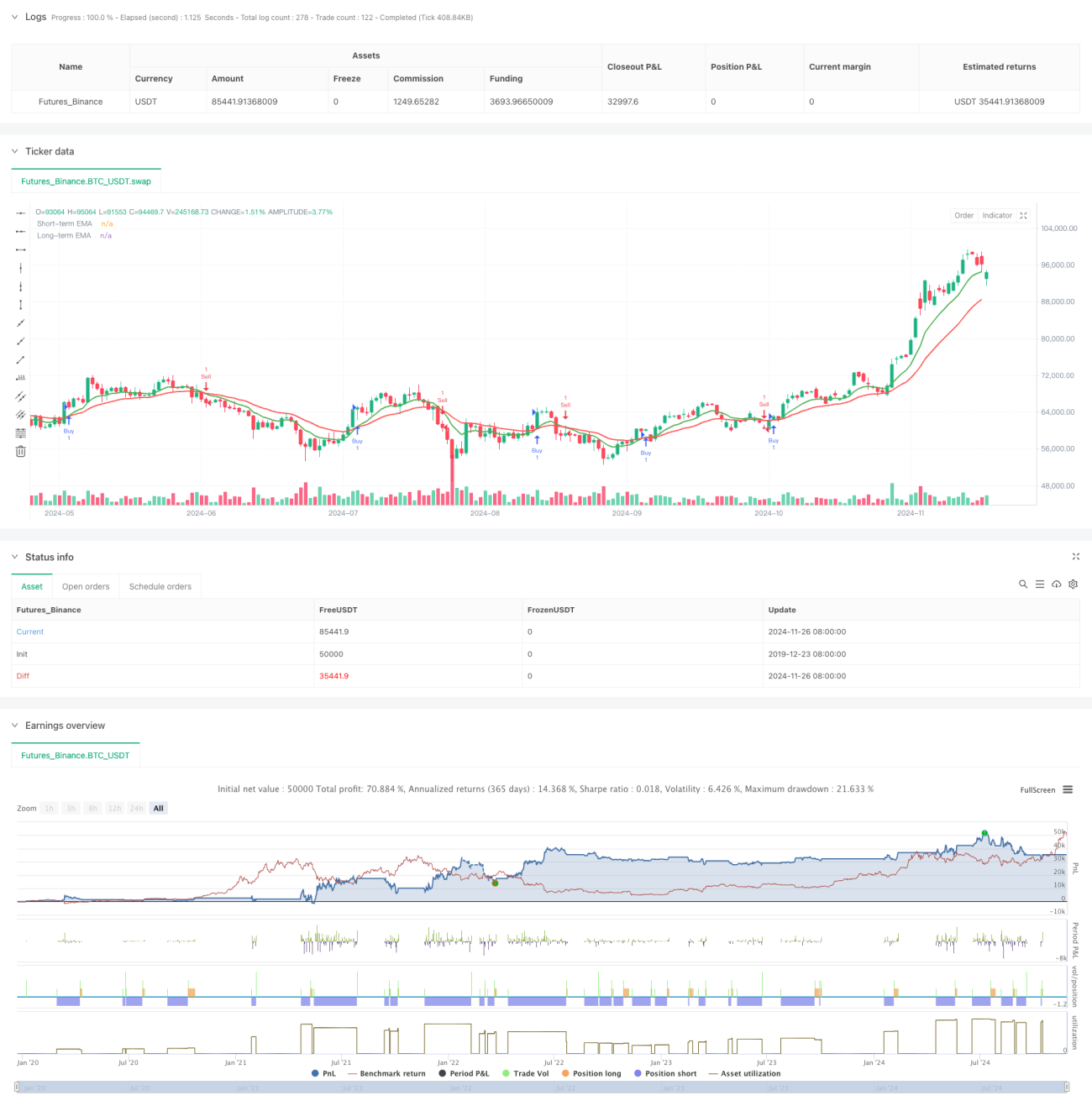
This is a quantitative trading strategy based on the EMA indicator, which makes trading decisions by calculating the crossover signals of short-term (9-period) and long-term (21-period) exponential moving averages. The strategy includes stop-loss and take-profit conditions set at 2% and 4% respectively to control risk and lock in profits. The core idea is to capture market trend turning points through moving average crossovers, enabling timely buy and sell operations when market trends change.
Strategy Principles
The strategy employs two exponential moving averages (EMA) with different periods: 9-period and 21-period. A buy signal is generated when the short-term EMA crosses above the long-term EMA, while a sell signal is triggered when the short-term EMA crosses below the long-term EMA. The strategy incorporates risk management mechanisms through 2% stop-loss and 4% take-profit levels to protect capital and secure gains. The short-term moving average is more sensitive to price changes, while the long-term moving average reflects longer-term trends, making their crossovers effective in capturing market trend transitions.
Strategy Advantages
- Clear operational rules and signals, easy to execute and backtest
- Effective risk control through stop-loss and take-profit settings
- Automatically adapts to market volatility without manual intervention
- Simple calculations with high execution efficiency
- Applicable to different time periods and market environments
- Clear code structure, easy to maintain and optimize
- Good scalability, can incorporate additional technical indicators for optimization
Strategy Risks
- May generate frequent false breakout signals in choppy markets
- Moving averages have inherent lag, potentially missing important market turning points
- Fixed stop-loss and take-profit parameters may not suit all market conditions
- Trading costs not considered, actual returns may be lower than backtest results
- Frequent stop-losses may be triggered in highly volatile markets
- Market liquidity risk not addressed
- Lack of consideration for macro market conditions
Strategy Optimization Directions
- Introduce volatility indicators for dynamic adjustment of stop-loss and take-profit parameters
- Add volume indicators to improve signal reliability
- Incorporate trend confirmation indicators like RSI or MACD
- Dynamically adjust moving average periods based on market conditions
- Add position management mechanisms for dynamic capital allocation
- Implement market condition assessment for parameter adjustment
- Consider trading costs and optimize trading frequency
Summary
This strategy is a classic trend-following approach that captures market trend changes through moving average crossovers. While relatively simple in design, it includes complete trading logic and risk control mechanisms. The strategy's stability and profitability can be further enhanced through optimization measures such as dynamic parameter adjustment and market condition assessment. In practical application, it is recommended to optimize parameters based on specific trading instruments and market conditions while maintaining proper risk control.
- 1