Advanced Five-Day Cross-Analysis Strategy Based on RSI and MACD Integration

Overview
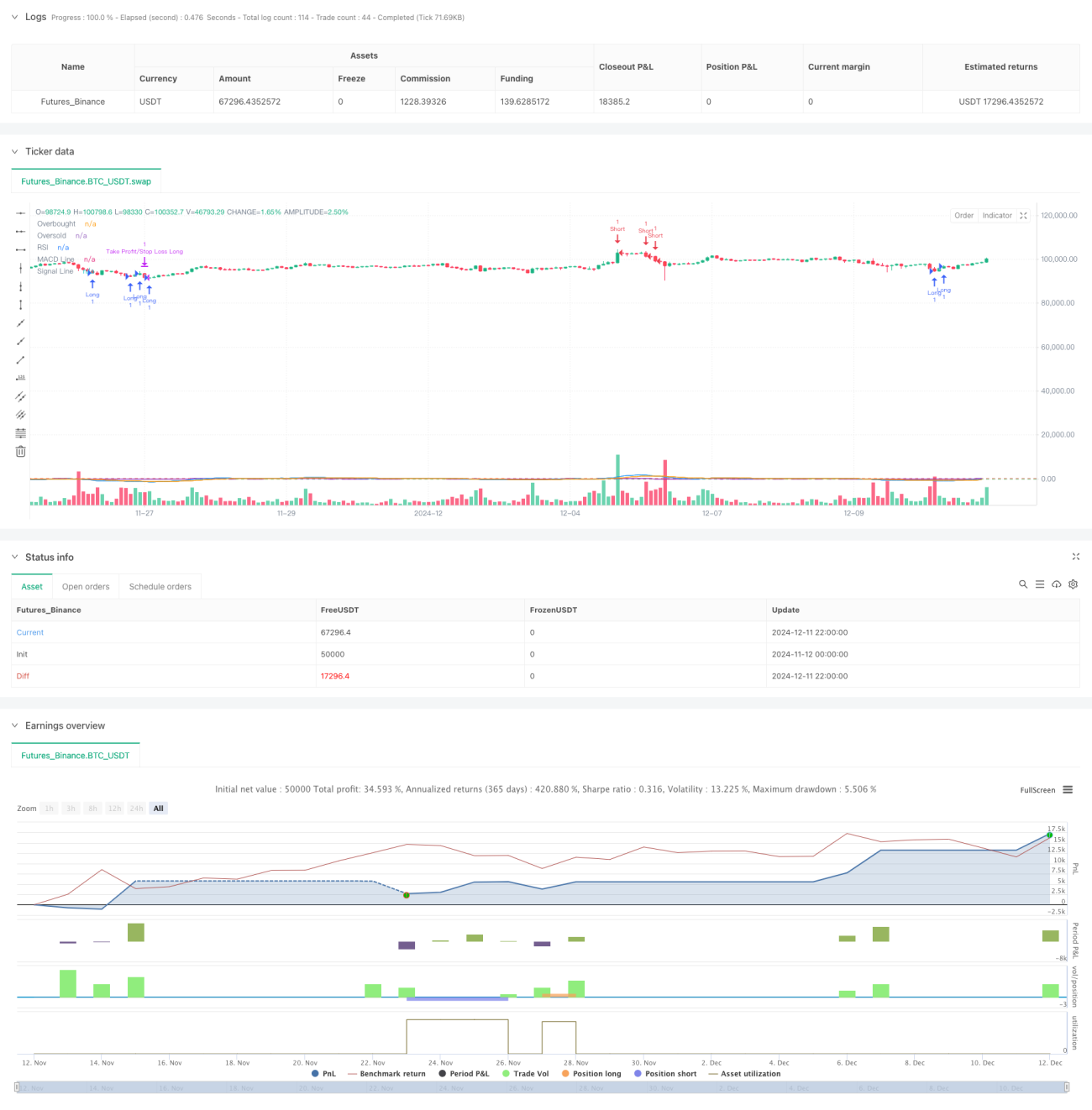
This strategy is a quantitative trading approach that combines the Relative Strength Index (RSI) and Moving Average Convergence Divergence (MACD) indicators. The core concept involves monitoring RSI overbought/oversold zones while confirming trends through MACD crossovers within a 5-period window. This methodology provides more accurate trading signals while effectively reducing risks from false signals.
Strategy Principles
The strategy is built on several key components:
- RSI indicator uses a 14-period parameter to identify potential reversals when assets are overbought (>70) or oversold (<30).
- MACD employs the classic 12-26-9 parameter combination, looking for crossovers between MACD and signal lines within 5 trading periods.
- Entry logic includes two conditions:
- Long entry: RSI's 5-period low drops below 30, coinciding with an upward MACD crossover within 5 periods.
- Short entry: RSI's 5-period high exceeds 70, coinciding with a downward MACD crossover within 5 periods.
- Risk management implements symmetrical 2% stop-loss and 2% take-profit levels.
Strategy Advantages
- Multi-indicator cross-validation enhances signal reliability by combining RSI and MACD to filter out false signals from single indicators.
- Flexible 5-day observation window captures more trading opportunities while avoiding missing crucial market turning points.
- Symmetrical stop-loss/take-profit setup facilitates effective money management and risk control per trade.
- Simple and clear strategy logic makes it easy to understand and execute, suitable as a foundation for further optimization.
Strategy Risks
- Both RSI and MACD are lagging indicators, potentially causing delays in volatile markets.
- Fixed stop-loss/take-profit percentages may not suit all market conditions and require adjustment as volatility changes.
- The 5-day observation period might be too short in certain market conditions, leading to overtrading.
- Lack of volume consideration may generate inaccurate signals in low-liquidity environments.
Optimization Directions
- Implement volatility-adaptive mechanisms to dynamically adjust stop-loss/take-profit levels.
- Incorporate volume indicators as additional confirmation to enhance signal reliability.
- Develop dynamic period selection mechanisms to automatically adjust the observation window based on market conditions.
- Add trend filters to avoid counter-trend trading in strong trend markets.
- Consider implementing time filters to avoid trading during highly volatile market opening and closing periods.
Summary
The strategy creates a relatively complete trading system by combining RSI and MACD indicators with flexible entry conditions and risk control mechanisms. While there are areas for optimization, the basic framework offers good scalability and, through further refinement and improvement, has the potential to evolve into a more robust trading strategy.
- 1