
Overview
The Multi-Timeframe Adaptive Market Regime Quantitative Trading Strategy is an advanced quantitative trading system that leverages multi-indicator comprehensive analysis to automatically adjust its trading approach based on different market conditions. This strategy utilizes AI adaptive technology to identify four market regimes (trending, ranging, volatile, and quiet) and dynamically adjusts trading parameters according to the current market state. Core technologies include multi-timeframe analysis, candlestick pattern recognition, dynamic risk management, and self-optimization algorithms, providing traders with a comprehensive and flexible trading tool.
Strategy Principles
The core of this strategy lies in its multi-layered market analysis framework, which integrates multiple technical indicators to achieve precise market state detection and signal generation:
-
Moving Average System: Uses fast (9-period) and slow (34-period) exponential moving averages (EMAs) to determine trend direction, enhanced with ATR thresholds for improved accuracy.
-
Multi-Timeframe Confirmation Mechanism: Provides a more macro market perspective through higher timeframe RSI and MACD indicators, filtering out noise signals from lower timeframes. The strategy places special emphasis on higher timeframe trend confirmation, using HTF_RSI and HTF_MACD crossover points as powerful filters.
-
Market Regime Identification Algorithm:
- Trending Market: ADX > 20 and MA difference greater than 0.3 times ATR, with higher timeframe trend confirmation
- Ranging Market: ADX < 25 and price range ratio less than 0.03, neutral in higher timeframe
- Volatile Market: Bollinger Band width greater than 1.5 times average width and ATR greater than 1.2 times average ATR
- Quiet Market: Bollinger Band width less than 0.8 times average width and ATR less than 0.9 times average ATR
-
Candlestick Pattern Recognition with Volume Confirmation: The strategy detects multiple high-probability candlestick patterns, including bullish engulfing, hammer, morning star, piercing line, double bottom, and their bearish counterparts. Each pattern requires volume expansion confirmation to enhance signal reliability.
-
Multi-Factor Scoring System: Comprehensively evaluates technical indicators, pattern recognition, and volume conditions to generate a composite score. Buy signals require a bullish score ≥ 1.0, while sell signals require a bearish score ≥ 1.0.
-
Dynamic Stop-Loss and Trailing Stops: Uses ATR to calculate dynamic stop-loss levels, ensuring risk management adapts to market volatility. Stop-loss distances automatically adjust based on ATR values, expanding during increased volatility and contracting during decreased volatility.
-
Self-Optimizing Performance Tracking: The system records trading performance across different market regimes, used to adjust trading parameters and scoring thresholds, achieving strategy self-adaptation and optimization.
Strategy Advantages
-
Full Market Adaptability: The most significant advantage of this strategy is its ability to automatically identify and adapt to four different market states, avoiding the limitations of single strategies in changing market environments. Whether the market is in a strong trend, consolidation, high volatility, or low volatility, the system can adjust parameters and signal thresholds accordingly.
-
Multi-Timeframe Confirmation: By integrating indicators from higher timeframes, the strategy significantly improves signal quality. This "top-down" analysis method effectively filters out low-quality signals, reducing false breakouts and noise trades.
-
Advanced Pattern Recognition: Candlestick pattern recognition combined with volume confirmation provides high-probability entry signals. These patterns are particularly effective when appearing near support and resistance levels with accompanying volume expansion.
-
Dynamic Risk Management: ATR-based stop-loss and trailing stop mechanisms ensure that risk management can automatically adjust with market volatility. This approach protects capital while allowing profitable positions to continue running, optimizing the risk-reward ratio.
-
Self-Optimization Mechanism: The strategy can record performance across different market regimes, providing feedback and adjustment basis for future trades, achieving continuous self-improvement.
-
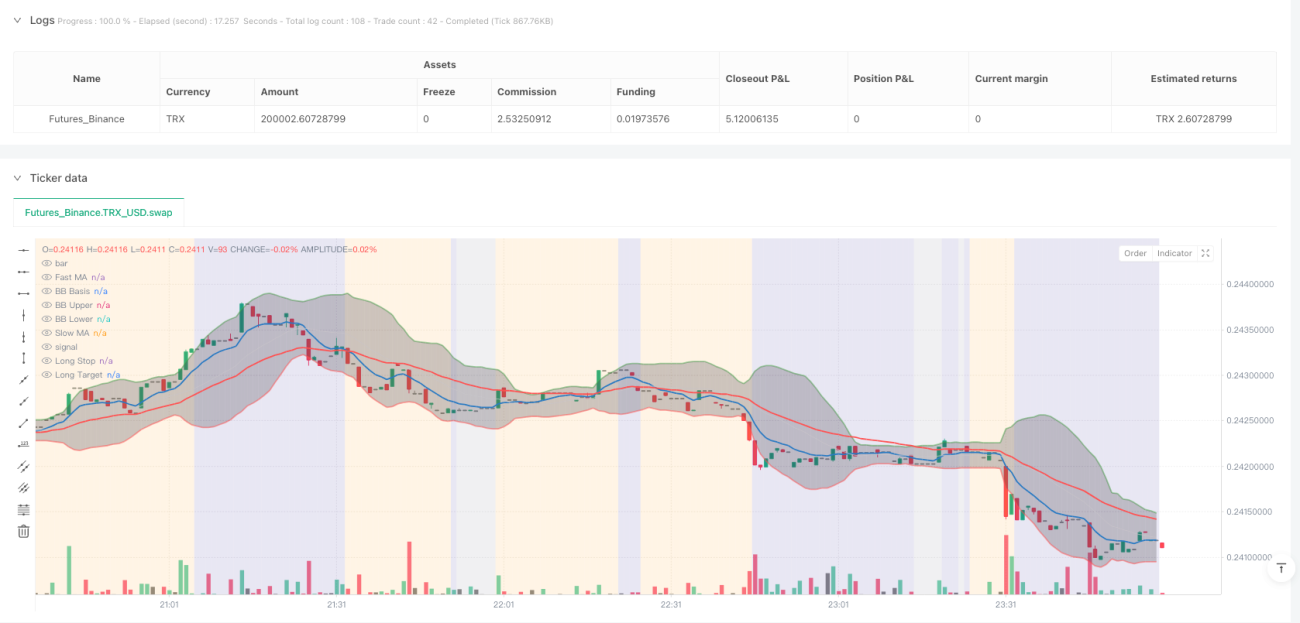
Visual Monitoring: Through color-coded backgrounds and performance dashboards, traders can intuitively understand the current market state, strategy performance, and key indicators, improving operational transparency.
Strategy Risks
-
Parameter Sensitivity: The strategy uses multiple parameters and thresholds for market regime identification and signal generation. These parameters need to be carefully adjusted, otherwise they may lead to misjudgment of market states or generate incorrect signals. Key thresholds such as ADX, ATR ratio, and Bollinger Band width need to be optimized according to the characteristics of different trading instruments.
-
Computational Complexity: Multi-layered indicator calculations and logical judgments increase the strategy's complexity, potentially slowing down backtesting and real-time execution, especially in lower timeframes or high-frequency trading environments.
-
Market Transition Delay: Although the strategy is designed to identify different market states, market transitions may not be instantaneous but gradual. During transitions, the strategy may face risks of misjudgment and false signals.
-
Over-reliance on Technical Indicators: The strategy is primarily based on technical indicators and price patterns, without considering fundamental factors and market sentiment. Pure technical analysis may fail during major news or black swan events.
-
Backtesting Bias: Due to the strategy's complexity and adaptability, there is a risk of overfitting historical data, and actual performance may not match backtesting results.
-
Capital Requirements: The dynamic risk management mechanism may require larger stop-loss distances under certain market conditions, requiring sufficient trading capital to maintain reasonable risk proportions.
Optimization Directions
-
Machine Learning Enhancement: Introduce machine learning algorithms to optimize market regime identification and parameter adjustment. Historical data can be used to train models to identify potential patterns in different market states and improve classification accuracy. Implementation methods can include using random forests or support vector machines for market state classification, and neural networks for optimizing indicator weights.
-
Sentiment Indicator Integration: Introduce market sentiment indicators (such as VIX, put/call ratios, social media sentiment analysis, etc.) as additional confirmation layers. Market sentiment data can serve as leading indicators, helping predict market transition points.
-
Fundamental Data Integration: Develop a framework to integrate key fundamental data, such as economic calendar events, earnings reports, or major news releases. This helps adjust risk exposure before important announcements, avoiding losses from unexpected volatility.
-
Time Filters: Implement trading session filters to avoid periods of low liquidity or abnormal volatility. This is particularly important for cross-market trading, avoiding abnormal behavior during the crossover periods of Asian, European, and American market trading sessions.
-
Correlation Analysis Module: Add cross-asset correlation analysis functionality to identify multi-market patterns and divergence signals. For example, correlations between currency pairs, relationships between stock indices and VIX, etc., can provide additional trade confirmations.
-
Dynamic Position Sizing Optimization: Automatically adjust position size based on current market regime and historical performance. Risk exposure can be increased in well-performing market regimes and reduced in uncertain or historically poor-performing environments.
-
Hardware Optimization: Improve code efficiency and reduce computational complexity, especially in real-time trading environments. Consider rewriting portions of logic using more efficient algorithms and data structures.
Summary
The Multi-Timeframe Adaptive Market Regime Quantitative Trading Strategy represents a significant innovation in quantitative trading systems, integrating market regime identification, multi-timeframe analysis, pattern recognition, and dynamic risk management. Its adaptive capability and comprehensive technical indicator integration allow it to remain competitive across various market environments, not just limited to a single market state.
The true value of this strategy lies in its overall framework rather than individual components. Through the synergy of market regime identification, multi-timeframe confirmation, pattern recognition, and dynamic risk management, the strategy can generate high-quality signals and effectively manage risk. This multi-layered approach reduces false signals and enhances overall robustness.
However, the strategy also faces challenges such as parameter sensitivity, computational complexity, and potential overfitting. Traders should be aware of these risks when applying this strategy, conducting thorough parameter optimization and forward testing.
Future optimization directions include machine learning enhancement, sentiment indicator integration, and dynamic position sizing adjustment. These improvements will further enhance the strategy's adaptability and robustness, making it a more comprehensive trading system. Overall, this strategy provides a powerful framework that can be customized and expanded according to traders' risk preferences and market views.
/*backtest
start: 2025-04-13 00:00:00
end: 2025-04-20 00:00:00
period: 1m
basePeriod: 1m
exchanges: [{"eid":"Futures_Binance","currency":"TRX_USD"}]
*/

//@version=6
strategy("Dskyz (DAFE) AI Adaptive Regime - Pro", overlay=true, default_qty_type=strategy.fixed, default_qty_value=1, calc_on_order_fills=true, calc_on_every_tick=true)

// This script uses higher timeframe values for RSI/MACD, integrated into regime detection and scoring.- 1