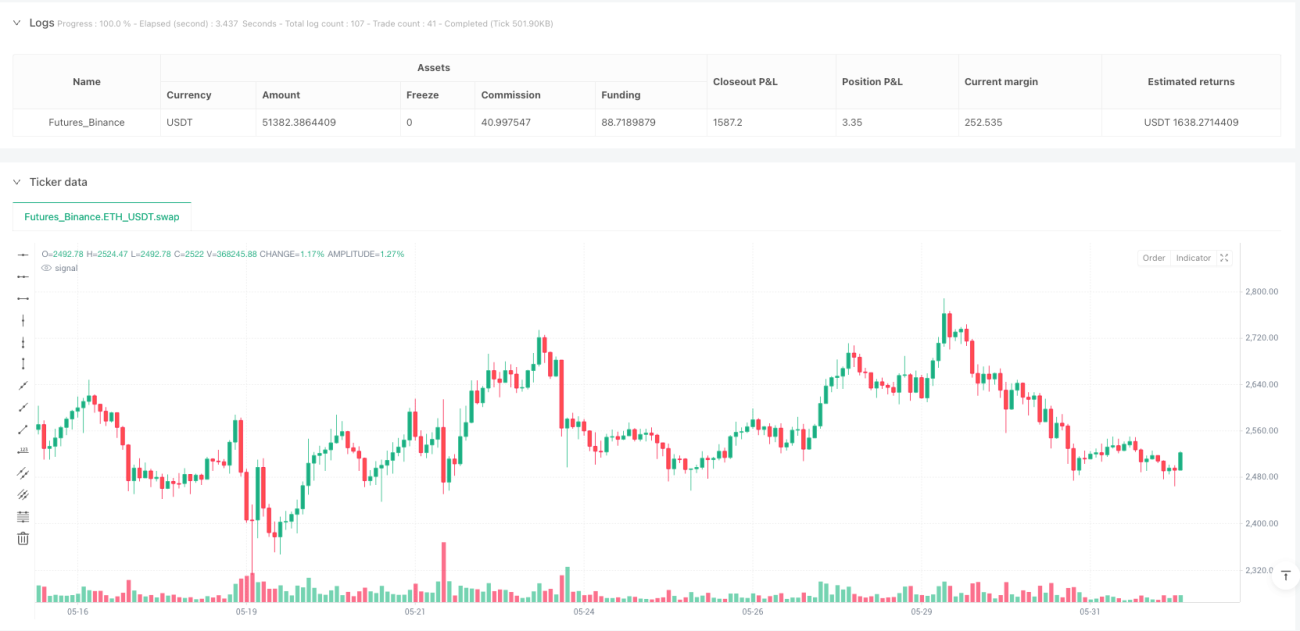
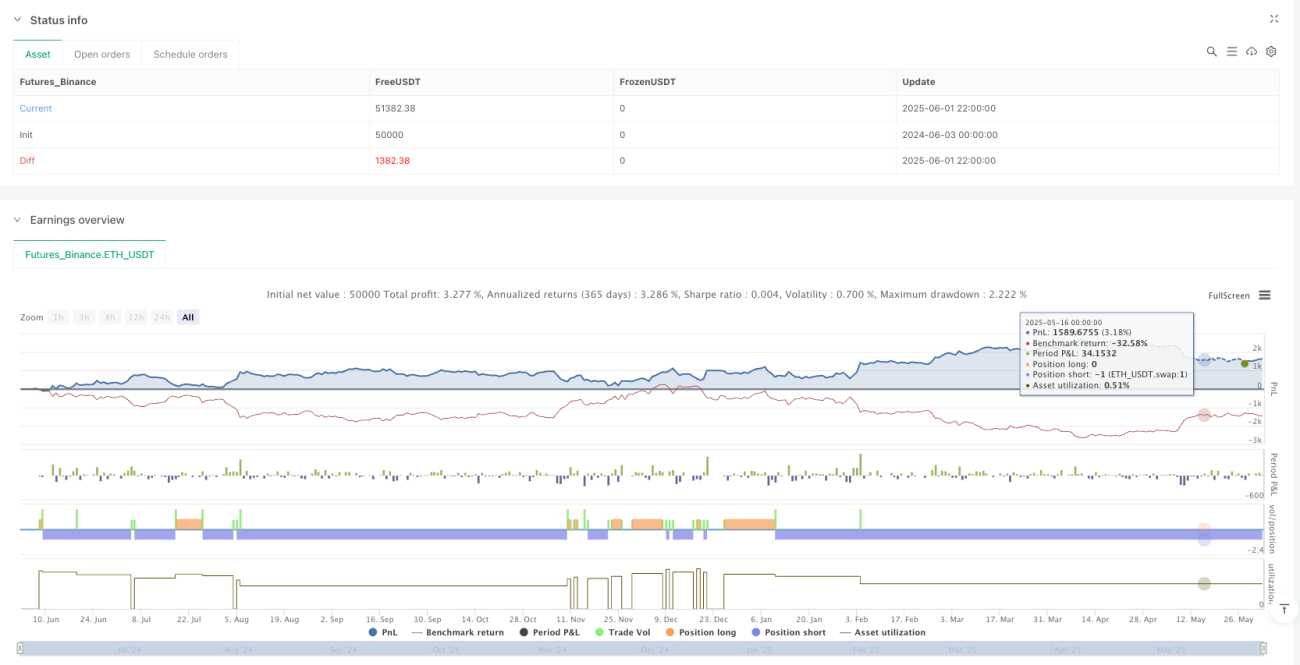
Multi-Timeframe Price Structure Recognition and Fair Value Gap Quantitative Trading System
Overview
The Multi-Timeframe Price Structure Recognition and Fair Value Gap Quantitative Trading System is an automated trading strategy based on price action principles, combining two key trading concepts: Change of Character (CHoCH) and Fair Value Gap (FVG). This strategy captures high-probability trading opportunities by identifying market structure change points and imbalance zones, entering trades when price retraces to fair value gaps. This systematic approach allows traders to analyze markets objectively, eliminate emotional factors, and implement clear risk management rules.
Strategy Principles
This quantitative trading system operates based on the following core principles:
-
Price Structure Identification: The system uses Pivot Points technique to identify swing highs and swing lows in the market, which are key components of market structure. It employs a parameterized swing length (default 5 periods) to determine these critical points.
-
Change of Character (CHoCH) Detection:
- Bullish CHoCH: Price breaks above a prior swing high after making a lower low
- Bearish CHoCH: Price breaks below a prior swing low after making a higher high
The system requires a minimum distance between CHoCH formations (default 10 bars) to filter out invalid signals.
-
Fair Value Gap (FVG) Identification:
- Bullish FVG: When the low of the current candle is higher than the high of a candle 2 bars ago
- Bearish FVG: When the high of the current candle is lower than the low of a candle 2 bars ago
The system sets a minimum FVG size threshold (default 2 ticks) to ensure it only captures meaningful price imbalances.
-
Entry Logic:
- Long Entry: After confirming a bullish CHoCH, wait for price to retrace to the bullish FVG zone
- Short Entry: After confirming a bearish CHoCH, wait for price to retrace to the bearish FVG zone
Entry price is set at the midpoint of the FVG region, providing a balanced entry price.
-
Risk Management Mechanism:
- Stop loss is placed at the recent swing low (for longs) or swing high (for shorts)
- Take profit is based on either risk-reward ratio (default 2.0) or a fixed target in ticks
- Optional automatic position sizing based on account risk percentage and stop loss distance
Strategy Advantages
After deep analysis of the code, this strategy exhibits the following significant advantages:
-
Structured Market Analysis: The strategy is based on price structure changes and market imbalance principles rather than simple indicator crossovers, giving it a unique advantage in identifying market turning points.
-
Precise Entry Timing: By waiting for FVG formation after CHoCH, the strategy can enter at favorable price levels, avoiding chasing highs or lows, thus improving entry quality.
-
Adaptive Risk Management: The strategy automatically adjusts stop loss placement based on actual market structure rather than using fixed points, a method more aligned with real market volatility characteristics.
-
Visualization of Trading Elements: The strategy provides comprehensive visualization features including CHoCH labels, FVG boxes, swing points, and trade lines, allowing traders to intuitively understand market structure and strategy logic.
-
Flexible Position Management: By automatically adjusting position size based on risk percentage, the system both protects account capital and automatically adjusts risk exposure according to volatility.
-
Performance-Optimized Design: The code includes mechanisms for cleaning up old FVG boxes, ensuring system performance doesn't degrade during long-term operation.
-
Comprehensive Performance Monitoring: The strategy provides a real-time performance table including strategy status, win rate, profit factor, and other key metrics, making it convenient for traders to evaluate strategy performance.
Strategy Risks
Despite being well-designed, the strategy still has some potential risks and limitations:
-
False Breakout Risk: CHoCH signals may be false breakouts, causing price to quickly retrace and trigger stop losses. To mitigate this risk, consider adding confirmation mechanisms, such as waiting for multiple candles to confirm the breakout.
-
Gap Risk: In volatile markets or overnight trading, price may gap beyond stop loss levels, resulting in actual losses exceeding expectations. Consider using guaranteed stop orders (if available) or reducing position size.
-
Parameter Sensitivity: Strategy performance is highly dependent on parameters such as swing length, minimum CHoCH distance, and FVG size. Different markets and timeframes may require different parameter combinations, so comprehensive backtesting optimization is recommended.
-
Market Environment Dependency: This strategy performs better in trending markets and may produce frequent false signals in ranging markets. Consider adding trend filters or market state recognition mechanisms.
-
Computational Complexity: The strategy uses multiple arrays and condition checks, which may cause performance issues on lower-spec devices. Although the code includes cleanup mechanisms, resource consumption should be monitored during long-term operation.
-
Drawdown Management Insufficiency: The current strategy doesn't consider dynamic position sizing adjustments under different market conditions, which may lead to significant drawdowns in continuously adverse environments. Implementing account drawdown limits and gradual position reduction mechanisms is recommended.
Optimization Directions
Based on code analysis, the following optimization directions are proposed:
-
Multi-Timeframe Confirmation: Introduce higher timeframe market structure analysis, trading only in the direction of the main trend. For example, add a daily trend filter and only execute trades consistent with the daily trend direction.
-
Dynamic Parameter Optimization: Implement a parameter system that automatically adjusts based on market volatility. For example, increase minimum FVG size and CHoCH distance requirements during high volatility periods and decrease these parameters during low volatility periods.
-
Entry Optimization:
- Implement a scaled entry strategy, for example, setting multiple entry points at different levels within the FVG zone
- Add additional entry confirmations, such as volume breakouts or momentum indicator confirmations
-
Risk Management Enhancement:
- Implement trailing stop functionality that automatically adjusts stop loss positions as trades move into profit
- Add partial profit-taking functionality, closing part of the position when certain profit levels are reached
- Introduce maximum drawdown limits, automatically reducing position size or pausing trading when account drawdown reaches thresholds
-
Market State Adaptation:
- Add market state recognition (trending/ranging/high volatility) and adjust strategy parameters according to different states
- Reduce or avoid trading in ranging markets
- Adopt more conservative position sizing when volatility suddenly increases
-
Machine Learning Enhancement: Introduce machine learning algorithms to analyze historical CHoCH and FVG patterns, identify pattern features with higher success rates, and adjust entry decision weights accordingly.
-
Trading Time Filters: Add trading time filters to avoid high volatility periods around major news announcements and market openings/closings, focusing on trading sessions with better liquidity.
Summary
The Multi-Timeframe Price Structure Recognition and Fair Value Gap Quantitative Trading System is a complete trading solution that combines advanced price action theories. It identifies market structure changes (CHoCH) and price imbalance areas (FVG) to enter at ideal price levels, while employing systematic risk management methods to protect trading capital.
The strategy's greatest advantage lies in its analysis method based on actual market structure rather than lagging indicators, allowing it to identify market turning points earlier. Meanwhile, comprehensive visualization features and performance monitoring systems enable traders to intuitively understand strategy logic and evaluate its effectiveness.
Although risks such as false breakouts and parameter sensitivity exist, through the proposed optimization directions—especially multi-timeframe confirmation, dynamic parameter adjustments, and enhanced risk management functions—the strategy's stability and performance can be significantly improved.
For investors looking to adopt a systematic approach to trading, this strategy provides a solid framework that incorporates both the essence of traditional price action trading and the objectivity and discipline advantages of quantitative systems. Through continuous parameter optimization and market adaptability adjustments, this strategy has the potential to achieve stable trading performance across various market environments.
/*backtest
start: 2024-06-03 00:00:00
end: 2025-06-02 00:00:00
period: 2h
basePeriod: 2h
exchanges: [{"eid":"Futures_Binance","currency":"ETH_USDT"}]
*/
//@version=5
strategy("ICT CHoCH & FVG Strategy - NQ1!", overlay=true, pyramiding=0, calc_on_every_tick=false, calc_on_order_fills=false, max_boxes_count=500, max_lines_count=100, max_labels_count=100)
// ============================================================================- 1