Overview
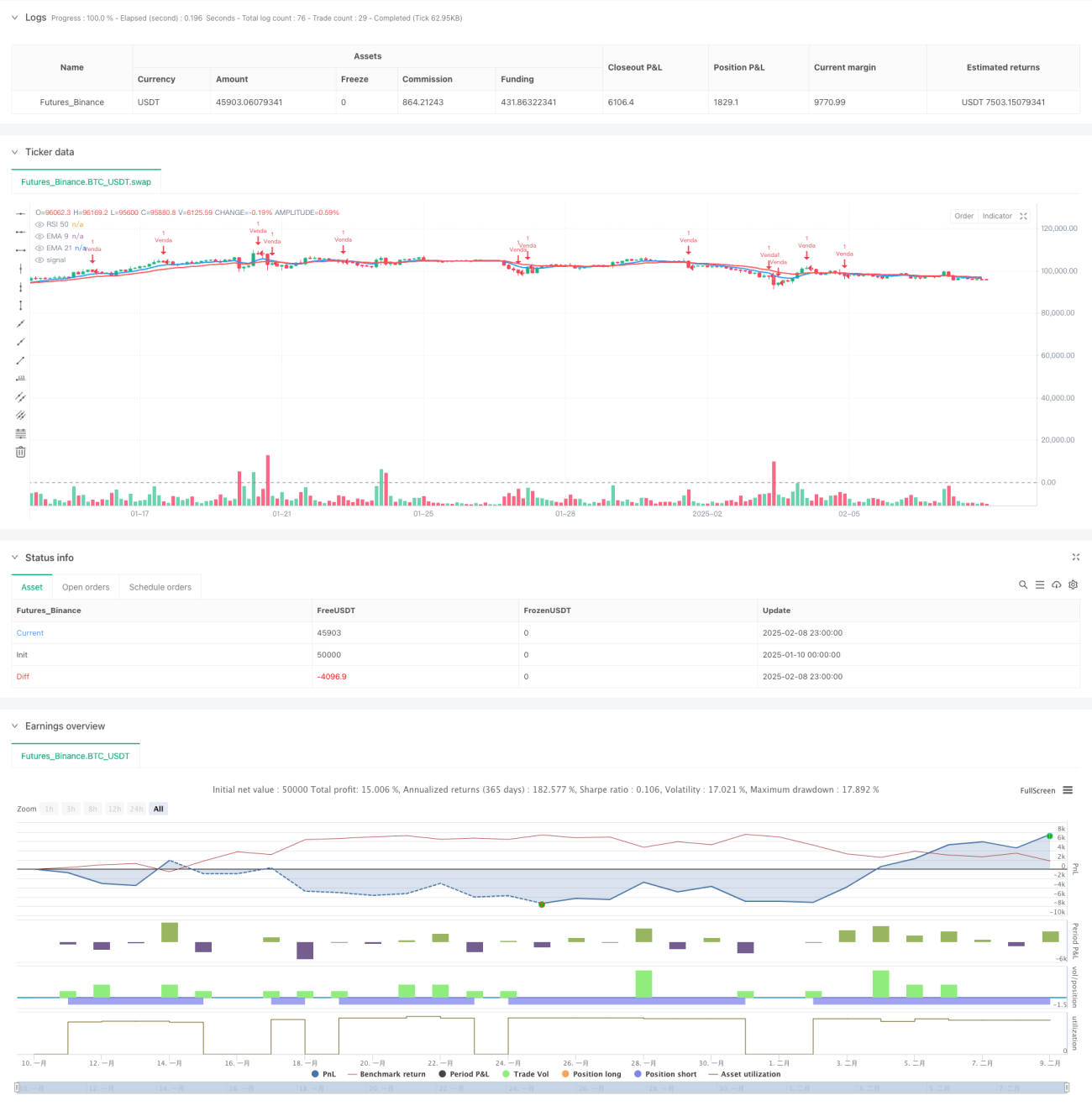
This strategy is a comprehensive trend following trading system that combines multiple technical indicators to confirm market trends and trading signals. The strategy uses EMA crossover as the primary trend identification tool, while integrating RSI, ADX, and volume indicators to filter trading signals, along with dynamic stop-loss and take-profit levels for risk management. This multi-faceted analysis approach can effectively improve trading accuracy and profitability.
Strategy Principles
The core logic of the strategy is based on the following key elements:
- Using 9-period and 21-period Exponential Moving Average (EMA) crossovers to determine trend direction
- Using 14-period Relative Strength Index (RSI) to measure market momentum
- Utilizing Average Directional Index (ADX) to confirm trend strength
- Incorporating 20-period volume moving average to verify price movements
- Employing a dynamic stop-loss (3%) and take-profit (5%) system based on entry price
Buy conditions require: EMA9 crosses above EMA21, RSI above 50, volume above average, ADX above 25
Sell conditions require any of: EMA9 crosses below EMA21, RSI below 50, volume below average (with ADX above 25)
Strategy Advantages
- Integration of multiple technical indicators provides more reliable trading signals
- Dynamic stop-loss and take-profit settings help automate risk management
- Inclusion of ADX ensures trading only in strong trends
- Volume confirmation increases signal reliability
- Strategy has good adaptability to different market environments
Strategy Risks
- Multiple indicators may cause missed trading opportunities
- False signals may occur in ranging markets
- Fixed percentage stop-loss and take-profit may not suit all market conditions
- Requires precise timing of trades
Risk management recommendations:
- Dynamically adjust stop-loss and take-profit percentages based on market volatility
- Add minimum trend strength duration requirements
- Consider adding volatility filters
Strategy Optimization Directions
- Introduce adaptive stop-loss and take-profit mechanisms based on market volatility
- Add trend persistence time requirements to avoid false breakouts
- Integrate market volatility indicators (like ATR) for position management
- Consider validating signals across different timeframes
- Add position sizing system based on signal strength
Summary
This is a well-designed trend following strategy that uses multiple technical indicators to improve trading reliability. The strategy's strengths lie in its comprehensive signal confirmation mechanism and risk management system, but attention must be paid to proper parameter optimization based on market conditions during practical application. Through the suggested optimization directions, both the strategy's stability and profitability can be further enhanced.
- 1

