
Overview
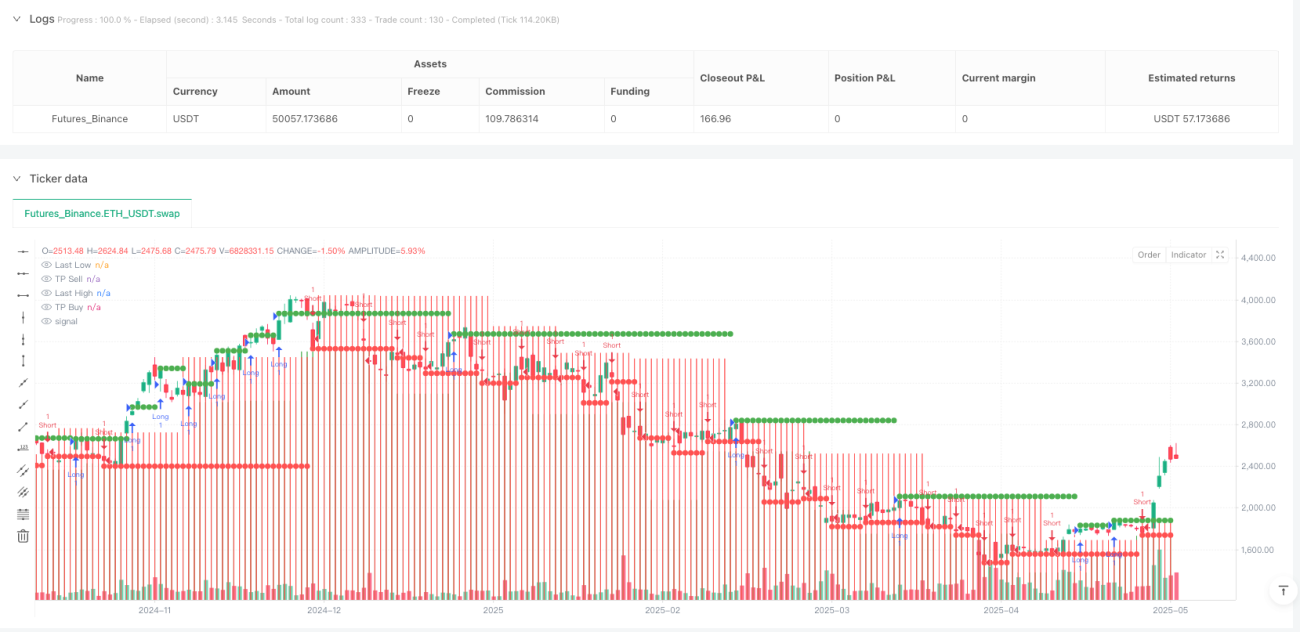
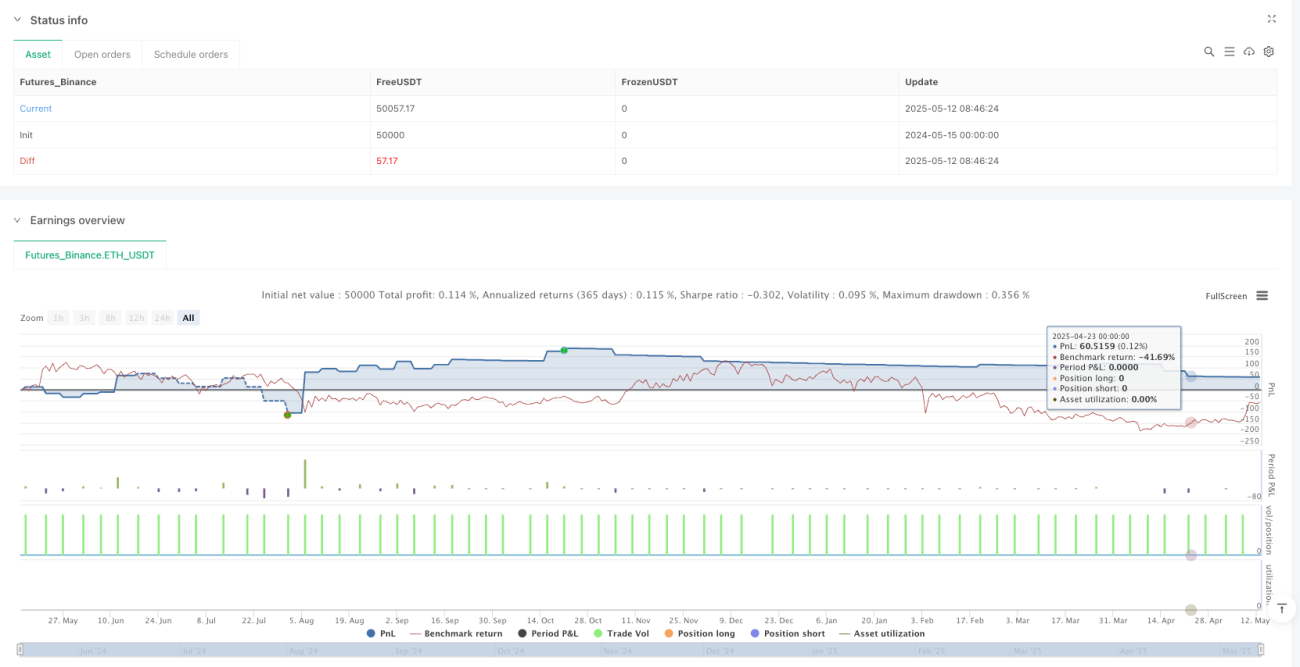
The Multi-Timeframe Trend Momentum Trading Strategy is a comprehensive trading system that integrates multi-timeframe trend analysis, momentum signals, volume confirmation, and smart money concepts (Change of Character [CHoCH] and Break of Structure [BOS]) to provide traders with a robust tool for capturing market trends while minimizing false signals. The strategy's unique "AI" component analyzes trends across multiple timeframes to provide a clear, actionable dashboard, making it accessible for both novice and experienced traders. The strategy is fully customizable, allowing users to tailor its filters to their trading style.
Strategy Principles
The strategy integrates multiple components to create a cohesive trading system:
-
Multi-Timeframe Trend Analysis: The strategy evaluates trends on three timeframes (1H, 4H, Daily) using Exponential Moving Averages (EMA) and Volume-Weighted Average Price (VWAP). A trend is considered bullish if the price is above both the EMA and VWAP, bearish if below, or neutral otherwise. Signals are only generated when the trend on the user-selected higher timeframe aligns with the trade direction (e.g., Buy signals require a bullish higher timeframe trend). This reduces noise and ensures trades follow the broader market context.
-
Momentum Filter: Measures the percentage price change between consecutive bars and compares it to a volatility-adjusted threshold (based on the Average True Range [ATR]). This ensures trades are taken only during significant price movements, filtering out low-momentum conditions.
-
Volume Filter (Optional): Checks if the current volume exceeds a long-term average and shows positive short-term volume change. This confirms strong market participation, reducing the risk of false breakouts.
-
Breakout Filter (Optional): Requires the price to break above (for Buy) or below (for Sell) recent highs/lows, ensuring the signal aligns with a structural shift in the market.
-
Smart Money Concepts (CHoCH/BOS):
- Change of Character (CHoCH): Detects potential reversals when the price crosses under a recent pivot high (for Sell) or over a recent pivot low (for Buy) with a bearish or bullish candle, respectively.
- Break of Structure (BOS): Confirms trend continuations when the price breaks below a recent pivot low (for Sell) or above a recent pivot high (for Buy) with strong momentum. These signals are plotted as horizontal lines with labels, making it easy to visualize key levels.
-
AI Trend Dashboard: Combines trend direction, momentum, and volatility (ATR) across timeframes to calculate a trend score. Scores above 0.5 indicate an "Up" trend, below -0.5 indicate a "Down" trend, and otherwise "Neutral." Displays a table summarizing trend strength (as a percentage), AI confidence (based on trend alignment), and Cumulative Volume Delta (CVD) for market context. A second table (optional) shows trend predictions for 1H, 4H, and Daily timeframes, helping traders anticipate future market direction.
-
Dynamic Trendlines: Plots support and resistance lines based on recent swing lows and highs within user-defined periods (shortTrendPeriod, longTrendPeriod). These lines adapt to market conditions and are colored based on trend strength.
Strategy Advantages
The Multi-Timeframe Trend Momentum Trading Strategy offers several significant advantages:
-
Reduces False Signals: By requiring confluence across trend, momentum, volume, and breakout filters, it minimizes trades in choppy or low-conviction markets.
-
Adapts to Market Context: The ATR-based momentum threshold adjusts dynamically to volatility, ensuring signals remain relevant in both trending and ranging markets.
-
Simplifies Decision-Making: The AI dashboard distills complex multi-timeframe data into a user-friendly table, eliminating the need for manual analysis.
-
Leverages Smart Money: CHoCH and BOS signals capture institutional price action patterns, giving traders an edge in identifying reversals and continuations.
-
Visual Clarity: The strategy makes market structure visible by marking key levels, signals, and trendlines, helping traders better understand price action.
-
Risk Management Built-In: Predefined take-profit and stop-loss levels facilitate disciplined risk management, which is crucial for long-term trading success.
-
Advanced Warning: With "Get Ready" signals, traders are alerted to potential setups before they fully develop, allowing more preparation and planning time.
Strategy Risks
Despite its many advantages, the strategy also presents some potential risks:
-
Parameter Optimization Trap: Over-optimizing strategy parameters may lead to curve-fitting that performs poorly in future market conditions. The solution is to conduct extensive backtesting across multiple markets and timeframes to find robust parameter sets.
-
Delayed Signals: The use of multiple filters may result in signals that lag price action, sometimes missing ideal entry points. The solution is to adjust parameters more sensitive to market speed, such as pivot length and momentum threshold.
-
Incorrect Trend Identification: In highly volatile or directionless markets, trend assessment may be inaccurate. The solution is to reduce trading during these conditions or increase the strictness of filter requirements.
-
Money Management Flaws: Fixed take-profit and stop-loss points may not be suitable for all market conditions. The solution is to adjust them to ATR-based values to adapt to current volatility.
-
Computation Intensity: The complexity of the strategy may cause performance issues on some platforms, especially when analyzing large amounts of historical data. The solution is to limit backtest time ranges or simplify non-critical calculations.
-
Data Dependency: The strategy relies on accurate multi-timeframe data, which may not be available in all trading environments. The solution is to implement reliable fallbacks, as shown in the code with local value calculations.
-
Preference for High Liquidity Markets: The strategy may produce more false signals on low liquidity markets. The solution is to focus on major currency pairs, widely held stocks, and major cryptocurrencies.
Strategy Optimization Directions
The strategy can be further optimized in several directions:
-
Adaptive Parameters: Implement automatic adjustment of parameters such as momentum threshold based on historical volatility data. This can improve the strategy's adaptability across different market conditions.
-
Machine Learning Integration: Apply machine learning algorithms to identify optimal parameter combinations or predict strategy performance under specific market conditions. This could be implemented by analyzing historical performance data, further enhancing the "AI" aspect of the strategy.
-
Market Sentiment Indicators: Add external market sentiment data, such as VIX index or social media sentiment analysis, to provide broader context for trading decisions. This can help the strategy avoid trading during extreme market conditions.
-
Time Filters: Add filters based on market volatility time patterns to avoid trading during known low-volatility periods (such as mid-Asian sessions). This can reduce the number of low-quality signals.
-
Correlation Analysis: Add cross-asset correlation checks to ensure trades align with movements in related markets (e.g., considering the Dollar Index when trading EUR/USD). This can provide additional signal confirmation.
-
Money Management Optimization: Implement volatility-based dynamic take-profit/stop-loss levels and add money management rules such as adjusting position sizes as the account grows. This will improve long-term risk-adjusted returns.
-
Performance Optimization: Streamline the code and reduce unnecessary calculations, particularly in trendline and table displays, to improve strategy responsiveness in real-time trading.
-
Data Agnosticism: Enhance the strategy to handle data interruptions or missing values more gracefully, ensuring robustness under less-than-ideal conditions.
Summary
The Multi-Timeframe Trend Momentum Trading Strategy provides a comprehensive trading system that combines traditional technical analysis, smart money concepts, and unique AI-driven trend analysis. Its strength lies in the multiple layers of filtering and confirmation that ensure trade signals are generated only in high-probability situations.
A particularly innovative aspect of the strategy is the integration of multi-timeframe trend information into an intuitive visual dashboard, enabling traders to quickly assess market conditions without complex manual analysis. The visualization of dynamic support/resistance lines and key structure levels further enhances this usability.
By intelligently combining CHoCH and BOS concepts, the strategy is able to capture subtle shifts in market psychology that often precede trend continuations or potential reversals. The use of ATR-adjusted thresholds ensures the strategy can adapt to different volatility conditions, making it suitable for various market environments.
Despite some risks and limitations, this already powerful system can be further enhanced through the suggested optimization measures. With wise application of risk management principles and parameter adjustments based on specific trading objectives and risk tolerance, the strategy has the potential to be a valuable tool in any trader's arsenal.
Ultimately, as with all trading strategies, success will depend on proper parameter optimization, disciplined execution, robust risk management, and a deep understanding of market dynamics.
- 1