

The Beginning: A Beautiful Arbitrage Dream
Recently while browsing Zhihu (Chinese Quora), I came across a post with an enticing title: "Stable Way to Get Rich in Crypto: 3,000 USDT to 12,000 USDT in Three Months."
I laughed. Stable? Get rich? When these two words appear together, there are usually only two possibilities: either it's a scam, or the person hasn't encountered a black swan event yet.
But as a quantitative trading developer, seeing this kind of strategy description, I couldn't resist clicking in to take a look.
The Theory Goes Like This:
- BTC is the leader in crypto, so its price swings must be larger than its followers (ETH, SOL, etc.)
- Bull market arrives: BTC rises aggressively → Long BTC + Short ETH → Profit from the spread
- Bear market arrives: BTC falls harder → Short BTC + Long ETH → Still profit from the spread
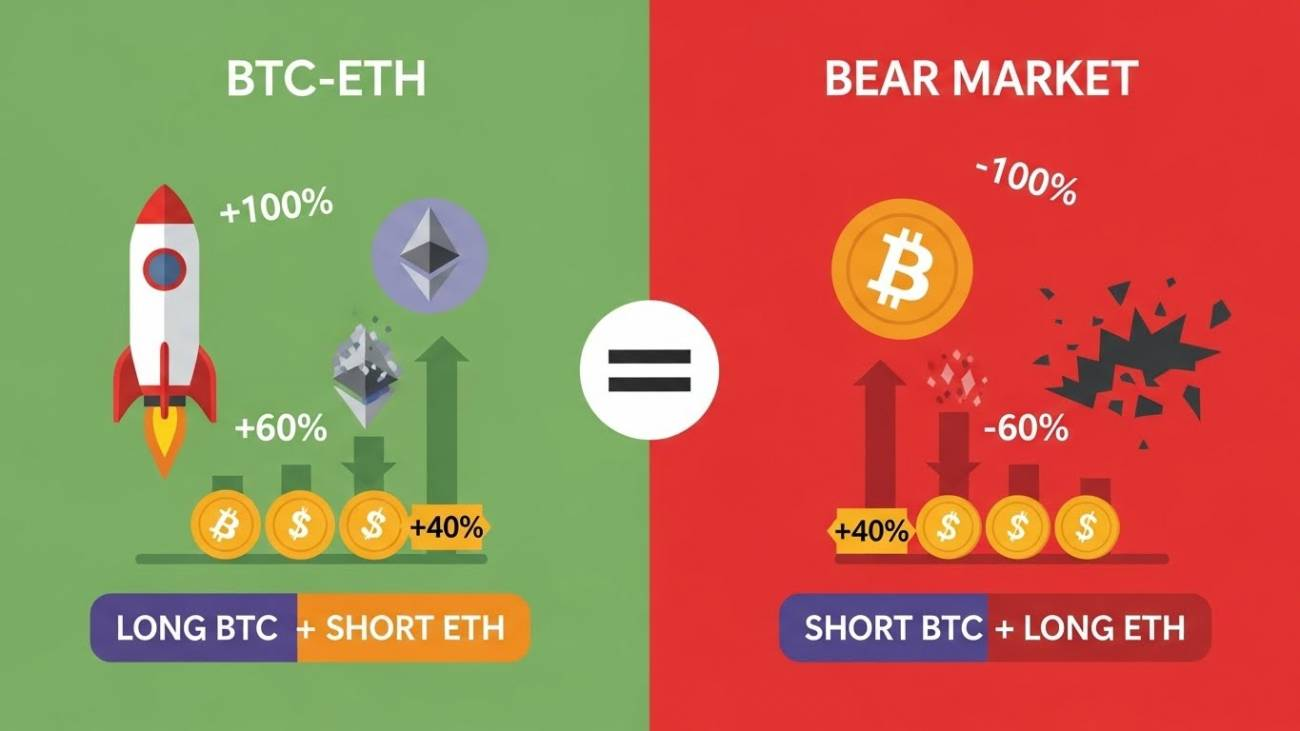
After reading this, I fell into deep thought...
It seems, perhaps, maybe, possibly, hope, wish, maybe... there's some logic to it?
Version 1: The Naive Beginning
Without further ado, I opened FMZ Quant Platform and got to work!
The simplest logic:
javascript
// Pseudocode
if (btcChange > 2%) {
Open Long 1 contract BTC
Open Short 1 contract ETH
}
After writing it, I confidently clicked backtest, and then...
Got absolutely wrecked.
Watching that equity curve plummet straight down, I fell into deep self-doubt.
Version 2: Scientific Hedging
Where's the Problem? The Art of Beta Hedging
Calming down and thinking about it, the problem was obvious:
1 contract BTC ≠ 1 contract ETH
BTC is now $100,000 each, while ETH is only $3,000+. If you hedge 1:1 by quantity, that's not hedging—that's giving away money.
A real hedging strategy needs to consider:
- Price ratio: BTC/ETH ≈ 30:1
- Volatility difference: The return correlation between the two
- Contract value: OKX BTC perpetual 1 contract = 0.01 BTC, ETH perpetual 1 contract = 0.1 ETH
Complete Implementation of Beta Hedging
This code is the core calculation engine of the strategy, fully implementing the Beta coefficient calculation of ETH relative to BTC. The Beta coefficient here represents two key pieces of information: the basic price ratio relationship and volatility linkage, which directly determines the hedging ratio.
            javascript

            // Calculate Beta coefficient of ETH relative to BTC
function calculateBeta(btcRecords, ethRecords, lookback) {
    // Fallback handling when data is insufficient
    if (btcRecords.length < lookback + 1 || ethRecords.length < lookback + 1) {
        Log("⚠️ Insufficient K-line data, using current price ratio as default Beta")
        let btcPrice = btcRecords[btcRecords.length - 1].Close
        let ethPrice = ethRecords[ethRecords.length - 1].Close
        let defaultBeta = btcPrice / ethPrice
        betaInfo.currentBeta = defaultBeta
        betaInfo.correlation = 0
        betaInfo.priceRatio = defaultBeta
        betaInfo.returnBeta = 1.0
        betaInfo.lastUpdate = new Date().toLocaleString()
        Log("  Default Beta =", _N(defaultBeta, 2), "| Price ratio:", _N(btcPrice, 0), "/", _N(ethPrice, 0))
        return defaultBeta
    }

    let btcReturns = []
    let ethReturns = []
    let priceRatios = []

    // Step 1: Calculate daily returns + historical price ratios
    for (let i = btcRecords.length - lookback; i < btcRecords.length; i++) {
        // Daily return = (Today's close - Yesterday's close) / Yesterday's close
        let btcRet = (btcRecords[i].Close - btcRecords[i-1].Close) / btcRecords[i-1].Close
        let ethRet = (ethRecords[i].Close - ethRecords[i-1].Close) / ethRecords[i-1].Close
        btcReturns.push(btcRet)
        ethReturns.push(ethRet)

        // Record daily price ratio
        let ratio = btcRecords[i].Close / ethRecords[i].Close
        priceRatios.push(ratio)
    }

    // Step 2: Calculate historical average price ratio
    let avgPriceRatio = priceRatios.reduce((a, b) => a + b, 0) / priceRatios.length

    // Step 3: Calculate price ratio volatility
    let priceRatioVariance = 0
    for (let i = 0; i < priceRatios.length; i++) {
        let diff = priceRatios[i] - avgPriceRatio
        priceRatioVariance += diff * diff
    }
    priceRatioVariance /= (priceRatios.length - 1)
    let priceRatioStd = Math.sqrt(priceRatioVariance)
    let priceRatioCv = priceRatioStd / avgPriceRatio  // Coefficient of variation

    // Step 4: Calculate mean of returns
    let btcMean = btcReturns.reduce((a,b) => a+b, 0) / btcReturns.length
    let ethMean = ethReturns.reduce((a,b) => a+b, 0) / ethReturns.length

    // Step 5: Calculate covariance and variance
    let covariance = 0
    let btcVariance = 0
    let ethVariance = 0
    for (let i = 0; i < btcReturns.length; i++) {
        let btcDiff = btcReturns[i] - btcMean
        let ethDiff = ethReturns[i] - ethMean
        covariance += btcDiff * ethDiff
        btcVariance += btcDiff * btcDiff
        ethVariance += ethDiff * ethDiff
    }
    covariance /= (btcReturns.length - 1)
    btcVariance /= (btcReturns.length - 1)
    ethVariance /= (ethReturns.length - 1)

    // Step 6: Calculate return Beta
    // Beta = Cov(ETH, BTC) / Var(BTC)
    let returnBeta = covariance / btcVariance

    // Step 7: Calculate correlation coefficient
    // Correlation = Cov(ETH, BTC) / (Std(BTC) × Std(ETH))
    let correlation = covariance / Math.sqrt(btcVariance * ethVariance)

    // Step 8: Final Beta = Historical average price ratio × Return Beta
    let finalBeta = avgPriceRatio * returnBeta

    // Step 9: Limit Beta range to avoid extreme values
    let minBeta = avgPriceRatio * 0.5
    let maxBeta = avgPriceRatio * 2.0
    finalBeta = Math.max(minBeta, Math.min(maxBeta, finalBeta))

    // Step 10: Get current price ratio
    let currentBtcPrice = btcRecords[btcRecords.length - 1].Close
    let currentEthPrice = ethRecords[ethRecords.length - 1].Close
    let currentPriceRatio = currentBtcPrice / currentEthPrice

    // Update Beta info to global
    betaInfo.currentBeta = finalBeta
    betaInfo.correlation = correlation
    betaInfo.returnBeta = returnBeta
    betaInfo.avgPriceRatio = avgPriceRatio
    betaInfo.currentPriceRatio = currentPriceRatio
    betaInfo.priceRatioStd = priceRatioStd
    betaInfo.priceRatioCv = priceRatioCv
    betaInfo.lastUpdate = new Date().toLocaleString()

    return finalBeta
}
Main Functions and Logic:
-
Data validation and fallback handling: Checks if historical data is sufficient; if not, uses current price ratio directly, ensuring the strategy can always run.
-
Return series calculation: Converts price data to returns, eliminating the dimensional effect of absolute prices, making assets with different prices comparable.
-
Core statistical calculations:
- Covariance: Measures the direction and strength of return co-movement between BTC and ETH
- Variance: Measures the volatility of BTC returns itself
- Return Beta: Cov(ETH,BTC) / Var(BTC), indicating ETH return sensitivity to BTC return changes
- Correlation coefficient: Standardized covariance, reflecting degree of linear correlation
-
Composite Beta synthesis: Final Beta = Historical average price ratio × Return Beta. This considers both basic price differences (e.g., BTC is 30x ETH) and volatility characteristic differences (e.g., ETH volatility is 0.8x BTC). For example, if price ratio is 30 and return Beta is 0.8, then final Beta = 24, meaning hedging 1 BTC requires 24 ETH.
-
Risk control mechanism: Sets reasonable range limits on Beta value, preventing unreasonable hedge ratios calculated from short-term extreme market conditions.
With Beta calculated, we still need to bridge "the gap between theory and reality"—converting theoretical coefficients to actually tradeable quantities on exchanges. This code completes this key conversion:
            javascript

            // Calculate hedge contract quantities
function calculateHedgeAmount(beta) {
    let btcCoinAmount = config.btcCoinAmount   // 0.1 BTC
    let ethCoinAmount = btcCoinAmount * beta   // ETH quantity = 0.1 × Beta

    // Convert to contract quantities
    let btcContracts = Math.floor(btcCoinAmount / contractInfo.btcCtVal)
    btcContracts = Math.max(1, btcContracts)   // At least 1 contract

    let ethContracts = Math.floor(ethCoinAmount / contractInfo.ethCtVal)
    ethContracts = Math.max(1, ethContracts)

    // Actual coin amounts for opening positions
    let actualBtcCoins = btcContracts * contractInfo.btcCtVal
    let actualEthCoins = ethContracts * contractInfo.ethCtVal

    Log("🎯 Hedge Calculation | Beta:", _N(beta, 3),
        "\n    BTC: ", _N(actualBtcCoins, 4), "coins =", btcContracts, "contracts (CtVal:", contractInfo.btcCtVal, ")",
        "\n    ETH: ", _N(actualEthCoins, 4), "coins =", ethContracts, "contracts (CtVal:", contractInfo.ethCtVal, ")",
        "\n    Actual ratio:", _N(actualEthCoins / actualBtcCoins, 3))

    return {
        btc: btcContracts,
        eth: ethContracts,
        btcCoins: actualBtcCoins,
        ethCoins: actualEthCoins,
        beta: beta
    }
}
Key Conversion Steps:
-
Determine base position size: Set base BTC quantity according to configuration (e.g., 0.1 BTC), serving as the "anchor" for the entire hedge portfolio.
-
Theoretical coin calculation: ETH theoretical quantity = BTC base quantity × Beta coefficient.
-
Contract value conversion: The most critical practical step. Divide theoretical coin amounts by each contract's "contract value" (CtVal). For example, 1 BTC contract might represent 0.01 BTC, 1 ETH contract represents 0.1 ETH, yielding contract quantities.
-
Integer handling: Use floor division to ensure trading integer contracts, with minimum of 1. Also reverse-calculate actual trading ratios for subsequent precise P&L calculations.
Opening and Closing Logic
This is the execution and risk control part of the strategy, converting calculated hedge plans into actual trading operations and managing risk. Here we show the opening logic; use long positions as an example—short positions follow mirror logic.
Trigger condition design: Uses dual conditions—BTC gain > 2% AND BTC gain > ETH gain. This ensures sufficient market volatility and that the expected relative strength relationship holds.
            javascript

            // BTC up > 2% and gain greater than ETH → Long BTC + Short ETH
if (btcChange > 0.02 && btcChange > ethChange) {
    let amounts = calculateHedgeAmount(beta)

    // First open BTC long
    let btcOrder = createMarketOrder(config.btcSymbol, "buy", amounts.btc)
    if (!btcOrder) {
        Log("❌ BTC long open failed")
        return null
    }

    // Then open ETH short
    let ethOrder = createMarketOrder(config.ethSymbol, "sell", amounts.eth)
    if (!ethOrder) {
        Log("❌ ETH short open failed, rolling back BTC")
        createMarketOrder(config.btcSymbol, "closebuy", amounts.btc)
        return null
    }

    Log("🟢 Position opened | Beta:", _N(beta, 3))
}
Atomic trade execution: Sequential execution with rollback mechanism. First open BTC long; if successful, then open ETH short. If ETH order fails, immediately close the already-opened BTC long, ensuring position integrity and avoiding single-sided risk exposure.
Here's the closing logic:
Calculate P&L by coin amount: Calculate combined P&L of both positions based on opening coin amounts, measuring comprehensive hedge effectiveness.
- BTC long P&L = (Current price - Entry price) × BTC coin amount held
- ETH short P&L = (Entry price - Current price) × ETH coin amount held
Risk control thresholds: Evaluate overall portfolio performance with asymmetric take-profit (+3%) and stop-loss (-1%) lines, pursuing positive expected value.
            javascript

            // Calculate P&L by coin amounts
function checkClose(pos, btcTicker, ethTicker) {
    let btcPnlUsd, ethPnlUsd

    if (pos.type === 'long_btc_short_eth') {
        // BTC long P&L = (Current price - Entry price) × Coins
        btcPnlUsd = (btcTicker.Last - pos.btcPrice) * pos.btcCoinAmount
        // ETH short P&L = (Entry price - Current price) × Coins
        ethPnlUsd = (pos.ethPrice - ethTicker.Last) * pos.ethCoinAmount
    } else {
        btcPnlUsd = (pos.btcPrice - btcTicker.Last) * pos.btcCoinAmount
        ethPnlUsd = (ethTicker.Last - pos.ethPrice) * pos.ethCoinAmount
    }

    let totalPnlUsd = btcPnlUsd + ethPnlUsd
    let totalCost = pos.btcPrice * pos.btcCoinAmount + pos.ethPrice * pos.ethCoinAmount
    let totalPnlPct = totalPnlUsd / totalCost

    // Take profit: +3%
    if (totalPnlPct >= 0.03) {
        return {close: true, reason: '✅ Take Profit', pnl: totalPnlPct, pnlUsd: totalPnlUsd}
    }

    // Stop loss: -1%
    if (totalPnlPct <= -0.01) {
        return {close: true, reason: '🛑 Stop Loss', pnl: totalPnlPct, pnlUsd: totalPnlUsd}
    }

    return {close: false, pnl: totalPnlPct, pnlUsd: totalPnlUsd}
}
Running the backtest again, the result...
The curve finally went up!
Backtest Data Analysis
From October 2025 to January 2026, approximately 3 months:
Capital Performance
| Metric | Value |
|---|---|
| Initial Capital | $50,000 |
| Final Equity | $51,095 |
| Total Return | ~2.2% |
| Max Drawdown | Controlled within reasonable range |
Trading Statistics
| Metric | Value |
|---|---|
| Take Profit Count | 6 times |
| Stop Loss Count | 14 times |
| Win Rate | 30% |
The Real Conclusion
After complete backtest verification, this strategy:
✅ What Works in Theory:
- Beta hedging does reduce single-sided risk
- Price ratio reversion provides arbitrage opportunities
- Take-profit and stop-loss can protect profits
⚠️ Problems in Reality:
- Low returns: Only 30% win rate, 2.2% cumulative return over 3 months—far from the 4x claimed in the post
- Few opportunities: The 2% threshold limits opening frequency
- Fee costs: Frequent opening/closing eats into profits
- Slippage risk: Live trading may be worse than backtest
- Extreme conditions: If BTC and ETH both surge/crash simultaneously, hedging fails
🔍 Optimization Directions:
- Multi-coin rotation: Don't just hedge ETH—can add SOL, BNB, etc.
- Dynamic thresholds: Adjust opening thresholds based on volatility
- Stop-loss cooldown: Prohibit immediate reopening after stop-loss
- Volatility Delta hedging: Besides price Beta, consider volatility hedging
- Position sizing: Dynamically adjust capital ratio per trade
Final Thoughts: The Meaning of Quantitative Trading
This is the charm of quantitative trading:
Start with an idea → Write code to implement → Backtest to verify → Optimize and improve
The strategy concept in that Zhihu post wasn't wrong, but the devil is in the details:
- Without Beta hedging, you're just gambling on direction
- Without risk controls, you're trading naked
- Without backtest verification, you're just daydreaming
Real quantitative trading means verifying every idea with data, implementing every strategy with code, and keeping records of every trade.
If you have an idea, verify it.
The code is at the end of this article. Feel free to run it yourself, modify it, and optimize it.
If you're interested, I can continue writing about:
- Volatility Delta hedging strategies
- Multi-coin rotation implementation
- Position sizing and risk control optimization
Welcome to like, comment, and ask for more!
📝 Article source code (strategy parameters can be flexibly set at the beginning of the source code, trading logic has been optimized): Bidirectional Beta Hedging Strategy
Disclaimer
This article is for educational and discussion purposes only and does not constitute any investment advice.
PS: There's no stable get-rich-quick method in crypto—only risk management and continuous optimization.
- 1