Stratégie de croisement MACD

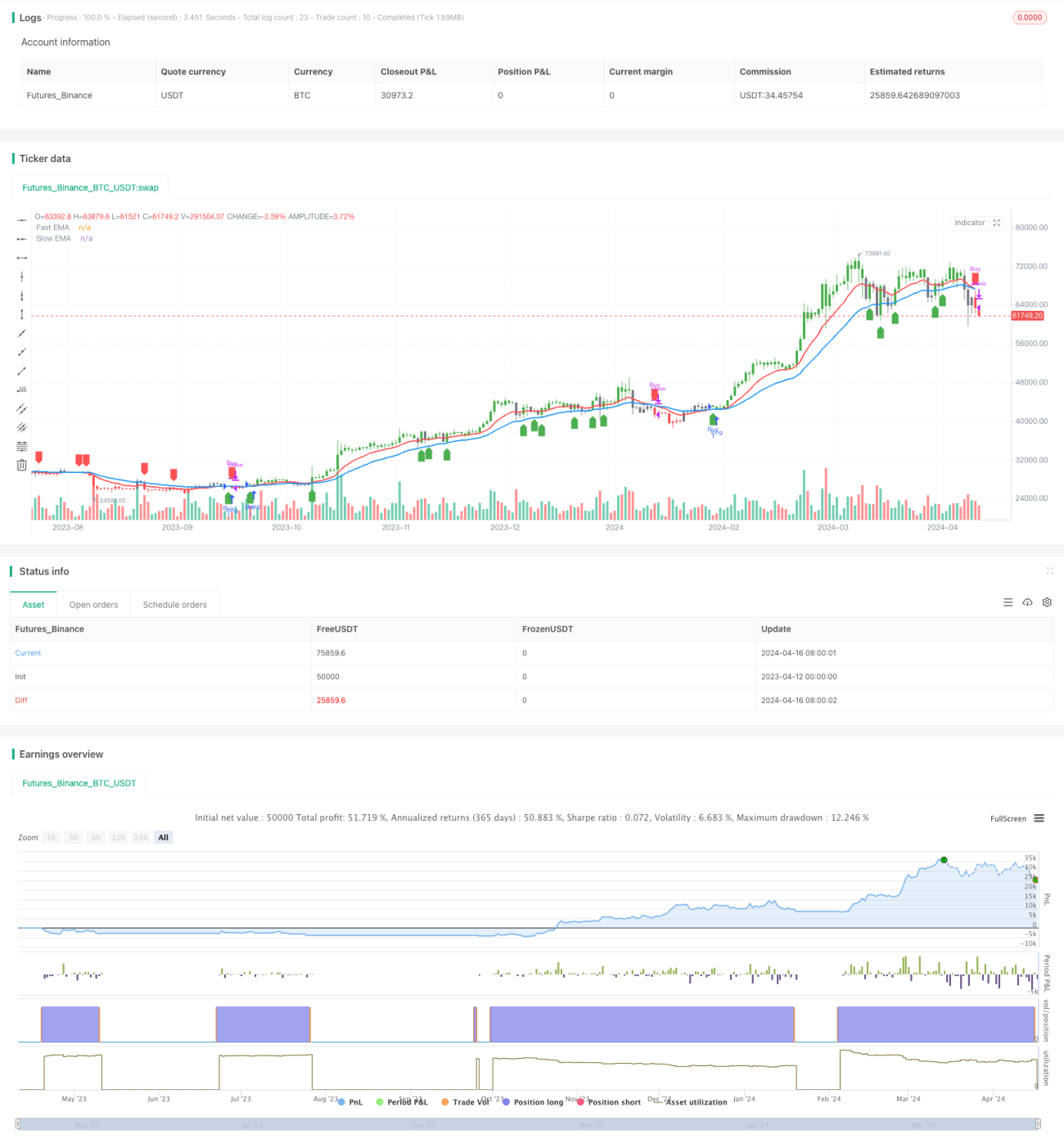
Aperçu
Cette stratégie utilise le croisement de deux moyennes mobiles exponentielles (EMA) de périodes différentes. Un signal d'achat est généré lorsque l'EMA rapide traverse l'EMA lente de bas en haut, et un signal de vente lorsqu'elle la traverse de haut en bas. Cette stratégie peut être appliquée à divers instruments financiers et unités de temps, par exemple elle est la plus efficace sur l'or en période de 2 heures, sur le Bitcoin en graphique journalier, etc.
Principe de la stratégie
- Calculer l'EMA rapide (période par défaut 12) et l'EMA lente (période par défaut 26).
- Définir la zone haussière (EMA rapide au-dessus de l'EMA lente et prix au-dessus de l'EMA rapide) et la zone baissière (EMA rapide en dessous de l'EMA lente et prix en dessous de l'EMA rapide).
- Acheter lors du passage de la zone baissière à la zone haussière, vendre lors du passage de la zone haussière à la zone baissière.
- Marquer les zones haussières et baissières respectivement en vert et en rouge sur le graphique, et les signaux d'achat/vente par des flèches.
Avantages de la stratégie
- Simple et facile à comprendre, adapté aux débutants.
- Large applicabilité, peut être utilisé sur divers instruments financiers et unités de temps.
- Forte capacité de suivi de tendance, capable de capturer les tendances à moyen et long terme.
- Paramètres ajustables, offrant une flexibilité accrue.
Risques de la stratégie
- En période de marché volatile, elle génère facilement de faux signaux, entraînant des pertes.
- Réaction lente lors des retournements de tendance, provoquant un certain glissement.
- Un choix de paramètres inapproprié affecte l'efficacité de la stratégie.
Pistes d'optimisation de la stratégie
- Ajouter un filtre de tendance, par exemple ne trader que lorsque l'ADX est supérieur à une certaine valeur, afin de réduire les pertes en marché volatile.
- Optimiser le moment d'entrée et de sortie, par exemple utiliser l'ATR pour déterminer le stop-loss et le take-profit, réduisant ainsi la perte par transaction.
- Optimiser les paramètres pour trouver la meilleure combinaison, améliorant la stabilité et la rentabilité.
- Combiner d'autres indicateurs auxiliaires, tels que le MACD, le RSI, etc., pour améliorer la précision des signaux.
Résumé
La stratégie de croisement MACD est une stratégie simple basée sur le suivi de tendance. Ses avantages sont la simplicité et la large applicabilité, ses inconvénients sont la difficulté à saisir les retournements de tendance et le choix des paramètres. En ajoutant un filtre de tendance, en optimisant les points d'entrée et de sortie, en sélectionnant les meilleurs paramètres et en combinant d'autres indicateurs, on peut améliorer les performances de cette stratégie, ce qui mérite une étude et des tests approfondis.
/*backtest
start: 2023-04-12 00:00:00
end: 2024-04-17 00:00:00
period: 1d
basePeriod: 1h
exchanges: [{"eid":"Futures_Binance","currency":"BTC_USDT"}]
*/

//@version=5
strategy('Advance EMA Crossover Strategy', overlay=true, precision=6)
//****************************************************************************//
// CDC Action Zone is based on a simple EMA crossover - 1