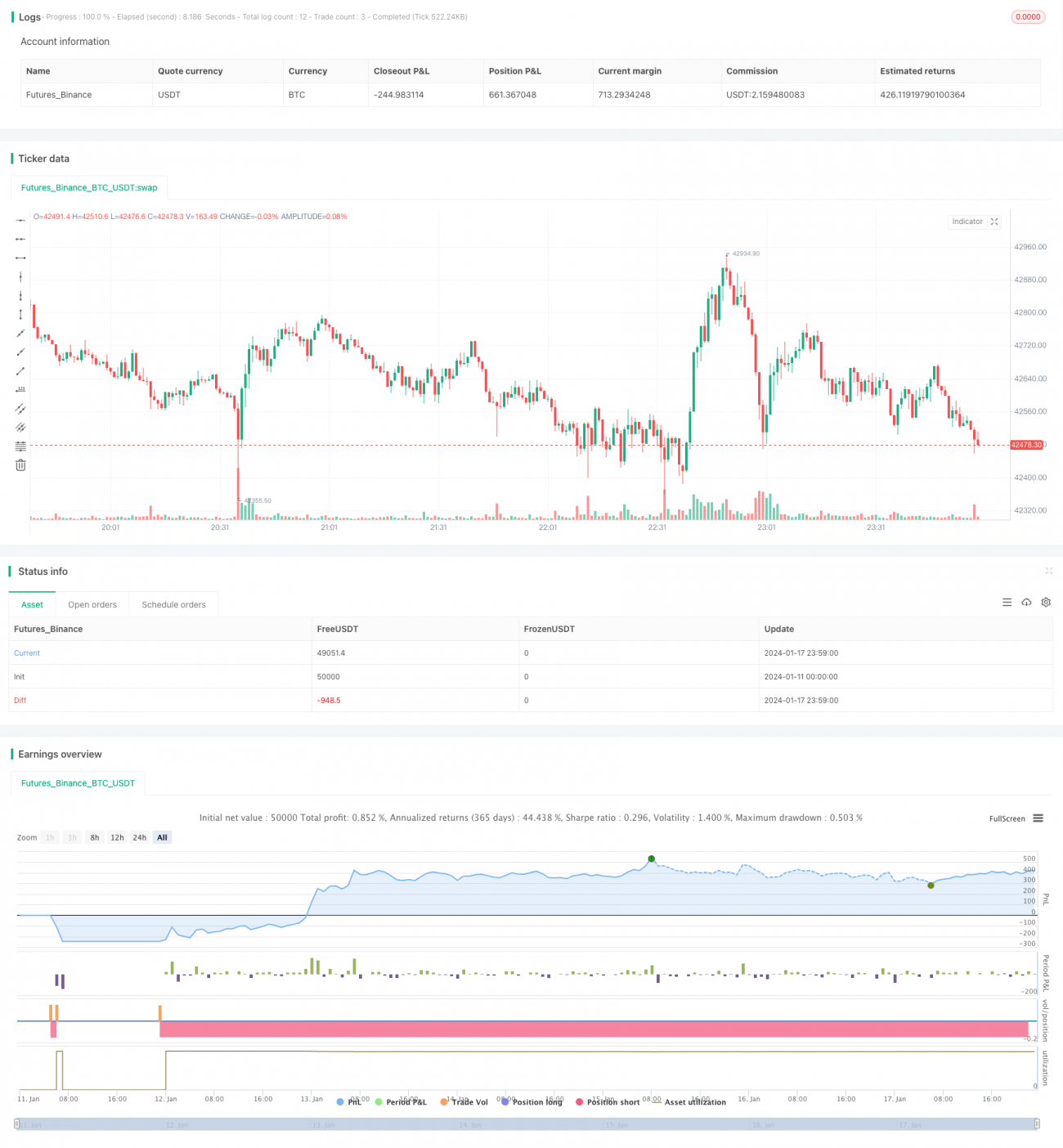
この戦略は,グリッド取引理念に基づく自適性暗号通貨の利策である.市場変動に応じてグリッド取引の価格範囲を自動的に調整し,その価格範囲内で効率的な利取引を行うことができる.
この戦略の核心となる考えは,
ダイナミクスは,歴史上の高点と低点に基づいて取引格子の価格範囲を計算します.
この価格範囲内で,等間隔でN条の取引格子線を設定します.
価格が各格子線を突破すると,固定数量でポジションをオーバーまたは空にする.
隣接するグリッドラインの間で競り合い,利益を得た後に平仓する.
価格が格子領域に戻ったとき,格子線の限界コスト価格でポジションを開くことを続けます.
格子価格の範囲内で高頻度リベラル取引を行う.
具体的には,戦略は,配置された回顧窓 ((i_boundLookback) と波動区間の ((i_boundDev) パラメータに基づいて,格子価格の上下限をリアルタイムで計算する.
そして,上下限の間には,それぞれNの格子線 ((i_gridQty) を分割する.これらの格子線の価格は,gridLineArrの配列に保存される.
価格が格子線を突破すると,固定数量 ((策略本金分格子数量) でポジションをオーバーまたは空にする. 注文はorderArr数列に記録される.
価格が再び隣接する格子線を突破すると,以前の注文とマッチした利潤を得て,利潤平衡のポジションを得ることができます.
価格の変動の範囲内で高頻度で取引を行う.
伝統的な格子戦略と比較して,この戦略の最大の優点は,格子範囲が自動的に調整され,市場の変動に応じて自律的に適応できるということです.以下の特徴があります:
自動で調整し 人工の介入も不要
価格の動向を把握し,その方向で取引する.
リスクはコントロールでき,一方的な攻撃の危険は避けられます.
取引頻度が高く,利益率も高い.
簡単に理解し,簡単に設定できます.
資金活用率が高いため 困ったことはありません.
ロボット取引に適した市場変化をリアルタイムで反映する.
この戦略には多くの利点がありますが,いくつかのリスクもあります.
価格の急激な変動により,大きな損失のリスクが生じます.
適当な保有期間と取引ペアが必要で,利益を得る.
資金の規模と波動範囲の適合性を慎重に評価する必要があります.
常時モニタリングと最適化パラメータが必要になる可能性があります.
対応策は以下の通りです.
網間を広げて網の範囲を広げます.
変動が安定した取引対を選びます.
資金の規模を調整し,十分な流動性を確保する.
自動監視と警報システムを構築する.
この戦略は以下の点で最適化できます.
ダイナミック・グリッド: 取引ペアの波動性に応じてグリッドパラメータを自動的に調整できます.
損失を抑える仕組みストップ・ポジションを合理的に設定し,極端な状況のリスクを回避する.
複合格子: 異なる時間帯で異なるパラメータを使用したグリッドの組み合わせで,時間複製を実現する.
機械学習: ニューラルネットワークなどの代替ルールを用いて,パラメータの自動最適化を実現する.
クロスマーケット裁定取引値取引は,取引先や通貨の間で行われます.
この戦略は,全体的に非常に実用的な自己適応の暗号通貨格子引換戦略である.従来の格子戦略と比較して,その最大の特徴は,格子範囲は自動的に調整され,市場の変化に応じて自分の取引範囲を構成できるという点である.戦略の構想は,明確で,理解しやすく,構成され,特定の基礎を持つ個人投資家が使用するのに適しており,取引ロボットとしての戦略テンプレートにも適している.パラメータ配置が適切であれば,非常に高い資金活用率を得ることができる.
/*backtest
start: 2024-01-11 00:00:00
end: 2024-01-18 00:00:00
period: 1m
basePeriod: 1m
exchanges: [{"eid":"Futures_Binance","currency":"BTC_USDT"}]
*/
//@version=4
strategy("(IK) Grid Script", overlay=true, pyramiding=14, close_entries_rule="ANY", default_qty_type=strategy.cash, initial_capital=100.0, currency="USD", commission_type=strategy.commission.percent, commission_value=0.1)
i_autoBounds = input(group="Grid Bounds", title="Use Auto Bounds?", defval=true, type=input.bool) // calculate upper and lower bound of the grid automatically? This will theorhetically be less profitable, but will certainly require less attention
i_boundSrc = input(group="Grid Bounds", title="(Auto) Bound Source", defval="Hi & Low", options=["Hi & Low", "Average"]) // should bounds of the auto grid be calculated from recent High & Low, or from a Simple Moving Average
i_boundLookback = input(group="Grid Bounds", title="(Auto) Bound Lookback", defval=250, type=input.integer, maxval=500, minval=0) // when calculating auto grid bounds, how far back should we look for a High & Low, or what should the length be of our sma
i_boundDev = input(group="Grid Bounds", title="(Auto) Bound Deviation", defval=0.10, type=input.float, maxval=1, minval=-1) // if sourcing auto bounds from High & Low, this percentage will (positive) widen or (negative) narrow the bound limits. If sourcing from Average, this is the deviation (up and down) from the sma, and CANNOT be negative.
i_upperBound = input(group="Grid Bounds", title="(Manual) Upper Boundry", defval=0.285, type=input.float) // for manual grid bounds only. The upperbound price of your grid
i_lowerBound = input(group="Grid Bounds", title="(Manual) Lower Boundry", defval=0.225, type=input.float) // for manual grid bounds only. The lowerbound price of your grid.
i_gridQty = input(group="Grid Lines", title="Grid Line Quantity", defval=8, maxval=15, minval=3, type=input.integer) // how many grid lines are in your grid
f_getGridBounds(_bs, _bl, _bd, _up) =>
if _bs == "Hi & Low"
_up ? highest(close, _bl) * (1 + _bd) : lowest(close, _bl) * (1 - _bd)
else
avg = sma(close, _bl)
_up ? avg * (1 + _bd) : avg * (1 - _bd)
f_buildGrid(_lb, _gw, _gq) =>
gridArr = array.new_float(0)
for i=0 to _gq-1
array.push(gridArr, _lb+(_gw*i))
gridArr
f_getNearGridLines(_gridArr, _price) =>
arr = array.new_int(3)
for i = 0 to array.size(_gridArr)-1
if array.get(_gridArr, i) > _price
array.set(arr, 0, i == array.size(_gridArr)-1 ? i : i+1)
array.set(arr, 1, i == 0 ? i : i-1)
break
arr
var upperBound = i_autoBounds ? f_getGridBounds(i_boundSrc, i_boundLookback, i_boundDev, true) : i_upperBound // upperbound of our grid
var lowerBound = i_autoBounds ? f_getGridBounds(i_boundSrc, i_boundLookback, i_boundDev, false) : i_lowerBound // lowerbound of our grid
var gridWidth = (upperBound - lowerBound)/(i_gridQty-1) // space between lines in our grid
var gridLineArr = f_buildGrid(lowerBound, gridWidth, i_gridQty) // an array of prices that correspond to our grid lines
var orderArr = array.new_bool(i_gridQty, false) // a boolean array that indicates if there is an open order corresponding to each grid line
var closeLineArr = f_getNearGridLines(gridLineArr, close) // for plotting purposes - an array of 2 indices that correspond to grid lines near price
var nearTopGridLine = array.get(closeLineArr, 0) // for plotting purposes - the index (in our grid line array) of the closest grid line above current price
var nearBotGridLine = array.get(closeLineArr, 1) // for plotting purposes - the index (in our grid line array) of the closest grid line below current price
strategy.initial_capital = 50000
for i = 0 to (array.size(gridLineArr) - 1)
if close < array.get(gridLineArr, i) and not array.get(orderArr, i) and i < (array.size(gridLineArr) - 1)
buyId = i
array.set(orderArr, buyId, true)
strategy.entry(id=tostring(buyId), long=true, qty=(strategy.initial_capital/(i_gridQty-1))/close, comment="#"+tostring(buyId))
if close > array.get(gridLineArr, i) and i != 0
if array.get(orderArr, i-1)
sellId = i-1
array.set(orderArr, sellId, false)
strategy.close(id=tostring(sellId), comment="#"+tostring(sellId))
if i_autoBounds
upperBound := f_getGridBounds(i_boundSrc, i_boundLookback, i_boundDev, true)
lowerBound := f_getGridBounds(i_boundSrc, i_boundLookback, i_boundDev, false)
gridWidth := (upperBound - lowerBound)/(i_gridQty-1)
gridLineArr := f_buildGrid(lowerBound, gridWidth, i_gridQty)
closeLineArr := f_getNearGridLines(gridLineArr, close)
nearTopGridLine := array.get(closeLineArr, 0)
nearBotGridLine := array.get(closeLineArr, 1)