Estrategia cuantitativa de media móvil adaptativa

Resumen
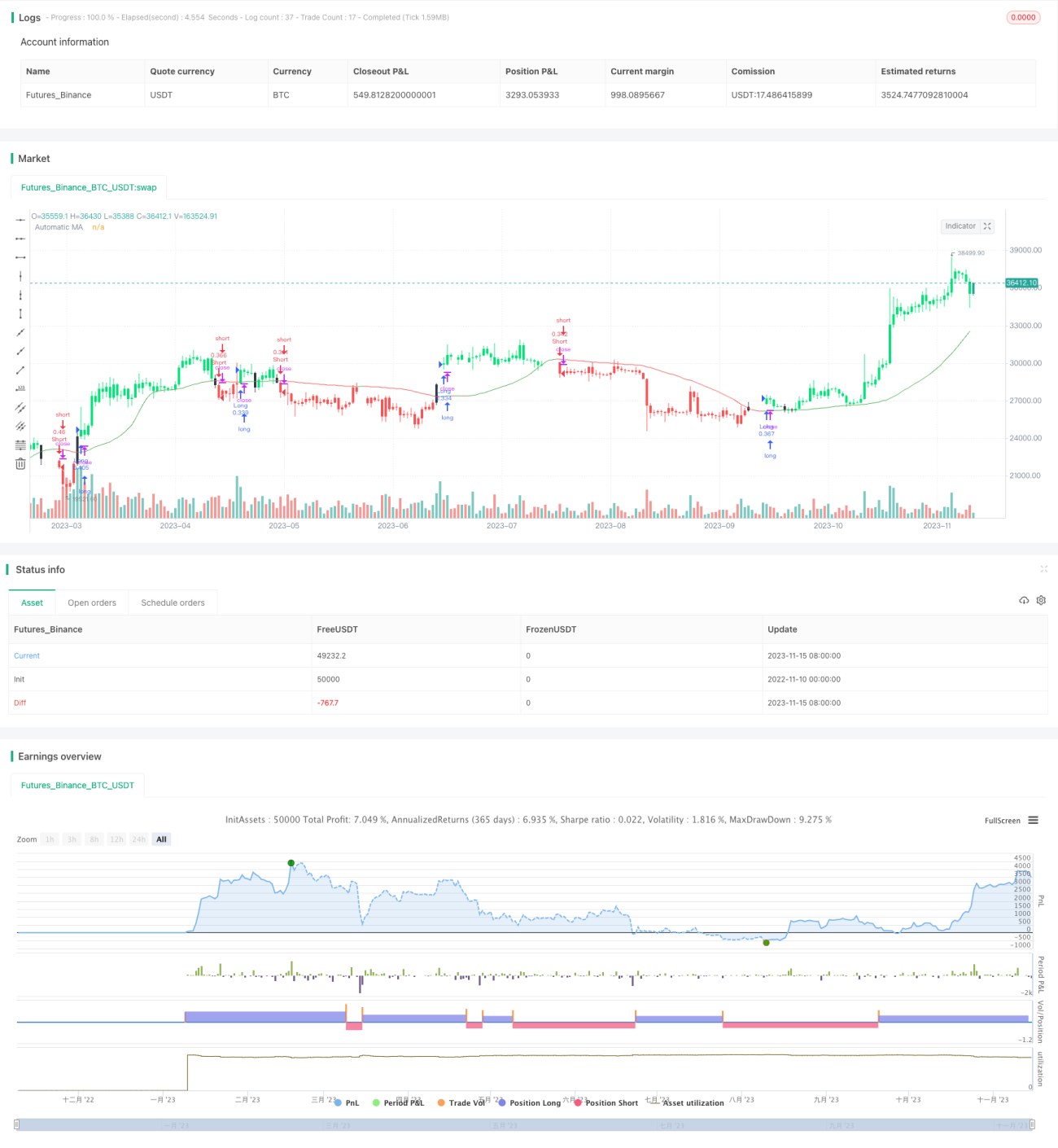
Esta estrategia se basa en medias móviles, ajusta automáticamente los parámetros y es adecuada para mercados volátiles en marcos temporales altos. Encuentra automáticamente la mejor combinación de parámetros y genera señales de trading cuando el precio rompe la media móvil.
Principio de la Estrategia
Esta estrategia utiliza una media móvil adaptativa como señal de trading. Primero calcula la media móvil simple (CMA) del período especificado (start). Luego prueba las combinaciones de parámetros alrededor del CMA, determinando qué combinación tiene el menor número de toques por parte del cuerpo y la mecha de la vela. Finalmente, utiliza el CMA con menos toques como línea de señal.
Específicamente, la estrategia prueba el CMA con período más 1 (CMA_P1) y menos 1 (CMA_M1), contando el número de toques del cuerpo y la mecha. Si el CMA tiene menos toques que CMA_P1 y CMA_M1, se mantiene el período actual; si CMA_P1 tiene menos toques, se incrementa el período en 1; si CMA_M1 tiene menos toques, se reduce el período en 1. Esto encuentra un CMA relativamente suave como línea de señal.
Cuando el precio rompe el CMA al alza, se genera una señal de compra; cuando el precio rompe el CMA a la baja, se genera una señal de venta.
Análisis de Ventajas
Esta estrategia de media móvil adaptativa ofrece las siguientes ventajas:
-
Encuentra automáticamente los parámetros óptimos. No es necesario seleccionar manualmente el período de la media móvil; la estrategia prueba diferentes períodos y encuentra el óptimo.
-
Reduce señales falsas. En comparación con una media móvil de período fijo, la media móvil adaptativa puede filtrar más ruido, reduciendo así muchas señales falsas.
-
Se adapta a los cambios del mercado. Cuando el mercado pasa de un rango lateral a una tendencia, el período de la media móvil aumenta automáticamente para generar señales; cuando pasa de tendencia a lateral, el período disminuye automáticamente. Por lo tanto, la estrategia se adapta dinámicamente a los cambios del mercado.
-
Simplifica el sistema de trading. Este método adaptativo simplifica todo el sistema de trading, sin necesidad de optimización manual de parámetros.
-
Alta escalabilidad. El concepto se puede aplicar a otros indicadores, como Bandas de Bollinger adaptativas, KD adaptativo, etc.
Análisis de Riesgos
Esta estrategia también conlleva algunos riesgos a considerar:
-
Riesgo de opción de compra (call option). Cuando el mercado presenta un patrón de opción de compra, el cuerpo de la vela puede no lograr romper la línea de media móvil, generando señales erróneas. Se necesitan filtros adicionales para reducir este riesgo.
-
Riesgo de ruptura fallida. La ruptura de la media móvil no siempre continuará; existe el riesgo de rupturas fallidas. Por lo tanto, se requiere validación de la ruptura para asegurar una alta tasa de éxito.
-
Riesgo de reversión de tendencia. La reversión después de entrar en una tendencia requiere cambiar de dirección a tiempo, de lo contrario se pueden generar pérdidas. Se pueden establecer condiciones de stop loss para controlar las pérdidas.
-
Riesgo de optimización de parámetros. Los parámetros ajustados adaptativamente pueden caer en un óptimo local, generando una media móvil claramente redundante. Es necesario introducir métodos de evaluación del modelo para evitar este problema.
-
Riesgo de sobreoptimización. El ajuste adaptativo de parámetros puede sobreoptimizar, perdiendo la capacidad de generalización del modelo. Es necesario realizar una validación prolongada en diferentes entornos de mercado, sin depender excesivamente de los resultados del backtesting.
Direcciones de Optimización
Las posibles direcciones de optimización para esta estrategia de media móvil adaptativa son:
-
Añadir un mecanismo de validación de ruptura de tendencia, filtrando rupturas falsas mediante rupturas consecutivas.
-
Incorporar una estrategia de stop loss, cerrando la posición cuando el precio vuelve al otro lado de la media móvil.
-
Agregar un filtro de opciones, evitando señales erróneas en escenarios de opción de compra.
-
Introducir métricas de evaluación para restringir el ajuste de parámetros, como IC, LIC, SIC, etc., para evitar la sobreoptimización.
-
Extender a otros indicadores, diseñando estrategias adaptativas de cruce dorado/ cruz de la muerte, Bandas de Bollinger adaptativas, etc.
-
Optimizar el cálculo de la media móvil, utilizando medias móviles ponderadas, exponenciales, etc., para suavizar la línea.
Conclusión
Esta estrategia ajusta adaptativamente el período de la media móvil para encontrar los parámetros óptimos y generar señales de trading. En comparación con parámetros fijos, reduce muchas señales falsas y se adapta a los cambios del mercado. Sin embargo, también debemos tener en cuenta algunos riesgos potenciales, y es necesario verificar y optimizar la estrategia mediante walk forward para obtener ganancias estables en el trading real.
-
Riesgo de reversión de tendencia. Después de entrar en la tendencia, si esta se revierte, es necesario cambiar de dirección a tiempo; de lo contrario, pueden ocurrir pérdidas. Se debe establecer un stop loss para controlar las pérdidas.
-
Riesgo de optimización de parámetros. Los parámetros ajustados adaptativamente pueden caer en una optimización local, resultando en MAs redundantes. Es necesario introducir métodos de evaluación del modelo para evitar este problema.
-
Riesgo de sobreajuste. Un ajuste excesivo de parámetros puede llevar al sobreajuste y perder la capacidad de generalización del modelo. Se requiere una verificación prolongada en diferentes entornos de mercado, no solo basarse en los resultados del backtest.
Direcciones de mejora
Algunas direcciones para mejorar esta estrategia de MA adaptativa:
-
Agregar validación de ruptura de tendencia mediante rupturas consecutivas para filtrar rupturas falsas.
-
Incrementar la estrategia de stop loss, deteniendo la pérdida cuando el precio retrocede al otro lado de la MA.
-
Agregar un filtro de opciones para evitar señales incorrectas cuando aparecen opciones de compra.
-
Introducir métricas de evaluación como IC, LIC, SIC, etc., para restringir el ajuste de parámetros y prevenir el sobreajuste.
-
Expandir a otros indicadores como estrategia de cruce dorado adaptativo, Bandas de Bollinger adaptativas, etc.
-
Optimizar el cálculo de la MA utilizando MA ponderada, MA exponencial, etc., para obtener una MA más suave.
Resumen
Esta estrategia genera señales de trading ajustando adaptativamente el período de la MA para encontrar los parámetros óptimos. En comparación con los parámetros fijos, puede reducir muchas señales falsas y adaptarse a los cambios del mercado. Pero también debemos estar atentos a los riesgos potenciales, y realizar verificación y optimización walk-forward antes de aplicarla en trading en vivo para obtener ganancias estables.
- 1