Système de point tournant oscillant de tendance


Date de création: 2023-10-23 17:18:28 Dernière modification: 2023-10-23 17:18:28
Copier: 0 Nombre de clics: 744
1
Suivre
1617
Abonnés

Système de point tournant oscillant de tendance

Aperçu

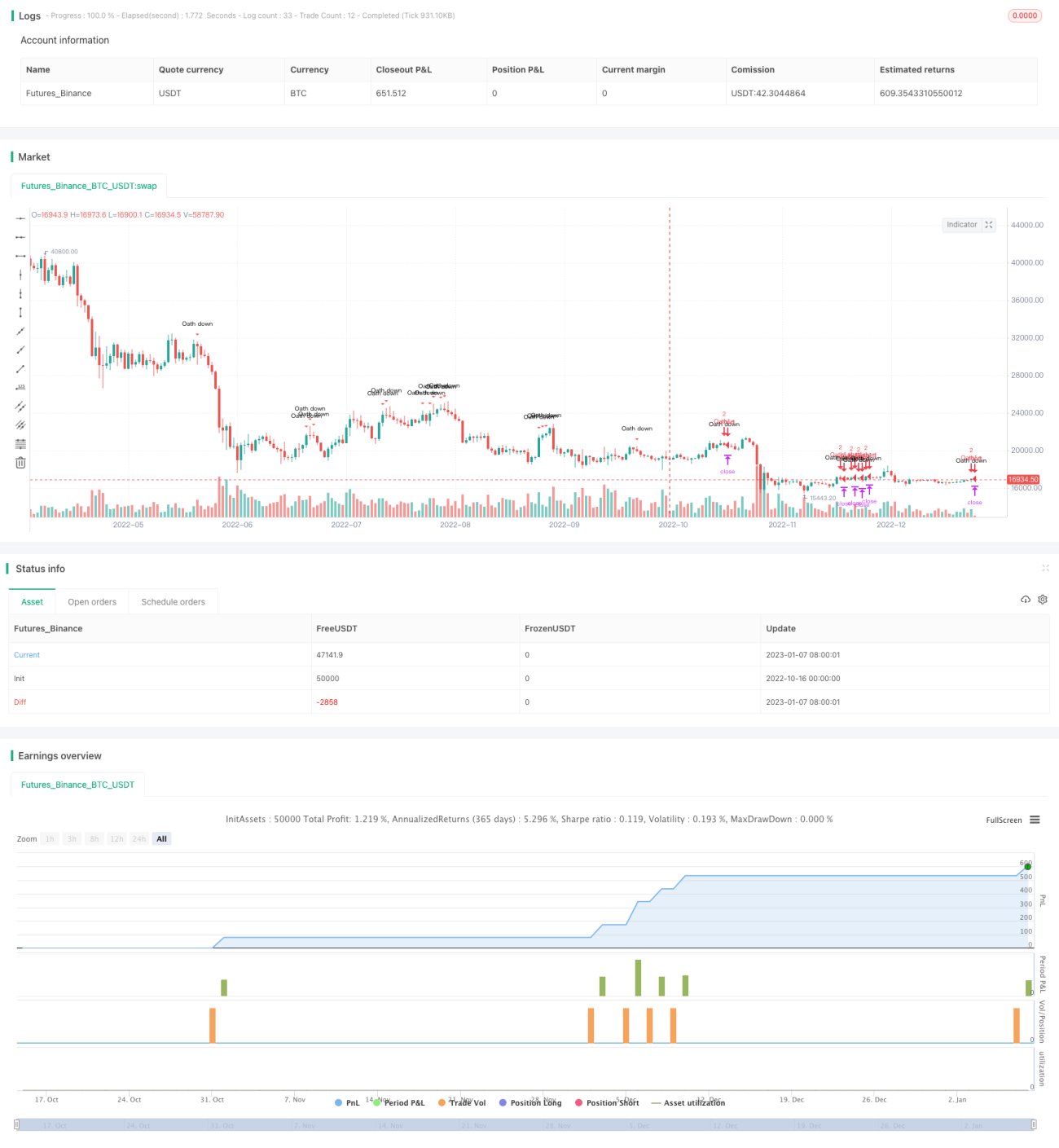
Le système de point de basculement de la tendance est une stratégie de suivi de la tendance qui utilise les moyennes mobiles, l’indicateur CCI et l’indicateur de tendance supérieure pour identifier la tendance et entrer en jeu lors d’un rebond. Il peut confirmer la direction de la tendance et fournir un signal d’entrée lors d’un rebond.

Principe de stratégie

La stratégie utilise une EMA de 21 cycles comme moyenne mobile à court terme et une EMA de 55 cycles comme moyenne mobile à long terme. Une EMA de 21 jours au-dessus de l’EMA de 55 jours indique qu’elle est actuellement en tendance à la hausse et une EMA de 21 jours en dessous de l’EMA de 55 jours indique qu’elle est actuellement en tendance à la baisse.

L’indicateur CCI peut indiquer si le prix a atteint un niveau extrême. Lorsque le CCI atteint les 100 ou -100 par défaut, c’est un signal de niveau un, 140/-140 est un signal de niveau deux, 180/-180 est un signal de niveau trois. Cela indique qu’il est actuellement susceptible d’être en survente ou en survente.

L’indicateur de super-tendance permet de déterminer la direction d’une tendance spécifique. Il combine l’ampleur moyenne des fluctuations réelles pour déterminer les points d’arrêt et d’entrée de la tendance haussière et de la tendance baissière.

Il est possible de faire une entrée en bourse lorsque l’EMA du 21 est au-dessus de l’EMA du 55 et que le CCI atteint un niveau bas (indiquant qu’il est actuellement en zone de survente). Il est possible de faire une entrée en bourse vide lorsque l’EMA du 21 est en dessous de l’EMA du 55 et que le CCI atteint un niveau élevé (indiquant qu’il est actuellement en zone de survente).

Analyse des avantages

Cette stratégie, combinant plusieurs indicateurs pour juger de la tendance et des situations de survente, permet de filtrer efficacement les fausses ruptures. L’utilisation d’un stop-loss fixe permet d’obtenir un rapport de retour sur risque stable.

Analyse des risques

La stratégie doit être optimisée pour les paramètres des variétés de négociation, car les paramètres de différentes variétés peuvent affecter l’efficacité de la stratégie. Les paramètres de stop-loss sont assez grossiers et ne peuvent pas être ajustés pour différents marchés. Les stop-loss fixes ne peuvent pas être ajustés en fonction de la volatilité du marché.

Direction d’optimisation

Vous pouvez tester différents types de paramètres de trading, optimiser le cycle de la moyenne mobile, le cycle d’ATR, le multiplicateur d’ATR, etc. Vous pouvez envisager de modifier le stop loss en stop ATR ou en trailing stop pour vous adapter à la fluctuation du marché. Vous pouvez tester le stop loss en stop oscillant et définir un profit cible en fonction de la valeur de l’ATR.

Résumer

Le système de point de basculement des chocs de tendance combine les moyennes mobiles, les indicateurs CCI et les super tendances pour identifier la direction de la tendance et les cas de survente et de survente pour entrer en jeu lors d’un retournement de tendance. Il présente une stabilité et un taux de victoire plus élevés, mais nécessite une optimisation supplémentaire des mécanismes d’arrêt-perte, d’arrêt-arrêt et de jugement de la tendance afin que les paramètres de la stratégie s’adaptent à différentes variétés et conditions de marché.

Code source de la stratégie
/*backtest
start: 2022-10-16 00:00:00
end: 2023-01-08 00:00:00
period: 1d
basePeriod: 1h
exchanges: [{"eid":"Futures_Binance","currency":"BTC_USDT"}]
*/

// This source code is subject to the terms of the Mozilla Public License 2.0 at https://mozilla.org/MPL/2.0/
// © greenmask9

//@version=4
strategy("Oath", overlay=true)

// 21 EMA
emalength = input(21, title="Short EMA")
emashort = ema(close, emalength)

// 55 EMA
emalength2 = input(55, title="Long EMA")
ema = ema(close, emalength2)

//CCI calculation and inputs
lengthcci = input(20, minval=1, title="Overbought/sold detector period")
src = input(close, title="Overbought/sold detector source")
ma = sma(src, lengthcci)
ccivalue = (src - ma) / (0.015 * dev(src, lengthcci))


//CCI plotting
ccioverbought = input(defval=100, title="Overbought level 1")
ccioverbought2 = input(defval=140, title="Overbought level 2")
ccioverbought3 = input(defval=180, title="Overbought level 3")

ccioversold = input(defval=-100, title="Oversold level 1")
ccioversold2 = input(defval=-140, title="Oversold level 2")
ccioversold3 = input(defval=-180, title="Oversold level 3")

//cciOB = (ccivalue >= ccioverbought and ccivalue < ccioverbought2)
//cciOS = (ccivalue <= ccioversold and ccivalue > ccioversold2)

//cciOB2 = (ccivalue >= ccioverbought2 and ccivalue < ccioverbought3)
//cciOS2 = (ccivalue <= ccioversold and ccivalue > ccioversold3)

//cciOB3 = (ccivalue >= ccioverbought3)
//cciOS3 = (ccivalue <= ccioversold3)

//Supertrend

length = input(title="ATR Period", type=input.integer, defval=55)
mult = input(title="ATR Multiplier", type=input.float, step=0.1, defval=5.0)
wicks = input(title="Take Wicks into Account ?", type=input.bool, defval=true)
illuminate = input(title="Illuminate Trend", type=input.bool, defval=false)

atr = mult * atr(length)

longStop = hl2 - atr
longStopPrev = nz(longStop[1], longStop)
longStop := (wicks ? low[1] : close[1]) > longStopPrev ? max(longStop, longStopPrev) : longStop

shortStop = hl2 + atr
shortStopPrev = nz(shortStop[1], shortStop)
shortStop := (wicks ? high[1] : close[1]) < shortStopPrev ? min(shortStop, shortStopPrev) : shortStop

dir = 1
dir := nz(dir[1], dir)
dir := dir == -1 and (wicks ? high : close) > shortStopPrev ? 1 : dir == 1 and (wicks ? low : close) < longStopPrev ? -1 : dir

//entries
uptrend = emashort>ema and dir == 1
upsignal = ccivalue<=ccioversold and ccivalue>ccioversold2
upsignal2 = ccivalue<=ccioversold2 and ccivalue>ccioversold3
upsignal3 = ccivalue<=ccioversold3
downtrend = emashort<ema and dir == -1
downsignal = ccivalue>=ccioverbought and ccivalue<ccioverbought2
downsignal2 = ccivalue>=ccioverbought2 and ccivalue<ccioverbought3
downsignal3 = ccivalue>=ccioverbought3

//adapts to the current bar, I need to save the bars number when the condition for buy was true, static number is spread
spread = input (0.00020, title="Spread")
upstoploss = longStop - spread
downstoploss = shortStop + spread
strategy.initial_capital = 50000
ordersize=floor(strategy.initial_capital/close)
testlong = input(title="Test longs", type=input.bool, defval=true)
testshort = input(title="Test shorts", type=input.bool, defval=true)
//new
degree = input(title="Test level 1 overbought/sold levels", type=input.bool, defval=true)
degree2 = input(title="Test level 2 overbought/sold levels", type=input.bool, defval=false)
degree3 = input(title="Test level 3 overbought/sold levels", type=input.bool, defval=false)

statictarget = input(title="Use static target", type=input.bool, defval=true)
statictargetvalue = input(title="Static target in pips", type=input.integer, defval=400)

//timetrade = input(title="Open trades only withing specified time", type=input.bool, defval=true)
//timtrade = input()

//přidat možnost TP podle ATR a sl podle ATR
buy1 = uptrend and upsignal and strategy.opentrades==0 and testlong and degree
x1 = barssince (buy1)
if (buy1)
//bodlo by zakázat atrtarget v tomto případě
    if (statictarget)
        strategy.entry("Oath1", strategy.long, ordersize)
        strategy.exit( "Oath1 Close", from_entry="Oath1" , profit=statictargetvalue,stop=upstoploss[x1])
 
buy2 = uptrend and upsignal2 and strategy.opentrades==0 and testlong and degree2
x2 = barssince (buy2)
if (buy2)
//bodlo by zakázat atrtarget v tomto případě
    if (statictarget)
        strategy.entry("Oath2", strategy.long, ordersize)
        strategy.exit( "Oath2 Close", from_entry="Oath2" , profit=statictargetvalue,stop=upstoploss[x2])
  
buy3 = uptrend and upsignal3 and strategy.opentrades==0 and testlong and degree3
x3 = barssince (buy3)
if (buy3)
//bodlo by zakázat atrtarget v tomto případě
    if (statictarget)
        strategy.entry("Oath3", strategy.long, ordersize)
        strategy.exit( "Oath3 Close", from_entry="Oath3" , profit=statictargetvalue,stop=upstoploss[x3])

sell1 = downtrend and downsignal and strategy.opentrades==0 and testshort and degree
y1 = barssince (sell1)
if (sell1)
    if (statictarget)
        strategy.entry("Oath1.s", strategy.short, ordersize)
        strategy.exit( "Oath1 Close", from_entry="Oath1.s" , profit=statictargetvalue,stop=downstoploss[y1])

sell2 = downtrend and downsignal2 and strategy.opentrades==0 and testshort and degree2
y2 = barssince (sell2)
if (sell2)
    if (statictarget)
        strategy.entry("Oath2.s", strategy.short, ordersize)
        strategy.exit( "Oath2 Close", from_entry="Oath2.s" , profit=statictargetvalue,stop=downstoploss[y2])

sell3 = downtrend and downsignal3 and strategy.opentrades==0 and testshort and degree3
y3 = barssince (sell3)
if (sell3)
    if (statictarget)
        strategy.entry("Oath3.s", strategy.short, ordersize)
        strategy.exit( "Oath3 Close", from_entry="Oath3.s" , profit=statictargetvalue,stop=downstoploss[y3])

plotshape(uptrend and upsignal and degree, location=location.belowbar, color=color.green, transp=0, style=shape.triangleup, size=size.tiny, text="Oath up")
plotshape(downtrend and downsignal and degree, location=location.abovebar, color=color.red, transp=0, style=shape.triangledown, size=size.tiny, text="Oath down")
plotshape(uptrend and upsignal2 and degree2, location=location.belowbar, color=color.green, transp=0, style=shape.triangleup, size=size.tiny, text="Oath up+")
plotshape(downtrend and downsignal2 and degree2, location=location.abovebar, color=color.red, transp=0, style=shape.triangledown, size=size.tiny, text="Oath down+")
plotshape(uptrend and upsignal3 and degree3, location=location.belowbar, color=color.green, transp=0, style=shape.triangleup, size=size.tiny, text="Oath up++")
plotshape(downtrend and downsignal3 and degree3, location=location.abovebar, color=color.red, transp=0, style=shape.triangledown, size=size.tiny, text="Oath down++")