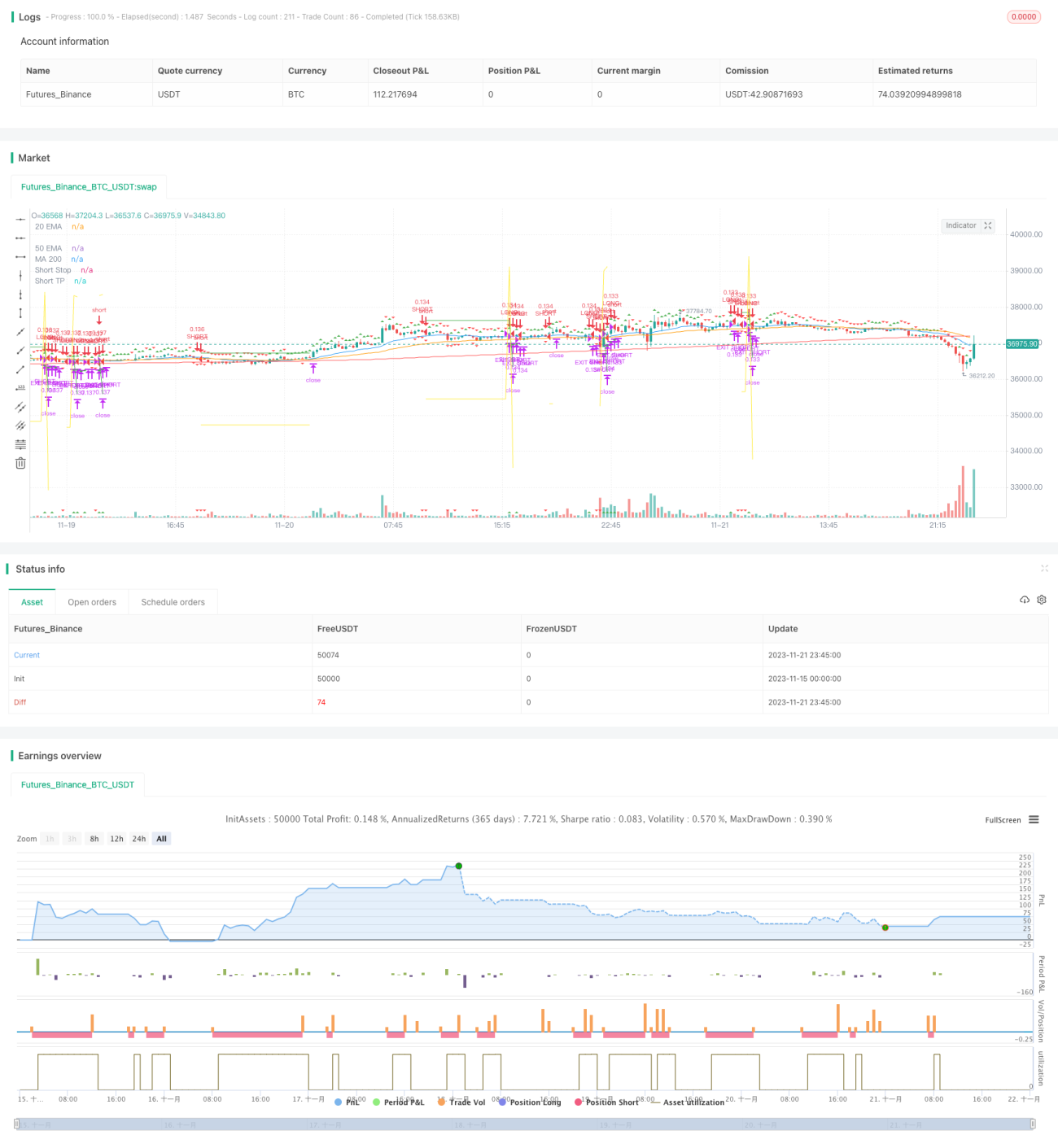
La stratégie utilise une combinaison de deux périodes et d’indicateurs de dynamique pour s’adapter aux arrêts et pertes. Les périodes principales surveillent la direction de la tendance et les périodes secondaires sont utilisées pour confirmer les signaux.
Le cadre de temps principal utilise l’indicateur de régression linéaire Sqqueeze Momentum (SQM) pour déterminer la tendance, le cadre de temps auxiliaire utilise l’indicateur SQM pour filtrer les faux signaux combinés EMA.
Lorsque le SQM de la carte principale est en hausse et que le SQM de la carte secondaire est en hausse, faites plus; lorsque le SQM de la carte principale est en baisse et que le SQM de la carte secondaire est en baisse, faites moins.
Après l’entrée, définissez un stop-loss et un stop-loss initiaux en fonction des paramètres d’entrée. Lorsque le prix atteint le stop-loss, mettez à jour le stop-loss et le stop-loss.
Le double cadre de temps filtre les faux signaux pour assurer l’exactitude des signaux.
L’indicateur SQM détermine la direction de la tendance et évite d’être dérangé par le bruit du marché.
Les mécanismes d’arrêt et de perte automatiques permettent de bloquer les bénéfices et de contrôler efficacement les risques.
Les paramètres de l’indicateur SQM sont mal réglés et risquent de manquer le point de basculement de la tendance, entraînant des pertes.
Le choix d’un cadre temporel d’aide au graphique est inadéquat, il ne permet pas de filtrer efficacement le bruit et génère des transactions erronées.
La marge de stop loss est trop élevée et les pertes individuelles peuvent être considérables.
Les paramètres de l’indicateur SQM doivent être adaptés aux différents marchés pour assurer leur sensibilité.
Les cadres de temps des diagrammes auxiliaires nécessitent également de tester différentes périodes pour voir quelle période est la plus efficace pour filtrer.
La marge de stop loss peut être réglée sur une marge de fluctuation plutôt que sur une valeur fixe, ce qui permet de s’adapter à la volatilité du marché.
Cette stratégie est très pratique dans l’ensemble, la double période de temps avec l’indicateur de dynamique de juger de la tendance, et d’utiliser l’adaptation de l’arrêt-stop-perte pour réaliser des profits stables. En optimisant les paramètres de l’indicateur SQM, l’aide de la carte de cycle et de l’amplitude de l’arrêt, la stratégie peut être plus efficace, il vaut la peine d’appliquer et d’optimiser dans le terrain.
/*backtest
start: 2023-11-15 00:00:00
end: 2023-11-22 00:00:00
period: 15m
basePeriod: 5m
exchanges: [{"eid":"Futures_Binance","currency":"BTC_USDT"}]
*/
//@version=4
strategy("SQZ Multiframe Strategy", overlay=true, default_qty_type=strategy.percent_of_equity, default_qty_value=10)
fast_ema_len = input(11, minval=5, title="Fast EMA")
slow_ema_len = input(34, minval=20, title="Slow EMA")
sqm_lengthKC = input(20, title="SQM KC Length")
kauf_period = input(20, title="Kauf Period")
kauf_mult = input(2,title="Kauf Mult factor")
min_profit_sl = input(5.0, minval=1, maxval=100, title="Min profit to start moving SL [%]")
longest_sl = input(10, minval=1, maxval=100, title="Maximum possible of SL [%]")
sl_step = input(0.5, minval=0.0, maxval=1.0, title="Take profit factor")
// ADMF
CMF_length = input(11, minval=1, title="CMF length") // EMA27 = SMMA/RMA14 ~ lunar month
show_plots = input(true, title="Show plots")
lower_resolution = timeframe.period=='1'?'5':timeframe.period=='5'?'15':timeframe.period=='15'?'30':timeframe.period=='30'?'60':timeframe.period=='60'?'240':timeframe.period=='240'?'D':timeframe.period=='D'?'W':'M'
higher_resolution = timeframe.period=='5'?'1':timeframe.period=='15'?'5':timeframe.period=='30'?'15':timeframe.period=='60'?'30':timeframe.period=='240'?'60':timeframe.period=='D'?'240':timeframe.period=='W'?'D':'W'
// Calculate Squeeze Momentum
sqm_val = linreg(close - avg(avg(highest(high, sqm_lengthKC), lowest(low, sqm_lengthKC)),sma(close,sqm_lengthKC)), sqm_lengthKC,0)
sqm_val_high = security(syminfo.tickerid, higher_resolution, linreg(close - avg(avg(highest(high, sqm_lengthKC), lowest(low, sqm_lengthKC)),sma(close,sqm_lengthKC)), sqm_lengthKC,0), lookahead=barmerge.lookahead_on)
sqm_val_low = security(syminfo.tickerid, lower_resolution, linreg(close - avg(avg(highest(high, sqm_lengthKC), lowest(low, sqm_lengthKC)),sma(close,sqm_lengthKC)), sqm_lengthKC,0), gaps=barmerge.gaps_off, lookahead=barmerge.lookahead_on)
// Emas
high_close = security(syminfo.tickerid, higher_resolution, close, lookahead=barmerge.lookahead_on)
high_fast_ema = security(syminfo.tickerid, higher_resolution, ema(close, fast_ema_len), lookahead=barmerge.lookahead_on)
high_slow_ema = security(syminfo.tickerid, higher_resolution, ema(close, slow_ema_len), lookahead=barmerge.lookahead_on)
//low_fast_ema = security(syminfo.tickerid, lower_resolution, ema(close, fast_ema_len), lookahead=barmerge.lookahead_on)
//low_slow_ema = security(syminfo.tickerid, lower_resolution, ema(close, slow_ema_len), lookahead=barmerge.lookahead_on)
// CMF
ad = close==high and close==low or high==low ? 0 : ((2*close-low-high)/(high-low))*volume
money_flow = sum(ad, CMF_length) / sum(volume, CMF_length)
// Entry conditions
low_condition_long = (sqm_val_low > sqm_val_low[1])
low_condition_short = (sqm_val_low < sqm_val_low[1])
money_flow_min = (money_flow[4] > money_flow[3]) and (money_flow[3] > money_flow[2]) and (money_flow[2] < money_flow[1]) and (money_flow[1] < money_flow)
money_flow_max = (money_flow[4] < money_flow[3]) and (money_flow[3] < money_flow[2]) and (money_flow[2] > money_flow[1]) and (money_flow[1] > money_flow)
condition_long = ((sqm_val > sqm_val[1])) and (money_flow_min or money_flow_min[1] or money_flow_min[2] or money_flow_min[3]) and lowest(sqm_val, 5) < 0
condition_short = ((sqm_val < sqm_val[1])) and (money_flow_max or money_flow_max[1] or money_flow_max[2] or money_flow_max[3]) and highest(sqm_val, 5) > 0
high_condition_long = true//high_close > high_fast_ema and high_close > high_slow_ema //(high_fast_ema > high_slow_ema) //and (sqm_val_low > sqm_val_low[1])
high_condition_short = true//high_close < high_fast_ema and high_close < high_slow_ema//(high_fast_ema < high_slow_ema) //and (sqm_val_low < sqm_val_low[1])
enter_long = low_condition_long and condition_long and high_condition_long
enter_short = low_condition_short and condition_short and high_condition_short
// Stop conditions
var current_target_price = 0.0
var current_sl_price = 0.0 // Price limit to take profit
var current_target_per = 0.0
var current_profit_per = 0.0
set_targets(isLong, min_profit, current_target_per, current_profit_per) =>
target = 0.0
sl = 0.0
if isLong
target := close * (1.0 + current_target_per)
sl := close * (1.0 - (longest_sl/100.0)) // Longest SL
else
target := close * (1.0 - current_target_per)
sl := close * (1.0 + (longest_sl/100.0)) // Longest SL
[target, sl]
target_reached(isLong, min_profit, current_target_per, current_profit_per) =>
target = 0.0
sl = 0.0
profit_per = 0.0
target_per = 0.0
if current_profit_per == 0
profit_per := (min_profit*sl_step) / 100.0
else
profit_per := current_profit_per + ((min_profit*sl_step) / 100.0)
target_per := current_target_per + (min_profit / 100.0)
if isLong
target := strategy.position_avg_price * (1.0 + target_per)
sl := strategy.position_avg_price * (1.0 + profit_per)
else
target := strategy.position_avg_price * (1.0 - target_per)
sl := strategy.position_avg_price * (1.0 - profit_per)
[target, sl, profit_per, target_per]
hl_diff = sma(high - low, kauf_period)
stop_condition_long = 0.0
new_stop_condition_long = low - (hl_diff * kauf_mult)
if (strategy.position_size > 0)
if (close > current_target_price)
[target, sl, profit_per, target_per] = target_reached(true, min_profit_sl, current_target_per, current_profit_per)
current_target_price := target
current_sl_price := sl
current_profit_per := profit_per
current_target_per := target_per
stop_condition_long := max(stop_condition_long[1], current_sl_price)
else
stop_condition_long := new_stop_condition_long
stop_condition_short = 99999999.9
new_stop_condition_short = high + (hl_diff * kauf_mult)
if (strategy.position_size < 0)
if (close < current_target_price)
[target, sl, profit_per, target_per] = target_reached(false, min_profit_sl, current_target_per, current_profit_per)
current_target_price := target
current_sl_price := sl
current_profit_per := profit_per
current_target_per := target_per
stop_condition_short := min(stop_condition_short[1], current_sl_price)
else
stop_condition_short := new_stop_condition_short
// Submit entry orders
if (enter_long and (strategy.position_size <= 0))
if (strategy.position_size < 0)
strategy.close(id="SHORT")
current_target_per := (min_profit_sl / 100.0)
current_profit_per := 0.0
[target, sl] = set_targets(true, min_profit_sl, current_target_per, current_profit_per)
current_target_price := target
current_sl_price := sl
strategy.entry(id="LONG", long=true)
// if show_plots
// label.new(bar_index, high, text=tostring("LONG\nSL: ") + tostring(stop_condition_long), style=label.style_labeldown, color=color.green)
if (enter_short and (strategy.position_size >= 0))
if (strategy.position_size > 0)
strategy.close(id="LONG")
current_target_per := (min_profit_sl / 100.0)
current_profit_per := 0.0
[target, sl] = set_targets(false, min_profit_sl, current_target_per, current_profit_per)
current_target_price := target
current_sl_price := sl
strategy.entry(id="SHORT", long=false)
// if show_plots
// label.new(bar_index, high, text=tostring("SHORT\nSL: ") + tostring(stop_condition_short), style=label.style_labeldown, color=color.red)
if (strategy.position_size > 0)
strategy.exit(id="EXIT LONG", stop=stop_condition_long)
if (strategy.position_size < 0)
strategy.exit(id="EXIT SHORT", stop=stop_condition_short)
// Plot anchor trend
plotshape(low_condition_long, style=shape.triangleup,
location=location.abovebar, color=color.green)
plotshape(low_condition_short, style=shape.triangledown,
location=location.abovebar, color=color.red)
plotshape(condition_long, style=shape.triangleup,
location=location.belowbar, color=color.green)
plotshape(condition_short, style=shape.triangledown,
location=location.belowbar, color=color.red)
//plotshape((close < profit_target_short) ? profit_target_short : na, style=shape.triangledown,
// location=location.belowbar, color=color.yellow)
plotshape(enter_long, style=shape.triangleup,
location=location.bottom, color=color.green)
plotshape(enter_short, style=shape.triangledown,
location=location.bottom, color=color.red)
// Plot emas
plot(ema(close, 20), color=color.blue, title="20 EMA")
plot(ema(close, 50), color=color.orange, title="50 EMA")
plot(sma(close, 200), color=color.red, title="MA 200")
// Plot stop loss values for confirmation
plot(series=(strategy.position_size > 0) and show_plots ? stop_condition_long : na,
color=color.green, style=plot.style_linebr,
title="Long Stop")
plot(series=(strategy.position_size < 0) and show_plots ? stop_condition_short : na,
color=color.green, style=plot.style_linebr,
title="Short Stop")
plot(series=(strategy.position_size < 0) and show_plots ? current_target_price : na,
color=color.yellow, style=plot.style_linebr,
title="Short TP")
plot(series=(strategy.position_size > 0) and show_plots ? current_target_price : na,
color=color.yellow, style=plot.style_linebr,
title="Long TP")
//plot(series=(strategy.position_size < 0) ? profit_sl_short : na,
// color=color.gray, style=plot.style_linebr,
// title="Short Stop")