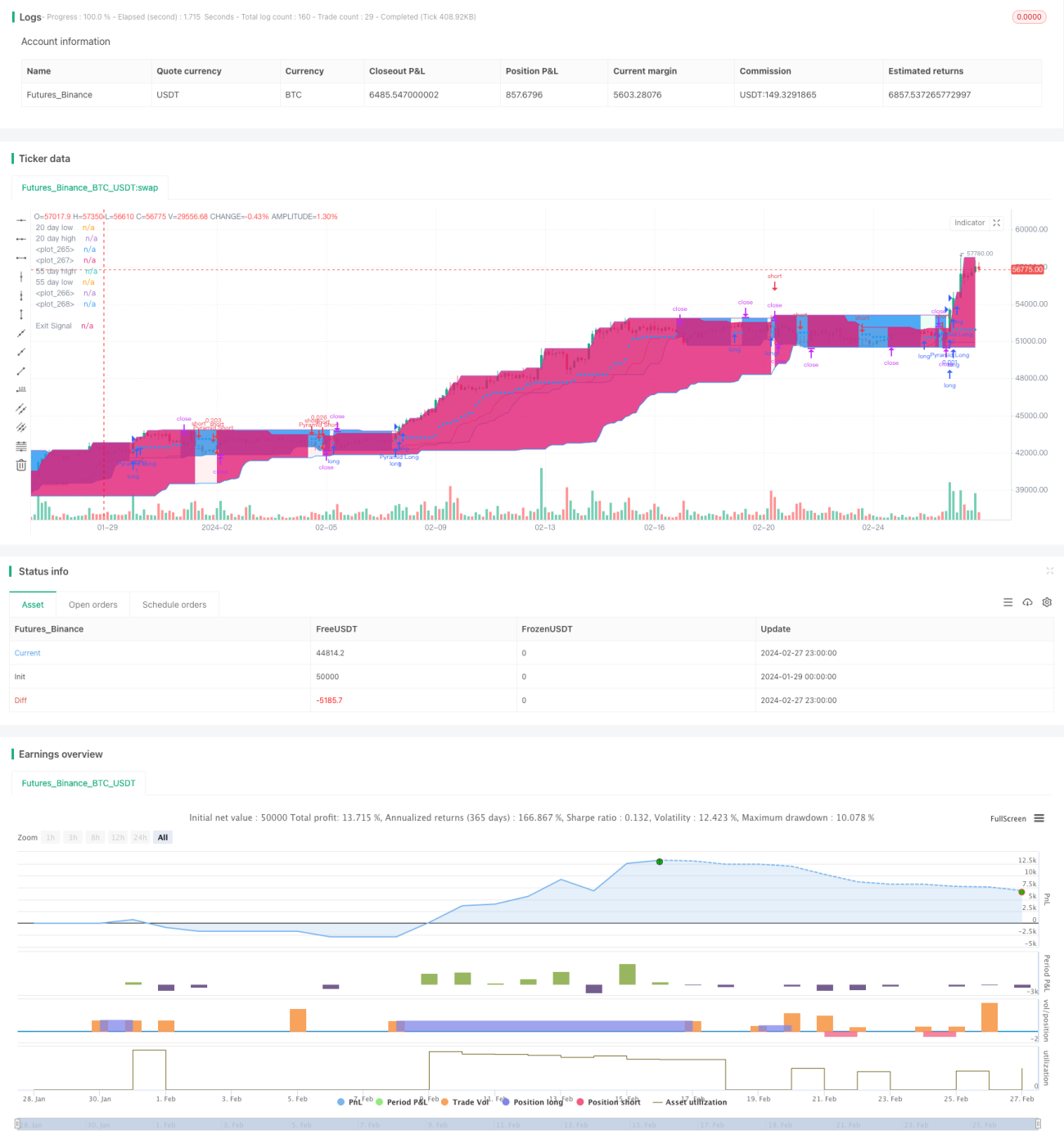
La stratégie de trading de l’écureuil est une stratégie de suivi de tendance améliorée et optimisée basée sur la célèbre stratégie de trading de l’écureuil. Cette stratégie utilise les signaux de négociation formés par les moyennes mobiles doubles pour réaliser des transactions de suivi de tendance à faible risque. Ses règles d’entrée et de sortie standardisées permettent de contrôler efficacement les risques de négociation et de réaliser une croissance stable des fonds.
La stratégie de trading au gré du vent consiste à calculer les hauts de 20 jours, les bas de 20 jours, les hauts de 55 jours et les bas de 55 jours, en combinant l’indicateur ATR pour définir des objectifs de stop-loss et de profit. Elle génère un signal long lorsque le prix dépasse le haut de 20 jours; génère un signal vide lorsque le prix tombe au-dessus du bas de 20 jours.
Une fois sur le marché, la stratégie utilise les valeurs de l’indicateur ATR pour définir des objectifs de stop-loss et de mise en position. Arrêtez-vous activement lorsque les pertes atteignent le stop-loss; augmentez la position lorsque les bénéfices atteignent le but de mise en position. Cela permet de contrôler le risque d’une seule transaction tout en maximisant le potentiel de profit dans une situation de tendance.
Le plus grand avantage d’une stratégie de trading agile réside dans son excellente capacité à contrôler les risques. Des règles d’entrée et de sortie standardisées permettent de contrôler efficacement les pertes d’une seule transaction.
En outre, la stratégie de trading au gré de l’ATR utilise l’indicateur ATR pour définir dynamiquement les arrêts de perte, ce qui permet aux arrêts de perte de s’adapter automatiquement aux changements de la volatilité du marché. Cela garantit que les arrêts de perte ne sont ni trop souples pour causer des pertes importantes, ni trop serrés lorsqu’ils sont déclenchés par les fluctuations normales du marché.
Enfin, le mécanisme d’hypothèque de la stratégie lui permet de saisir pleinement les bénéfices de la tendance.
Le risque principal de la stratégie de trading libre réside dans l’incapacité d’exploiter efficacement les conditions de choc pour tirer profit. Lorsque le marché est en état de choc prolongé, les lignes de stop-loss peuvent être fréquemment déclenchées et entraîner des pertes.
En outre, la stratégie s’appuie trop sur les indicateurs techniques et néglige l’analyse fondamentale, ce qui risque de l’empêcher d’identifier les changements politiques majeurs, ce qui entraînerait des pertes inutiles.
Les stratégies de négociation en libre-échange peuvent être optimisées dans les domaines suivants:
Combiner les indicateurs de volatilité pour ajuster la sensibilité du mécanisme de saut et augmenter la fréquence des transactions dans des conditions de choc
Ajout d’un signal de base comme filtre pour éviter les pannes soudaines
Optimisation des paramètres ATR afin de rendre la ligne de stop plus adaptée aux fluctuations réelles
Indicateur de quantité d’énergie combinée pour éviter une inversion de nullité après une perte
Dans l’ensemble, les stratégies de trading de tournesol améliorent la rentabilité et la capacité de contrôle des risques des stratégies de trading de tournesol originales, une stratégie d’algorithmes à faible risque adaptée au suivi des tendances. Avec une optimisation supplémentaire, la stratégie peut devenir une partie importante de la construction d’un portefeuille de profits stables à long terme.
/*backtest
start: 2024-01-29 00:00:00
end: 2024-02-28 00:00:00
period: 3h
basePeriod: 15m
exchanges: [{"eid":"Futures_Binance","currency":"BTC_USDT"}]
*/
//@version=5
strategy("TURTLE STRATEGY", precision=2, overlay=true, initial_capital=1000, commission_type=strategy.commission.percent, commission_value=0.18, slippage=3, pyramiding=5, close_entries_rule="ANY", margin_long=100, margin_short=100)
//------------------------------TOOL TIPS--------------------------------//
t1 = "Percentage of the account the trader is willing to lose. This percentage is used to define the position size based on previous gains or losses. Turtle traders default to 1%."
t2 = "ATR Length"
t3 = "ATR Multiplier to fix the Stop Loss"
t4 = "Pyramiding : ATR Multiplier to set a profit target to increase position size"
t5 = "System 1 enter long if there is a new high after this selected period of time"
t6 = "System 2 enter long if there is a new high after this selected period of time"
t7 = "Exit Long from system 1 if there is a new low after this selected period of time"
t8 = "Exit Long from system 2 if there is a new low after this selected period of time"
t9 = "System 1 enter short if there is a new low after this selected period of time"
t10 = "System 2 enter short if there is a new low after this selected period of time"
t11 = "Exit short from system 1 if there is a new high after this selected period of time"
t12 = "Exit short from system 2 if there is a new high after this selected period of time"
//----------------------------------------FUNCTIONS---------------------------------------//
//@function Displays text passed to `txt` when called.
debugLabel(txt, color) =>
label.new(bar_index, high, text=txt, color=color, style=label.style_label_lower_right, textcolor=color.black, size=size.small)
//@function which looks if the close date of the current bar falls inside the date range
inBacktestPeriod(start, end) => (time >= start) and (time <= end)
//---------------------------------------USER INPUTS--------------------------------------//
//Risk Management and turtle system input
percentage_to_risk = input.float(1, "Risk % of capital", maxval=100, minval=0, group="Turtle Parameters", tooltip=t1)
atr_period = input.int(20, "ATR period", minval=1, group="Turtle Parameters", tooltip=t2)
stop_N_multiplier = input.float(1.5, "Stop ATR", minval=0.1, group="Turtle Parameters", tooltip=t3)
pyramid_profit = input.float(0.5, "Pyramid Profit", minval=0.01, group="Turtle Parameters", tooltip=t4)
S1_long = input.int(20, "S1 Long", minval=1, group="Turtle Parameters", tooltip=t5)
S2_long = input.int(55, "S2 Long", minval=1, group="Turtle Parameters", tooltip=t6)
S1_long_exit = input.int(10, "S1 Long Exit", minval=1, group="Turtle Parameters", tooltip=t7)
S2_long_exit = input.int(20, "S2 Long Exit", minval=1, group="Turtle Parameters", tooltip=t8)
S1_short = input.int(15, "S1 Short", minval=1, group="Turtle Parameters", tooltip=t9)
S2_short = input.int(55, "S2 Short", minval=1, group="Turtle Parameters", tooltip=t10)
S1_short_exit = input.int(7, "S1 Short Exit", minval=1, group="Turtle Parameters", tooltip=t11)
S2_short_exit = input.int(20, "S2 Short Exit", minval=1, group="Turtle Parameters", tooltip=t12)
//Backtesting period
startDate = input(title="Start Date", defval=timestamp("1 Jan 2020 00:00:00"), group="Backtesting Period")
endDate = input(title="End Date", defval=timestamp("1 July 2034 00:00:00"), group="Backtesting Period")
//----------------------------------VARIABLES INITIALISATION-----------------------------//
//Turtle variables
atr = ta.atr(atr_period)
var float buy_price_long = na
var float buy_price_short = na
var float stop_loss_long = na
var float stop_loss_short = na
float account = na
//Entry variables
day_high_syst1 = ta.highest(high, S1_long)
day_low_syst1 = ta.lowest(low, S1_short)
day_high_syst2 = ta.highest(high, S2_long)
day_low_syst2 = ta.lowest(low, S2_short)
var bool skip = false
var bool unskip_buffer_long = false
var bool unskip_buffer_short = false
//Exit variables
exit_long_syst1 = ta.lowest(low, S1_long_exit)
exit_short_syst1 = ta.highest(high, S1_short_exit)
exit_long_syst2 = ta.lowest(low, S2_long_exit)
exit_short_syst2 = ta.highest(high, S2_short_exit)
float exit_signal = na
//Backtesting period
bool inRange = na
//------------------------------CHECKING SOME CONDITIONS ON EACH SCRIPT EXECUTION-------------------------------//
//Checking if the date belong to the range
inRange := true
strategy.initial_capital = 50000
//Checking if the current equity is higher or lower than the initial capital to adjusted position size
if strategy.equity - strategy.openprofit < strategy.initial_capital
account := (strategy.equity-strategy.openprofit)*(strategy.equity-strategy.openprofit)/strategy.initial_capital
else
account := strategy.equity - strategy.openprofit
//Checking if we close all trades in case where we exit the backtesting period
if strategy.position_size!=0 and not inRange
strategy.close_all()
debugLabel("END OF BACKTESTING PERIOD : we close the trade", color=color.rgb(116, 116, 116))
//--------------------------------------SKIP MANAGEMENT------------------------------------//
//Checking if a long signal has been skiped and system2 is not triggered
if skip and high>day_high_syst1[1] and high<day_high_syst2[1]
unskip_buffer_long := true
//Checking if a short signal has been skiped and system2 is not triggered
if skip and low<day_low_syst1[1] and low>day_low_syst2[1]
unskip_buffer_short := true
//Checking if current high is lower than previous 20_day_high after a skiped long signal to set skip to false
if unskip_buffer_long
if high<day_high_syst1[1]
skip := false
unskip_buffer_long := false
//Checking if current low is higher than previous 20_day_low after a skiped short signal to set skip to false
if unskip_buffer_short
if low>day_low_syst1[1]
skip := false
unskip_buffer_short := false
//Checking if we have an open position to reset skip and unskip buffers
if strategy.position_size!=0 and skip
skip := false
unskip_buffer_long := false
unskip_buffer_short := false
//--------------------------------------------ENTRY CONDITIONS--------------------------------------------------//
//We calculate the position size based on turtle calculation
unit = (percentage_to_risk/100)*account/atr*syminfo.pointvalue
//Long order for system 1
if not skip and not (strategy.position_size>0) and inRange and unit>0
strategy.cancel("Long Syst 2")
//We check that position size doesn't exceed available equity
if unit*day_high_syst1>account
unit := account/day_high_syst1
stop_loss_long := day_high_syst1 - stop_N_multiplier*atr
//We adjust SL if it's greater than 10% of trade value and fix it to 10%
if stop_loss_long < day_high_syst1*0.9
stop_loss_long := day_high_syst1*0.9
strategy.order("Long Syst 1", strategy.long, unit, stop=day_high_syst1)
buy_price_long := day_high_syst1
//Long order for system 2
if skip and not (strategy.position_size>0) and inRange and unit>0
//We check that position size doesn't exceed available equity
if unit*day_high_syst2>account
unit := account/day_high_syst2
stop_loss_long := day_high_syst2 - stop_N_multiplier*atr
//We adjust SL if it's greater than 10% of trade value and fix it to 10%
if stop_loss_long < day_high_syst2*0.9
stop_loss_long := day_high_syst2*0.9
strategy.order("Long Syst 2", strategy.long, unit, stop=day_high_syst2)
buy_price_long := day_high_syst2
//Short order for system 1
if not skip and not (strategy.position_size<0) and inRange and unit>0
strategy.cancel("Short Syst 2")
//We check that position size doesn't exceed available equity
if unit*day_low_syst1>account
unit := account/day_low_syst1
stop_loss_short := day_low_syst1 + stop_N_multiplier*atr
//We adjust SL if it's greater than 10% of trade value and fix it to 10%
if stop_loss_short > day_low_syst1*1.1
stop_loss_short := day_low_syst1*1.1
strategy.order("Short Syst 1", strategy.short, unit, stop=day_low_syst1)
buy_price_short := day_low_syst1
//Short order for system 2
if skip and not (strategy.position_size<0) and inRange and unit>0
//We check that position size doesn't exceed available equity
if unit*day_low_syst2>account
unit := account/day_low_syst2
stop_loss_short := day_low_syst2 + stop_N_multiplier*atr
//We adjust SL if it's greater than 10% of trade value and fix it to 10%
if stop_loss_short > day_low_syst2*1.1
stop_loss_short := day_low_syst2*1.1
strategy.order("Short Syst 2", strategy.short, unit, stop=day_low_syst2)
buy_price_short := day_low_syst2
//-------------------------------PYRAMIDAL------------------------------------//
//Pyramid for long orders
if close > buy_price_long + (pyramid_profit*atr) and strategy.position_size>0
//We calculate the remaining capital
remaining_capital = account - strategy.position_size*strategy.position_avg_price*(1-0.0018)
//We calculate units to add to the long position
units_to_add = (percentage_to_risk/100)*remaining_capital/atr*syminfo.pointvalue
if remaining_capital > units_to_add and units_to_add>0
//We set the new Stop loss
stop_loss_long := stop_loss_long + pyramid_profit*atr
strategy.entry("Pyramid Long", strategy.long, units_to_add)
buy_price_long := close
//Pyramid for short orders
if close < buy_price_short - (pyramid_profit*atr) and strategy.position_size<0
//We calculate the remaining capital
remaining_capital = account + strategy.position_size*strategy.position_avg_price*(1-0.0018)
//We calculate units to add to the short position
units_to_add = (percentage_to_risk/100)*remaining_capital/atr*syminfo.pointvalue
if remaining_capital > units_to_add and units_to_add>0
//We set the new Stop loss
stop_loss_short := stop_loss_short - pyramid_profit*atr
strategy.entry("Pyramid Short", strategy.short, units_to_add)
buy_price_short := close
//----------------------------EXIT ORDERS-------------------------------//
//Checking if exit_long_syst1 is higher than stop_loss_long
if strategy.opentrades.entry_id(0)=="Long Syst 1"
if exit_long_syst1[1] > stop_loss_long
exit_signal := exit_long_syst1[1]
else
exit_signal := stop_loss_long
//Checking if exit_long_syst2 is higher than stop_loss_long
if strategy.opentrades.entry_id(0)=="Long Syst 2"
if exit_long_syst2[1] > stop_loss_long
exit_signal := exit_long_syst2[1]
else
exit_signal := stop_loss_long
//Checking if exit_short_syst1 is lower than stop_loss_short
if strategy.opentrades.entry_id(0)=="Short Syst 1"
if exit_short_syst1[1] < stop_loss_short
exit_signal := exit_short_syst1[1]
else
exit_signal := stop_loss_short
//Checking if exit_short_syst2 is lower than stop_loss_short
if strategy.opentrades.entry_id(0)=="Short Syst 2"
if exit_short_syst2[1] < stop_loss_short
exit_signal := exit_short_syst2[1]
else
exit_signal := stop_loss_short
//If the exit order is configured to close the position at a profit, we set 'skip' to true (we substract commission)
if strategy.position_size*exit_signal>strategy.position_size*strategy.position_avg_price*(1-0.0018)
strategy.cancel("Long Syst 1")
strategy.cancel("Short Syst 1")
skip := true
if strategy.position_size*exit_signal<=strategy.position_size*strategy.position_avg_price*(1-0.0018)
skip := false
//We place stop exit orders
if strategy.position_size > 0
strategy.exit("Exit Long", stop=exit_signal)
if strategy.position_size < 0
strategy.exit("Exit Short", stop=exit_signal)
//------------------------------PLOTTING ELEMENTS-------------------------------//
plotchar(atr, "ATR", "", location.top, color.rgb(131, 5, 83))
//Plotting enter threshold
plot(day_high_syst1[1], "20 day high", color.rgb(118, 217, 159))
plot(day_high_syst2[1], "55 day high", color.rgb(4, 92, 53))
plot(day_low_syst1[1], "20 day low", color.rgb(234, 108, 108))
plot(day_low_syst2[1], "55 day low", color.rgb(149, 17, 17))
//Plotting Exit Signal
plot(exit_signal, "Exit Signal", color.blue, style=plot.style_circles)
//Plotting our position
exit_long_syst2_plot = plot(exit_long_syst2[1], color=na)
day_high_syst2_plot = plot(day_high_syst2[1], color=na)
exit_short_syst2_plot = plot(exit_short_syst2[1], color=na)
day_low_syst2_plot = plot(day_low_syst2[1], color=na)
fill(exit_long_syst2_plot, day_high_syst2_plot, color=strategy.position_size>0 ? color.new(color.lime, 90) : na)
fill(exit_short_syst2_plot, day_low_syst2_plot, color=strategy.position_size<0 ? color.new(color.red, 90) : na)