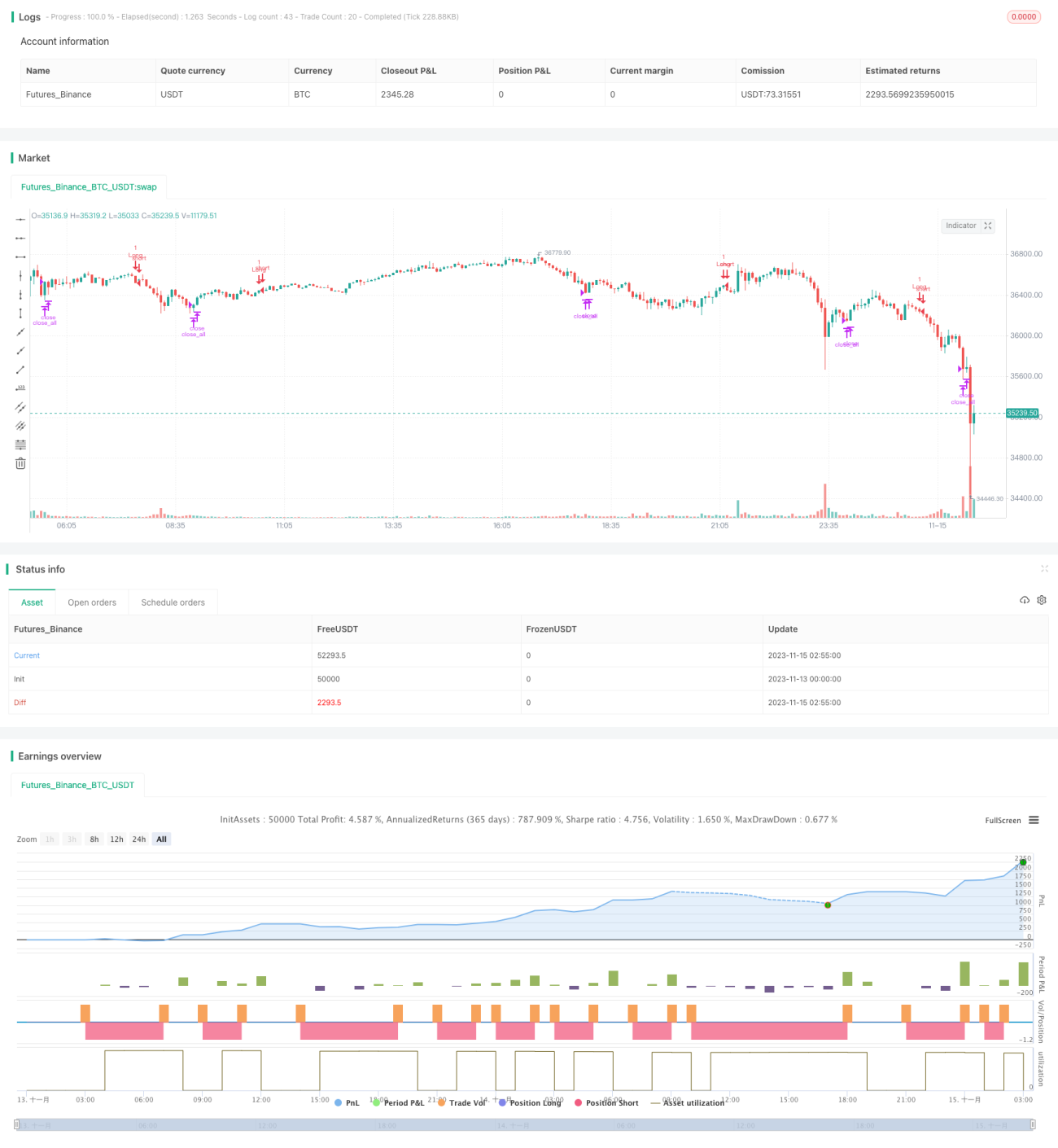
Chiến lược này tính toán nhiều chỉ số xu hướng và thực hiện các hoạt động mua và bán khi chúng đảo ngược. Các chỉ số xu hướng chính là TDI, TCF, TTF và TII. Chiến lược sẽ chọn trong cấu hình để sử dụng chỉ số nào để tạo tín hiệu giao dịch.
Chỉ số TDI dựa trên động lực thay đổi của giá để tính toán. Nó được xây dựng thông qua các kỹ thuật tổng hợp và làm mịn.
Chỉ số TCF tính toán sự thay đổi tích cực và tiêu cực của giá, để đánh giá sức mạnh của đầu nhiều và đầu trống. Khi sức mạnh thay đổi tích cực lớn hơn sức mạnh thay đổi tiêu cực, hãy làm nhiều hơn, nếu không hãy thanh toán.
Chỉ số TTF đánh giá xu hướng bằng cách so sánh sức mạnh của điểm cao và điểm thấp.
Chỉ số TII kết hợp đường trung bình và phạm vi giá để đánh giá xu hướng đảo ngược. Nó xem xét cả xu hướng ngắn hạn và dài hạn.
Lập vào logic của nhiều vị trí hòa bình để chọn tín hiệu giao dịch phù hợp dựa trên các chỉ số được cấu hình.
Chiến lược này kết hợp nhiều chỉ số giao dịch xu hướng được sử dụng thường xuyên và có thể thích ứng linh hoạt với môi trường thị trường. Các ưu điểm cụ thể là:
Chiến lược này có những rủi ro:
Các biện pháp sau đây có thể làm giảm nguy cơ:
Chiến lược này có thể được tối ưu hóa theo các khía cạnh sau:
Chiến lược này kết hợp lợi thế của nhiều chỉ số đảo ngược xu hướng, được tối ưu hóa thông qua các chỉ số và tham số cấu hình, có thể thích ứng với các môi trường thị trường khác nhau, hoạt động tại các điểm đảo ngược xu hướng. Chìa khóa là tìm ra các tham số và kết hợp chỉ số tối ưu nhất, đồng thời kiểm soát rủi ro.
/*backtest
start: 2023-11-13 00:00:00
end: 2023-11-15 03:00:00
period: 5m
basePeriod: 1m
exchanges: [{"eid":"Futures_Binance","currency":"BTC_USDT"}]
*/
//@version=4
//
// This source code is subject to the terms of the Mozilla Public License 2.0 at https://mozilla.org/MPL/2.0/
// © kruskakli
//
// Here is a collection of Trend Indicators as defined by M.H Pee and presented
// in various articles of the "STOCKS & COMMODITIES Magazine"
//
// The actual implementation of the indicators here are made by: everget
//
// I have gather them here so that they easily can be tested.
//
// My own test was made using 15 companies from the OMXS30 list
// during the time period of 2016-2018, and I only went LONG.
//
// The result was as follows:
//
// Average Std.Dev
// profit
// TDI 3.04% 5.97
// TTF 1.22%. 5.73
// TII 1.07% 6.2
// TCF 0.32% 2.68
//
strategy("M.H Pee indicators", overlay=true)
use = input(defval="TDI", title="Use Indicator", type=input.string,
options=["TDI","TCF","TTF","TII"])
src = close
//
// TDI
//
length = input(title="Length", type=input.integer, defval=20)
mom = change(close, length)
tdi = abs(sum(mom, length)) - sum(abs(mom), length * 2) + sum(abs(mom), length)
// Direction Indicator
tdiDirection = sum(mom, length)
tdiLong = crossover(tdiDirection, tdi)
tdiXLong = crossunder(tdiDirection, tdi)
//
// TCF
//
tcflength = input(title="Length", type=input.integer, defval=35)
plusChange(src) =>
change_1 = change(src)
change(src) > 0 ? change_1 : 0.0
minusChange(src) =>
change_1 = change(src)
change(src) > 0 ? 0.0 : -change_1
plusCF = 0.0
plusChange__1 = plusChange(src)
plusCF := plusChange(src) == 0 ? 0.0 : plusChange__1 + nz(plusCF[1])
minusCF = 0.0
minusChange__1 = minusChange(src)
minusCF := minusChange(src) == 0 ? 0.0 : minusChange__1 + nz(minusCF[1])
plusTCF = sum(plusChange(src) - minusCF, tcflength)
minusTCF = sum(minusChange(src) - plusCF, tcflength)
tcfLong = plusTCF > 0
tcfXLong = plusTCF < 0
//
// TTF
//
ttflength = input(title="Lookback Length", type=input.integer, defval=15)
hh = highest(length)
ll = lowest(length)
buyPower = hh - nz(ll[length])
sellPower = nz(hh[length]) - ll
ttf = 200 * (buyPower - sellPower) / (buyPower + sellPower)
ttfLong = crossover(ttf, 100)
ttfXLong = crossunder(ttf, -100)
//
// TII
//
majorLength = input(title="Major Length", type=input.integer, defval=60)
minorLength = input(title="Minor Length", type=input.integer, defval=30)
upperLevel = input(title="Upper Level", type=input.integer, defval=80)
lowerLevel = input(title="Lower Level", type=input.integer, defval=20)
sma = sma(src, majorLength)
positiveSum = 0.0
negativeSum = 0.0
for i = 0 to minorLength - 1 by 1
price = nz(src[i])
avg = nz(sma[i])
positiveSum := positiveSum + (price > avg ? price - avg : 0)
negativeSum := negativeSum + (price > avg ? 0 : avg - price)
negativeSum
tii = 100 * positiveSum / (positiveSum + negativeSum)
tiiLong = crossover(tii, 80)
tiiXLong = crossunder(tii,80)
//
// LOGIC
//
enterLong = (use == "TDI" and tdiLong) or (use == "TCF" and tcfLong) or (use == "TTF" and ttfLong) or (use == "TII" and tiiLong)
exitLong = (use == "TDI" and tdiXLong) or (use == "TCF" and tcfXLong) or (use == "TTF" and ttfXLong) or (use == "TII" and tiiXLong)
// Time range for Back Testing
btStartYear = input(title="Back Testing Start Year", type=input.integer, defval=2016)
btStartMonth = input(title="Back Testing Start Month", type=input.integer, defval=1)
btStartDay = input(title="Back Testing Start Day", type=input.integer, defval=1)
startTime = timestamp(btStartYear, btStartMonth, btStartDay, 0, 0)
btStopYear = input(title="Back Testing Stop Year", type=input.integer, defval=2028)
btStopMonth = input(title="Back Testing Stop Month", type=input.integer, defval=12)
btStopDay = input(title="Back Testing Stop Day", type=input.integer, defval=31)
stopTime = timestamp(btStopYear, btStopMonth, btStopDay, 0, 0)
window() => time >= startTime and time <= stopTime ? true : false
riskPerc = input(title="Max Position %", type=input.float, defval=20, step=0.5)
maxLossPerc = input(title="Max Loss Risk %", type=input.float, defval=5, step=0.25)
// Average True Range (ATR) measures market volatility.
// We use it for calculating position sizes.
atrLen = input(title="ATR Length", type=input.integer, defval=14)
stopOffset = input(title="Stop Offset", type=input.float, defval=1.5, step=0.25)
limitOffset = input(title="Limit Offset", type=input.float, defval=1.0, step=0.25)
atrValue = atr(atrLen)
// Calculate position size
maxPos = floor((strategy.equity * (riskPerc/100)) / src)
// The position sizing algorithm is based on two parts:
// a certain percentage of the strategy's equity and
// the ATR in currency value.
riskEquity = (riskPerc / 100) * strategy.equity
// Translate the ATR into the instrument's currency value.
atrCurrency = (atrValue * syminfo.pointvalue)
posSize0 = min(floor(riskEquity / atrCurrency), maxPos)
posSize = posSize0 < 1 ? 1 : posSize0
if (window())
strategy.entry("Long", long=true, qty=posSize0, when=enterLong)
strategy.close_all(when=exitLong)