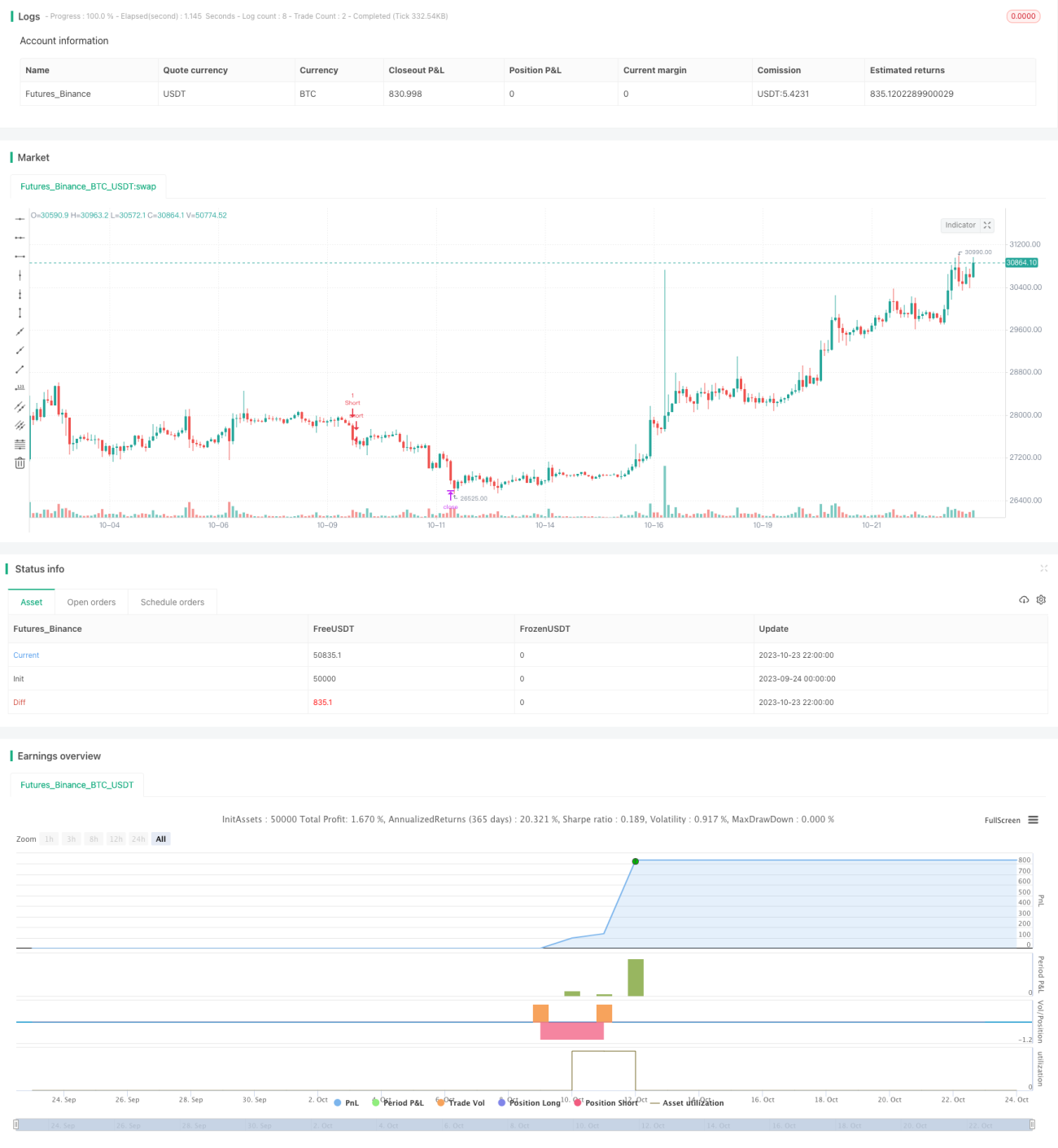
A estratégia baseia-se principalmente na combinação de indicadores de Brin e RSI para julgar os sinais de negociação, e é uma estratégia de combinação típica. Utiliza integralmente os benefícios de diferentes indicadores para determinar a direção da tendência através da faixa de Brin, o RSI detecta sobrecompra e sobrevenda, para entrar e sair.
Usando o meio, o alto e o baixo da faixa de Brin para avaliar o movimento atual do preço das ações. Quando o preço quebra o caminho acima, é considerado como entrando em uma situação de bullish, e quando o preço quebra o caminho abaixo, é considerado como entrando em uma situação de bearish.
A largura de banda de Brin (diferença entre a linha superior e a linha inferior) pode refletir a taxa de flutuação atual do mercado. Quando a largura de banda de Brin aumenta, a flutuação aumenta, e o RSI pode detectar melhor os casos de sobrecompra e sobrevenda.
O indicador RSI julga a tendência de sobrecompra e sobrevenda. Se o RSI estiver acima de 70, é uma zona de sobrecompra, e se estiver abaixo de 30, é uma zona de sobrevenda.
Sinais de negociação específicos: (1) Sinais de alarme: o preço entrou no caminho e o RSI não superou (RSI menor que 70) (2) Sinais de baixa: o preço entrou em queda e o RSI não superou (RSI maior que 30)
Exit Stop Loss: A negociação de bullish termina se o RSI for abaixo de 70; a negociação de bearish termina se o RSI for acima de 30.
A estratégia tem as seguintes vantagens:
A vantagem de integrar vários indicadores é que a informação é mais abrangente e os sinais são mais confiáveis.
A utilização da faixa de Bryn para determinar a direção geral da tendência, apoiar a massa e entender a tendência.
O indicador RSI julga a sobrecompra e a sobrevenda locais, evitando ainda mais riscos desnecessários.
O mecanismo de prevenção de prejuízos é rigoroso e ajuda a reduzir os prejuízos.
A estratégia também apresenta os seguintes riscos:
O indicador de correlação de tendências (BRI) e o RSI podem falhar, o que pode levar a erros nos sinais de negociação.
Apesar das medidas de parada, a configuração inadequada do ponto de parada ainda pode causar grandes perdas.
A frequência excessiva de transações aumenta as taxas de transação e os custos de deslizamento.
PARAMETERS Otimização inadequada pode levar a um excesso de compatibilidade.
A estratégia pode ser melhorada em vários aspectos:
Testar diferentes combinações de parâmetros de indicadores para encontrar o parâmetro otimizado.
Aumentar a flexibilidade dos métodos de stop loss, como ADDR/ATR stop loss, stop loss móvel, etc.
Adicionar estratégias de gerenciamento de posições, como posições fixas, Martingale, etc.
Combinação de mais indicadores de filtragem de sinais, como volume de transação e energia.
Otimizar a auto-adaptação de parâmetros usando aprendizado de máquina.
Otimizar o tempo de entrada, e depois de um sinal de confirmação de tendência.
A estratégia, em geral, é uma estratégia típica de combinação de vários indicadores. Integra os seus respectivos pontos fortes nas faixas Brin e RSI, evitando, ao mesmo tempo, o risco de sobrevenda local e de sobrevenda ao capturar a tendência.
/*backtest
start: 2023-09-24 00:00:00
end: 2023-10-24 00:00:00
period: 2h
basePeriod: 15m
exchanges: [{"eid":"Futures_Binance","currency":"BTC_USDT"}]
*/
// This source code is subject to the terms of the Mozilla Public License 2.0 at https://mozilla.org/MPL/2.0/
// © evillalobos1123
//@version=5
strategy("Villa Dinamic Pivot Supertrend Strategy", overlay=true, calc_on_every_tick = true, default_qty_type = strategy.fixed)
//INPUTS
ema_b = input.bool(false, "Use Simple EMA Filter", group = "Strategy Inputs")
ema_b_ang = input.bool(true, "Use DEMA Angle Filter", group = "Strategy Inputs")
dema_b = input.bool(true, "Use DEMA Filter", group = "Strategy Inputs")
st_sig = input.bool(false, "Take Every Supertrend Signal" , group = "Strategy Inputs")
take_p = input.bool(true, "Stop Loss at Supertrend", group = "Strategy Inputs")
din_tp = input.bool(false, "2 Steps Take Profit", group = "Strategy Inputs")
move_sl = input.bool(true, "Move SL", group = "Strategy Inputs")
sl_atr = input.float(2.5, "Stop Loss ATR Multiplier", group = "Strategy Inputs")
tp_atr = input.float(4, "Take Profit ATR Multiplier", group = "Strategy Inputs")
din_tp_qty = input.int(50, "2 Steps TP qty%", group = "Strategy Inputs")
dema_a_filter = input.float(0, "DEMA Angle Threshold (+ & -)", group = "Strategy Inputs")
dema_a_look = input.int(1, "DEMA Angle Lookback", group = "Strategy Inputs")
dr_test = input.string("Backtest", "Testing", options = ["Backtest", "Forwardtest", "All"], group = "Strategy Inputs")
not_in_trade = strategy.position_size == 0
//Backtesting date range
start_year = input.int(2021, "Backtesting start year", group = "BT Date Range")
start_month = input.int(1, "Backtesting start month", group = "BT Date Range")
start_date = input.int(1, "Backtesting start day", group = "BT Date Range")
end_year = input.int(2021, "Backtesting end year", group = "BT Date Range")
end_month = input.int(12, "Backtesting end month", group = "BT Date Range")
end_date = input.int(31, "Backtesting end day", group = "BT Date Range")
bt_date_range = (time >= timestamp(syminfo.timezone, start_year,
start_month, start_date, 0, 0)) and
(time < timestamp(syminfo.timezone, end_year, end_month, end_date, 0, 0))
//Forward testing date range
start_year_f = input.int(2022, "Forwardtesting start year", group = "FT Date Range")
start_month_f = input.int(1, "Forwardtesting start month", group = "FT Date Range")
start_date_f = input.int(1, "Forwardtesting start day", group = "FT Date Range")
end_year_f = input.int(2022, "Forwardtesting end year", group = "FT Date Range")
end_month_f = input.int(03, "Forwardtesting end month", group = "FT Date Range")
end_date_f = input.int(26, "Forwardtesting end day", group = "FT Date Range")
ft_date_range = (time >= timestamp(syminfo.timezone, start_year_f,
start_month_f, start_date_f, 0, 0)) and
(time < timestamp(syminfo.timezone, end_year_f, end_month_f, end_date_f, 0, 0))
//date condition
date_range_cond = if dr_test == "Backtest"
bt_date_range
else if dr_test == "Forwardtest"
ft_date_range
else
true
//INDICATORS
//PIVOT SUPERTREND
prd = input.int(2, "PVT ST Pivot Point Period", group = "Pivot Supertrend")
Factor=input.float(3, "PVT ST ATR Factor", group = "Pivot Supertrend")
Pd=input.int(9 , "PVT ST ATR Period", group = "Pivot Supertrend")
// get Pivot High/Low
float ph = ta.pivothigh(prd, prd)
float pl = ta.pivotlow(prd, prd)
// calculate the Center line using pivot points
var float center = na
float lastpp = ph ? ph : pl ? pl : na
if lastpp
if na(center)
center := lastpp
else
//weighted calculation
center := (center * 2 + lastpp) / 3
// upper/lower bands calculation
Up = center - (Factor * ta.atr(Pd))
Dn = center + (Factor * ta.atr(Pd))
// get the trend
float TUp = na
float TDown = na
Trend = 0
TUp := close[1] > TUp[1] ? math.max(Up, TUp[1]) : Up
TDown := close[1] < TDown[1] ? math.min(Dn, TDown[1]) : Dn
Trend := close > TDown[1] ? 1: close < TUp[1]? -1: nz(Trend[1], 1)
Trailingsl = Trend == 1 ? TUp : TDown
// check and plot the signals
bsignal = Trend == 1 and Trend[1] == -1
ssignal = Trend == -1 and Trend[1] == 1
//get S/R levels using Pivot Points
float resistance = na
float support = na
support := pl ? pl : support[1]
resistance := ph ? ph : resistance[1]
//DEMA
dema_ln = input.int(200, "DEMA Len", group = 'D-EMAs')
dema_src = input.source(close, "D-EMAs Source", group = 'D-EMAs')
ema_fd = ta.ema(dema_src, dema_ln)
dema = (2*ema_fd)-(ta.ema(ema_fd,dema_ln))
//EMA
ema1_l = input.int(21, "EMA 1 Len", group = 'D-EMAs')
ema2_l = input.int(50, "EMA 2 Len", group = 'D-EMAs')
ema3_l = input.int(200, "EMA 3 Len", group = 'D-EMAs')
ema1 = ta.ema(dema_src, ema1_l)
ema2 = ta.ema(dema_src, ema2_l)
ema3 = ta.ema(dema_src, ema3_l)
//Supertrend
Periods = input.int(21, "ST ATR Period", group = "Normal Supertrend")
src_st = input.source(hl2, "ST Supertrend Source", group = "Normal Supertrend")
Multiplier = input.float(2.0 , "ST ATR Multiplier", group = "Normal Supertrend")
changeATR= true
atr2 = ta.sma(ta.tr, Periods)
atr3= changeATR ? ta.atr(Periods) : atr2
up=src_st-(Multiplier*atr3)
up1 = nz(up[1],up)
up := close[1] > up1 ? math.max(up,up1) : up
dn=src_st+(Multiplier*atr3)
dn1 = nz(dn[1], dn)
dn := close[1] < dn1 ? math.min(dn, dn1) : dn
trend = 1
trend := nz(trend[1], trend)
trend := trend == -1 and close > dn1 ? 1 : trend == 1 and close < up1 ? -1 : trend
buySignal = trend == 1 and trend[1] == -1
sellSignal = trend == -1 and trend[1] == 1
//ATR
atr = ta.atr(14)
///CONDITIONS
//BUY
/// ema simple
ema_cond_b = if ema_b
ema1 > ema2 and ema2 > ema3
else
true
///ema angle
dema_angle_rad = math.atan((dema - dema[dema_a_look])/0.0001)
dema_angle = dema_angle_rad * (180/math.pi)
dema_ang_cond_b = if ema_b_ang
if dema_angle >= dema_a_filter
true
else
false
else
true
///ema distance
dema_cond_b = if dema_b
close > dema
else
true
//supertrends
///if pivot buy sig or (st buy sig and pivot. trend = 1)
pvt_cond_b = bsignal
st_cond_b = if st_sig
buySignal and Trend == 1
else
false
st_entry_cond = pvt_cond_b or st_cond_b
///stop loss tp
sl_b = if take_p
if trend == 1
up
else
close - (atr * sl_atr)
else
close - (atr * sl_atr)
tp_b = if take_p
if trend == 1
close + ((close - up) * (tp_atr / sl_atr))
else
close + (atr * tp_atr)
else
close + (atr * tp_atr)
//position size
init_cap = strategy.equity
pos_size_b = math.round((init_cap * .01) / (close - sl_b))
ent_price = strategy.opentrades.entry_price(strategy.opentrades - 1)
var sl_b_n = 0.0
var tp_b_n = 0.0
longCondition = (ema_cond_b and dema_cond_b and dema_ang_cond_b and st_entry_cond and date_range_cond and not_in_trade)
if (longCondition)
strategy.entry("Long", strategy.long, qty = pos_size_b)
sl_b_n := sl_b
tp_b_n := tp_b
ent_price := strategy.opentrades.entry_price(strategy.opentrades - 1)
if (up[1] < ent_price and up >= ent_price and trend[0] == 1)
if din_tp
strategy.close("Long", qty_percent = din_tp_qty)
if move_sl
sl_b_n := ent_price
strategy.exit("Exit", "Long", stop =sl_b_n, limit = tp_b_n)
//sell
///ema simple
ema_cond_s = if ema_b
ema1 < ema2 and ema2 < ema3
else
true
//ema distance
dema_cond_s = if dema_b
close < dema
else
true
//dema angle
dema_ang_cond_s = if ema_b_ang
if dema_angle <= (dema_a_filter * -1)
true
else
false
else
true
//supertrends
///if pivot buy sig or (st buy sig and pivot. trend = 1)
pvt_cond_s = ssignal
st_cond_s = if st_sig
sellSignal and Trend == -1
else
false
st_entry_cond_s = pvt_cond_s or st_cond_s
///stop loss tp
sl_s = if take_p
if trend == -1
dn
else
close + (atr * sl_atr)
else
close + (atr * sl_atr)
tp_s = if take_p
if trend == -1
close - ((dn - close) * (tp_atr / sl_atr))
else
close - (atr * tp_atr)
else
close - (atr * tp_atr)
shortCondition = (ema_cond_s and dema_cond_s and dema_ang_cond_s and st_entry_cond_s and not_in_trade)
pos_size_s = math.round((init_cap * .01) / (sl_s - close))
var sl_s_n = 0.0
var tp_s_n = 0.0
if (shortCondition)
strategy.entry("Short", strategy.short, qty = pos_size_s)
sl_s_n := sl_s
tp_s_n := tp_s
if (dn[1] > ent_price and dn <= ent_price and trend[0] == -1)
if din_tp
strategy.close("Short", qty_percent = din_tp_qty)
if move_sl
sl_s_n := ent_price
strategy.exit("Exit", "Short", stop = sl_s_n, limit = tp_s_n)