Estrategia de promediación de costos en dólares de BTC basada en bandas BEAM

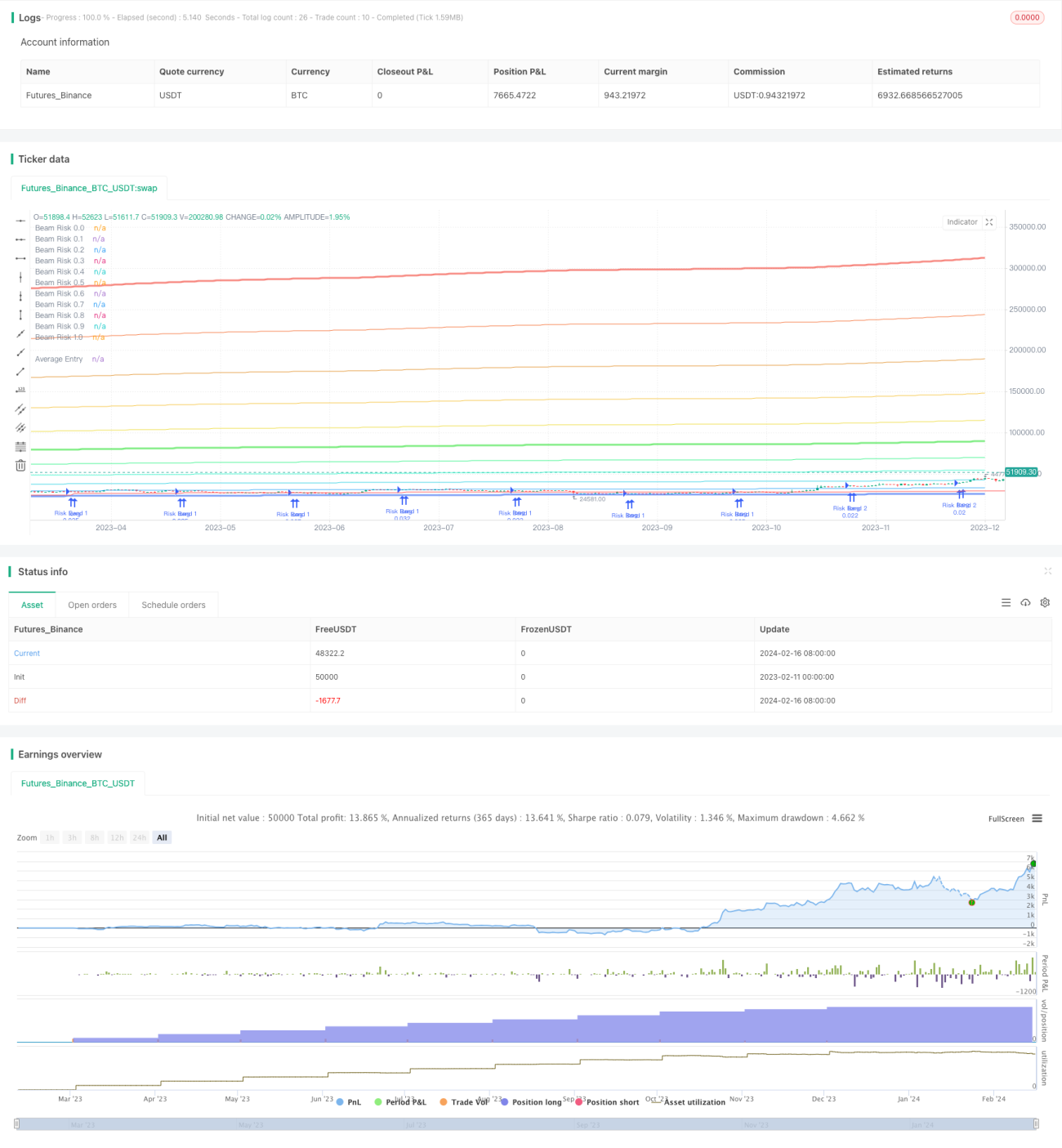
Resumen
Esta estrategia se basa en la teoría de niveles de riesgo de Ben Cowen, con el objetivo de implementar un método similar utilizando las bandas BEAM. El límite superior de la banda BEAM es la media móvil de 200 semanas después de aplicar el logaritmo, y el límite inferior es la propia media móvil de 200 semanas. Esto nos da un rango de 0 a 1. Cuando el precio se encuentra por debajo de la banda de 0.5, se emite una orden de compra; cuando está por encima de 0.5, se emite una orden de venta.
Principio de la estrategia
Esta estrategia se basa principalmente en la teoría de las bandas BEAM propuesta por Ben Cowen. Según la variación del precio de BTC, el precio se puede dividir en 10 zonas de 0 a 1, que representan 10 niveles de riesgo diferentes. El nivel 0 indica que el precio está cerca de la media móvil de 200 semanas, con el menor riesgo; el nivel 5 representa la zona media; y el nivel 10 indica que el precio está cerca del límite superior, con el mayor riesgo.
Cuando el precio cae a niveles bajos, la estrategia aumenta gradualmente el tamaño de la posición de compra. Específicamente, si el precio se encuentra en la banda de 0 a 0.5, se emite una orden de compra en un día fijo del mes configurado, y el monto de compra aumenta progresivamente a medida que el número de banda disminuye. Por ejemplo, en la banda 5, el monto de compra es del 20% del monto total de DCA mensual; en la banda 1, el monto de compra aumenta al 100% del total mensual.
Cuando el precio sube a niveles altos, la estrategia reduce gradualmente la posición. Específicamente, si el precio supera la banda de 0.5, se emite una orden de venta proporcional, y el porcentaje de venta aumenta a medida que el número de banda aumenta. Por ejemplo, en la banda 6, se vende el 6.67%; en la banda 10, se vende la totalidad de la posición.
Análisis de ventajas
La mayor ventaja de esta estrategia de promediación de costos (DCA) con bandas BEAM es que aprovecha al máximo las características de volatilidad de BTC, comprando cuando el precio cae a mínimos y obteniendo ganancias cuando sube a máximos. Este enfoque no pierde ninguna oportunidad de compra o venta. Las ventajas específicas se pueden resumir de la siguiente manera:
- Utiliza la teoría BEAM para determinar el grado de subvaloración de un activo, evitando riesgos de manera científica.
- Aprovecha plenamente la volatilidad de BTC para capturar con precisión las mejores oportunidades de compra y venta.
- Emplea el método de promediación de costos para controlar eficazmente los costos de inversión y obtener rendimientos estables a largo plazo.
- Ejecuta automáticamente las transacciones de compra y venta sin intervención manual, reduciendo el riesgo operativo.
- Permite personalizar parámetros y ajustar la estrategia de manera flexible para adaptarse a los cambios del mercado.
En resumen, se trata de una estrategia de ajuste de parámetros fina que puede obtener rendimientos estables a largo plazo en un mercado de BTC con tendencia lateral.
Análisis de riesgos
Aunque la estrategia DCA con bandas BEAM tiene muchas ventajas, también presenta algunos riesgos potenciales que deben tenerse en cuenta. Los principales puntos de riesgo se pueden resumir de la siguiente manera:
- La teoría BEAM y la configuración de parámetros dependen de juicios subjetivos, lo que puede llevar a errores de evaluación.
- La tendencia de BTC es difícil de predecir, existiendo el riesgo de pérdidas.
- Las operaciones automáticas son susceptibles a fallos del sistema y efectos adversos de la manipulación de parámetros.
- Una volatilidad excesiva puede aumentar las pérdidas.
Para reducir los riesgos, se pueden tomar las siguientes medidas:
- Optimizar la configuración de parámetros para mejorar la precisión de la teoría BEAM.
- Reducir adecuadamente el tamaño de las posiciones para disminuir las pérdidas por operación.
- Aumentar la redundancia y la tolerancia a fallos para reducir el riesgo operativo de las transacciones automáticas.
- Establecer stop-loss para evitar pérdidas excesivas en una sola operación.
Direcciones de optimización
Considerando los puntos de riesgo mencionados, la estrategia se puede optimizar principalmente en los siguientes aspectos:
- Optimizar los parámetros de la teoría BEAM: ajustar los parámetros del método logarítmico, el período de backtesting, etc., para mejorar la precisión del modelo.
- Optimizar el control de posiciones: ajustar el monto total mensual de DCA, las proporciones de compra y venta, etc., para controlar el riesgo de pérdida por operación.
- Agregar módulos de seguridad para transacciones automáticas: configurar servidores redundantes, procesamiento local, etc., para mejorar la tolerancia a fallos.
- Incorporar un módulo de stop-loss: establecer puntos de stop-loss razonables basados en la volatilidad histórica para controlar eficazmente las pérdidas.
A través de estos medios, se puede mejorar significativamente la estabilidad y seguridad de la estrategia.
Resumen
La estrategia DCA con bandas BEAM es una estrategia cuantitativa de gran valor práctico. Utiliza con éxito la teoría BEAM para guiar las decisiones de trading, combinada con el modelo de promediación de costos para controlar los costos de compra. Al mismo tiempo, presta atención a la gestión de riesgos, estableciendo stop-loss para prevenir la ampliación de pérdidas. Mediante la optimización de parámetros y la incorporación de módulos, esta estrategia puede convertirse en una herramienta importante para el trading cuantitativo, obteniendo rendimientos estables a largo plazo en el mercado de BTC. Merece una mayor investigación y aplicación por parte de los profesionales del trading cuantitativo.
/*backtest
start: 2023-02-11 00:00:00
end: 2024-02-17 00:00:00
period: 1d
basePeriod: 1h
exchanges: [{"eid":"Futures_Binance","currency":"BTC_USDT"}]
*/

// © gjfsdrtytru - BEAM DCA Strategy {
// Based on Ben Cowen's risk level strategy, this aims to copy that method but with BEAM band levels.
// Upper BEAM level is derived from ln(price/200W MA)/2.5, while the 200W MA is the floor price. This is our 0-1 range.
// Buy limit orders are set at the < 0.5 levels and sell orders are set at the > 0.5 level.- 1