Stratégie de suivi de tendance basée sur un oscillateur lissé

Date de création: 2023-12-27 15:41:37 Dernière modification: 2023-12-27 15:41:37
Copier: 0 Nombre de clics: 740
1
Suivre
1621
Abonnés

Stratégie de suivi de tendance basée sur un oscillateur lissé

Aperçu

La stratégie est basée sur des indicateurs de fluctuation lisse pour identifier les tendances des prix et pour effectuer des transactions en suivant les tendances.

Principe de stratégie

La stratégie utilise un indicateur de fluctuation de la fluctuation de la fluctuation pour identifier la tendance des prix. L’indicateur calcule le cours de l’inversion de la ligne K actuelle, c’est-à-dire le prix théorique qui peut entraîner une inversion des pertes et des pertes.

La stratégie utilise la rupture de la ligne de référence comme signal de prise de position. Faire plus lorsque le prix dépasse la ligne de référence et faire moins lorsque le prix dépasse la ligne de référence. La ligne d’arrêt est définie comme un certain pourcentage du prix d’entrée pour bloquer les bénéfices et contrôler les risques.

Avantages stratégiques

  1. Les indicateurs personnalisés permettent d’identifier les tendances et de mieux les mesurer.
  2. Utilisation de suivi de tendance, en accord approximatif avec la théorie de la négociation de tendance quantifiée
  3. Le paramètre de stop loss est propice à la maîtrise des risques.

Analyse des risques

  1. Les indicateurs présentent une certaine régression qui peut entraîner une mauvaise performance de la stratégie
  2. Les signaux erronés peuvent être générés par un seul indicateur.
  3. Les paramètres d’arrêt de perte ont une marge d’optimisation et peuvent être sur-arrêtés.

Direction d’optimisation

  1. Considérez de filtrer les signaux de trading en les combinant avec d’autres indicateurs, tels que les bandes de Brin, le RSI, etc.
  2. Tester différents paramètres de l’indicateur
  3. Test et optimisation des méthodes de prévention des pertes
  4. Plus de données sur les différentes variétés et les cycles de test

Résumer

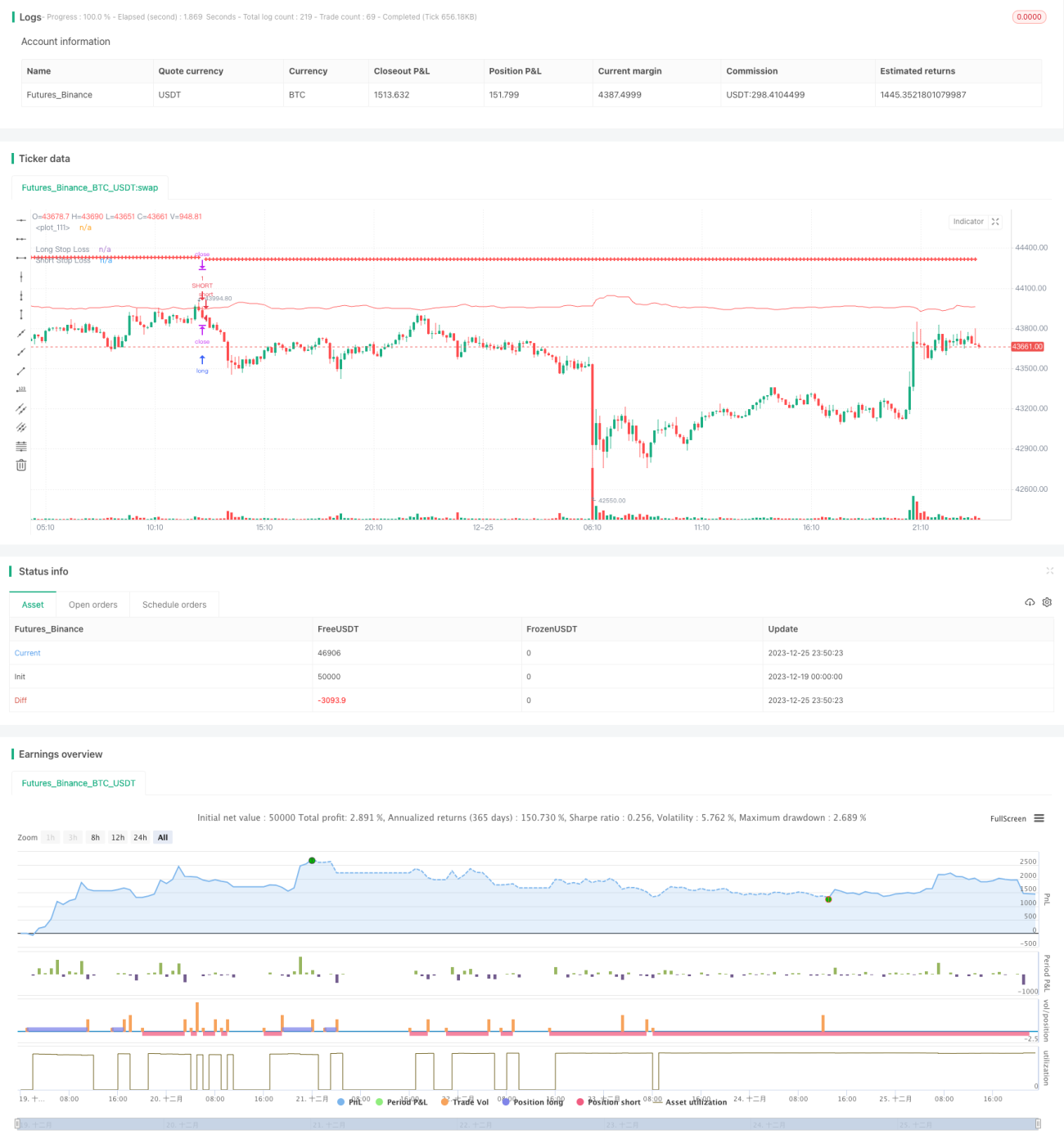
La stratégie est clairement conçue, avec des indicateurs personnalisés pour identifier les tendances et les traiter de manière à suivre les tendances. Du point de vue des résultats de la rétroanalyse, la stratégie fonctionne bien et a un certain potentiel d’utilisation sur le marché.

Code source de la stratégie
/*backtest
start: 2023-12-19 00:00:00
end: 2023-12-26 00:00:00
period: 10m
basePeriod: 1m
exchanges: [{"eid":"Futures_Binance","currency":"BTC_USDT"}]
*/

// This source code is subject to the terms of the Mozilla Public License 2.0 at https://mozilla.org/MPL/2.0/

// © TraderHalai
// This is a backtest of the Smoothed Heikin Ashi Trend indicator, which computes the reverse candle close price required to flip a heikin ashi trend from red to green and vice versa. Original indicator can be found on the scripts section of my profile.

// Default testing parameters are 10% of equity position size, with a 1% stop loss on short and long strategy.opentrades.commission

// This particular back test uses this indicator as a Trend trading tool with a tight stop loss. The equity curve as tested seems promising but requires further work to refine. Note in an actual trading setup, you may wish to use this with volatilty filters as most of the losses are in sideways, low volatility markets.


//@version=5
strategy("Smoothed Heikin Ashi Trend on Chart - TraderHalai BACKTEST", " SHA Trend - BACKTEST", overlay=true)
//Inputs

i_useSmooth =       input ( true, "Use smoothing Heikin Ashi")
i_smoothingMethod = input.string("SMA", "Method", options=["SMA", "EMA", "HMA", "VWMA", "RMA"])
i_smoothingPeriod = input ( 10, "Smoothing period")

i_infoBox   =       input ( true, "Show Info Box"        )
i_decimalP  =       input ( 2,    "Prices Decimal Places") 
i_boxOffSet =       input ( 5,    "Info Box Offset"      )
i_repaint   =       input (false,  "Repaint -  Keep on for live / Off for backtest")

i_longLossPerc = input.float(title="Long Stop Loss (%)",minval=0.0, step=0.1, defval=1) * 0.01

i_shortLossPerc = input.float(title="Short Stop Loss (%)", minval=0.0, step=0.1, defval=1) * 0.01


timeperiod = timeframe.period

//Security functions to avoid repaint, as per PineCoders
f_secureSecurity(_symbol, _res, _src) => request.security(_symbol, _res, _src[1], lookahead = barmerge.lookahead_on)
f_security(_symbol, _res, _src, _repaint) => request.security(_symbol, _res, _src[_repaint ? 0 : barstate.isrealtime ? 1 : 0])[_repaint ? 0 : barstate.isrealtime ? 0 : 1]
f_secSecurity2(_symbol, _res, _src) => request.security(_symbol, _res, _src[1])


candleClose = f_security(syminfo.tickerid, timeperiod, close, i_repaint)
candleOpen = f_security(syminfo.tickerid, timeperiod, open, i_repaint)
candleLow = f_security(syminfo.tickerid, timeperiod, low, i_repaint)
candleHigh = f_security(syminfo.tickerid, timeperiod, high, i_repaint)

haTicker = ticker.heikinashi(syminfo.tickerid)
haClose = f_security(haTicker, timeperiod, close, i_repaint)
haOpen = f_security(haTicker, timeperiod, open, i_repaint)
haLow = f_security(haTicker, timeperiod, low, i_repaint)
haHigh= f_security(haTicker, timeperiod, high, i_repaint)


reverseClose = (2 * (haOpen[1] + haClose[1])) - candleHigh - candleLow - candleOpen

if(reverseClose < candleLow)
    reverseClose := (candleLow + reverseClose) / 2

if(reverseClose > candleHigh)
    reverseClose := (candleHigh + reverseClose) / 2
    
//Smoothing
    
smaSmoothed = ta.sma(reverseClose, i_smoothingPeriod)
emaSmoothed = ta.ema(reverseClose, i_smoothingPeriod)
hmaSmoothed = ta.hma(reverseClose, i_smoothingPeriod)
vwmaSmoothed = ta.vwma(reverseClose, i_smoothingPeriod)
rmaSmoothed = ta.rma(reverseClose, i_smoothingPeriod)

shouldApplySmoothing = i_useSmooth and i_smoothingPeriod > 1 

smoothedReverseClose = reverseClose

if(shouldApplySmoothing)
    if(i_smoothingMethod == "SMA")
        smoothedReverseClose := smaSmoothed
    else if(i_smoothingMethod == "EMA")
        smoothedReverseClose := emaSmoothed
    else if(i_smoothingMethod == "HMA")
        smoothedReverseClose := hmaSmoothed
    else if(i_smoothingMethod == "VWMA")
        smoothedReverseClose := vwmaSmoothed
    else if(i_smoothingMethod == "RMA")
        smoothedReverseClose := rmaSmoothed
    else 
        smoothedReverseClose := reverseClose // Default to non-smoothed for invalid smoothing type
    
haBull = candleClose >= smoothedReverseClose
haCol = haBull ? color.green : color.red


//Overall trading strategy
if(ta.crossover(candleClose, smoothedReverseClose))
    strategy.entry("LONG", strategy.long, stop=smoothedReverseClose)
else
    strategy.cancel("LONG")

if(ta.crossunder(candleClose, smoothedReverseClose))
    strategy.entry("SHORT", strategy.short, stop=smoothedReverseClose)
else
    strategy.cancel("SHORT")
    

longStopPrice  = strategy.position_avg_price * (1 - i_longLossPerc)
shortStopPrice = strategy.position_avg_price * (1 + i_shortLossPerc)


plot(series=(strategy.position_size > 0) ? longStopPrice : na,
     color=color.red, style=plot.style_cross,
     linewidth=2, title="Long Stop Loss")
plot(series=(strategy.position_size < 0) ? shortStopPrice : na,
     color=color.red, style=plot.style_cross,
     linewidth=2, title="Short Stop Loss")
     
plot(smoothedReverseClose, color=haCol)

if (strategy.position_size > 0)
    strategy.exit(id="XL STP", stop=longStopPrice)

if (strategy.position_size < 0)
    strategy.exit(id="XS STP", stop=shortStopPrice)