Stratégie de moyenne des coûts BTCdollar basée sur la bande BEAM

Aperçu
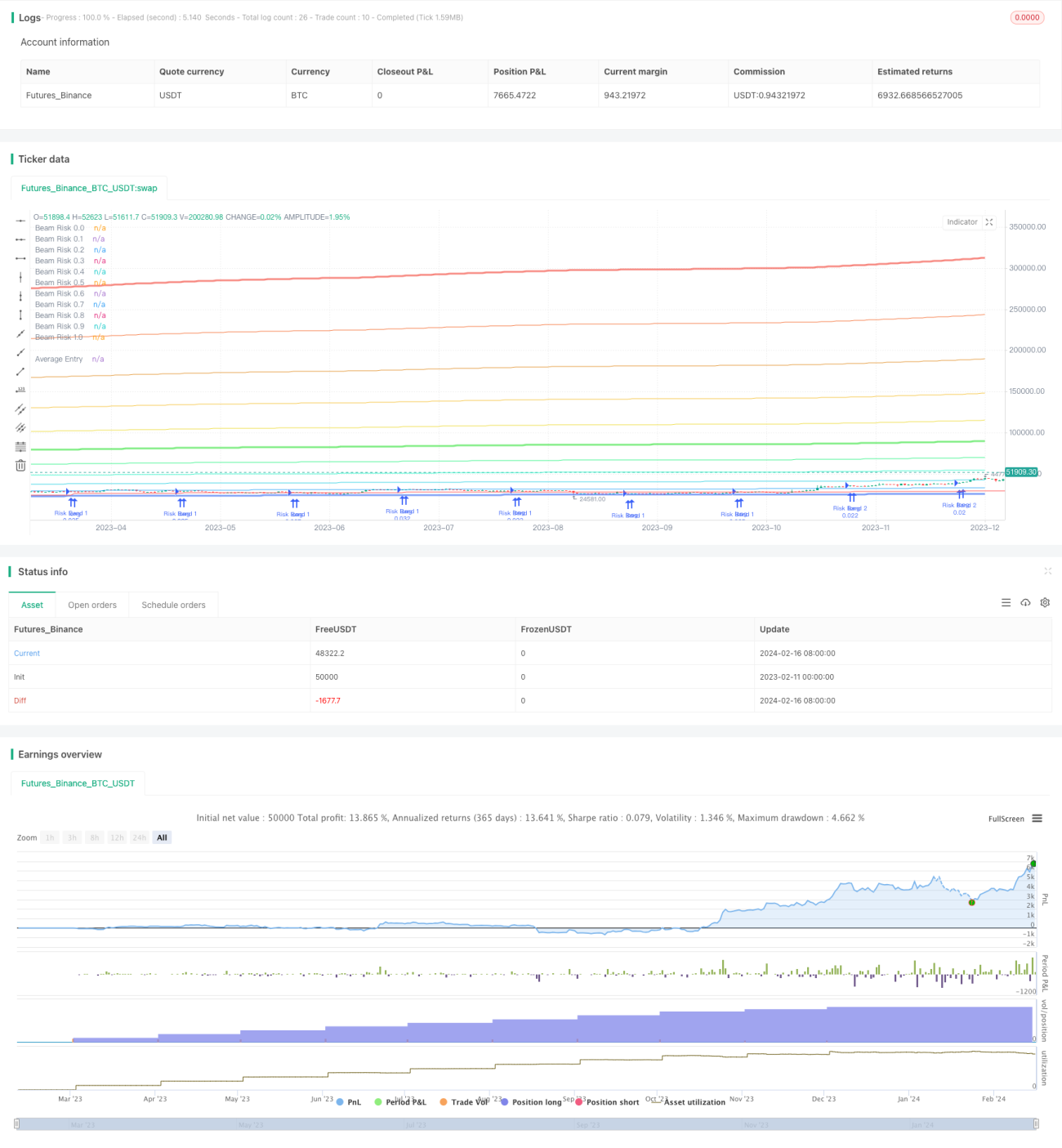
Cette stratégie se base sur la théorie des niveaux de risque de Ben Cowen et vise à utiliser les bandes BEAM pour appliquer une approche similaire. La limite supérieure des bandes BEAM est la moyenne mobile sur 200 semaines après transformation logarithmique, tandis que la limite inférieure est la moyenne mobile sur 200 semaines elle-même. Cela nous donne une échelle de 0 à 1. Lorsque le prix se situe en dessous de la bande 0,5, un ordre d'achat est déclenché ; lorsqu'il se situe au-dessus de la bande 0,5, un ordre de vente est émis.
Principe de la stratégie
Cette stratégie repose principalement sur la théorie des bandes BEAM proposée par Ben Cowen. En fonction des variations du prix du BTC, le prix peut être divisé en 10 zones comprises entre 0 et 1, représentant 10 niveaux de risque différents. Le niveau 0 indique que le prix est proche de la moyenne mobile sur 200 semaines, avec un risque minimal ; le niveau 5 correspond à la zone médiane ; le niveau 10 indique que le prix est proche de la limite supérieure, avec un risque maximal.
Lorsque le prix baisse vers des niveaux bas, la stratégie augmente progressivement la taille des positions d'achat. Plus précisément, si le prix se trouve dans la bande 0 à 0,5, un ordre d'achat est émis un jour donné du mois configuré, et le montant acheté augmente progressivement à mesure que le numéro de la bande diminue. Par exemple, à la bande 5, le montant acheté correspond à 20 % du montant total DCA mensuel ; à la bande 1, le montant acheté est augmenté à 100 % du montant total DCA mensuel.
Lorsque le prix monte vers des niveaux élevés, la stratégie réduit progressivement les positions. Plus précisément, si le prix dépasse la bande 0,5, un ordre de vente est émis proportionnellement, et la taille de la position vendue augmente progressivement avec le numéro de la bande. Par exemple, à la bande 6, 6,67 % sont vendus ; à la bande 10, la totalité de la position est vendue.
Analyse des avantages
Le principal avantage de cette stratégie DCA par bandes BEAM réside dans le fait qu'elle exploite pleinement les caractéristiques de volatilité du BTC : acheter davantage lorsque le BTC atteint des creux et prendre des bénéfices lorsqu'il atteint des sommets. Cette approche ne manque aucune opportunité d'achat ou de vente. Les avantages spécifiques peuvent être résumés comme suit :
- Utiliser la théorie BEAM pour évaluer le degré de sous-évaluation de l'actif, évitant ainsi les risques de manière scientifique ;
- Exploiter pleinement les caractéristiques de volatilité du BTC pour saisir avec une grande précision les meilleures opportunités d'achat et de vente ;
- Adopter une méthode de coût moyen pour contrôler efficacement les coûts d'investissement et obtenir des rendements stables à long terme ;
- Exécuter automatiquement les transactions sans intervention humaine, réduisant ainsi les risques opérationnels ;
- Paramètres personnalisables permettant d'ajuster la stratégie en fonction des évolutions du marché.
En résumé, il s'agit d'une stratégie de réglage fin des paramètres, capable de générer des rendements stables à long terme dans un contexte de fluctuation du BTC.
Analyse des risques
Bien que la stratégie DCA par bandes BEAM présente de nombreux avantages, elle comporte également certains risques potentiels à surveiller. Les principaux points de risque sont les suivants :
- La théorie BEAM et le réglage des paramètres reposent sur un jugement subjectif, ce qui peut entraîner des erreurs d'appréciation ;
- La tendance du BTC est difficile à prévoir, ce qui expose à un risque de perte ;
- Le trading automatique est vulnérable aux pannes système et aux effets néfastes du piratage des paramètres ;
- Une volatilité excessive peut entraîner une aggravation des pertes.
Pour réduire les risques, les mesures suivantes peuvent être prises :
- Optimiser le réglage des paramètres pour améliorer la précision du jugement de la théorie BEAM ;
- Réduire la taille des positions afin de limiter le montant des pertes par transaction ;
- Augmenter la redondance et la tolérance aux pannes pour réduire les risques opérationnels du trading automatique ;
- Mettre en place des stop-loss pour éviter des pertes trop importantes sur une seule transaction.
Axes d'optimisation
Compte tenu des points de risque ci-dessus, la stratégie peut être optimisée principalement sur les aspects suivants :
- Optimiser les paramètres de la théorie BEAM : ajuster les paramètres logarithmiques, la période de backtest, etc., pour améliorer la précision du modèle ;
- Optimiser le contrôle des positions : ajuster le montant total DCA mensuel, les proportions d'achat et de vente, etc., pour contrôler le risque de perte par transaction ;
- Ajouter un module de sécurité pour le trading automatique : mettre en place des serveurs redondants, un traitement local, etc., pour améliorer la tolérance aux pannes ;
- Ajouter un module de stop-loss : définir des niveaux de stop-loss raisonnables en fonction de la volatilité historique pour contrôler efficacement les pertes.
Grâce à ces moyens, la stabilité et la sécurité de la stratégie peuvent être considérablement améliorées.
Conclusion
La stratégie DCA par bandes BEAM est une stratégie quantitative à forte valeur pratique. Elle utilise avec succès la théorie BEAM pour guider les décisions de trading, tout en y associant un modèle de coût moyen pour contrôler les coûts d'achat. Par ailleurs, elle accorde une attention particulière à la gestion des risques en fixant des stop-loss pour éviter l'aggravation des pertes. Grâce à l'optimisation des paramètres et à l'ajout de modules, cette stratégie peut devenir un outil important pour le trading quantitatif et permettre d'obtenir des rendements stables à long terme sur le marché du BTC. Elle mérite d'être étudiée et appliquée plus en profondeur par les professionnels du trading quantitatif.
/*backtest
start: 2023-02-11 00:00:00
end: 2024-02-17 00:00:00
period: 1d
basePeriod: 1h
exchanges: [{"eid":"Futures_Binance","currency":"BTC_USDT"}]
*/

// © gjfsdrtytru - BEAM DCA Strategy {
// Based on Ben Cowen's risk level strategy, this aims to copy that method but with BEAM band levels.
// Upper BEAM level is derived from ln(price/200W MA)/2.5, while the 200W MA is the floor price. This is our 0-1 range.
// Buy limit orders are set at the < 0.5 levels and sell orders are set at the > 0.5 level.- 1