Stratégie de briques de momentum

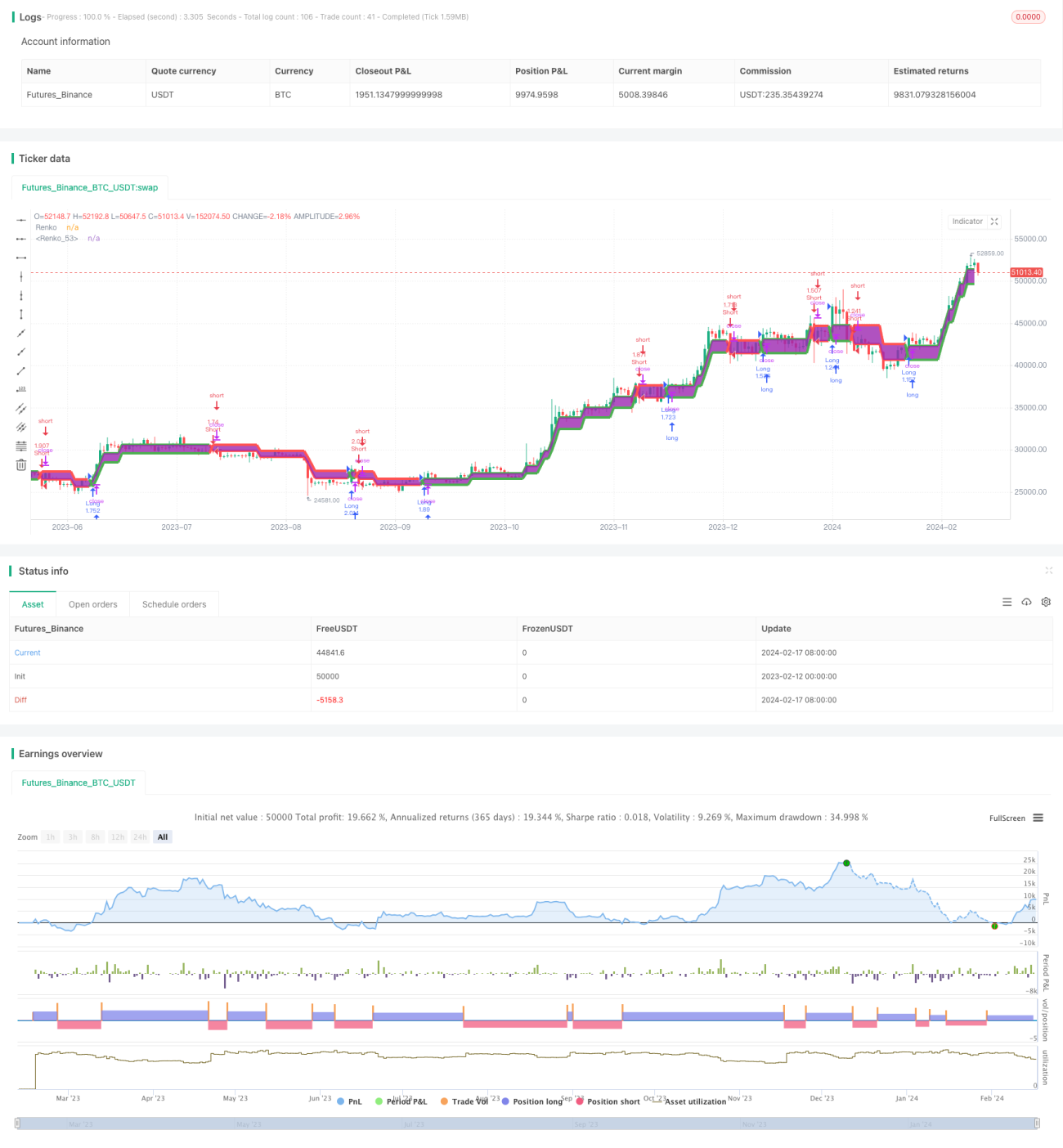
Cette stratégie détermine les variations de momentum du marché en simulant la formation de briques et prend des positions longues ou courtes en fonction de la direction des briques.
Principe de la stratégie
Le principe central de cette stratégie consiste à calculer la relation entre l'ATR et le prix de clôture pour simuler la formation de briques. Plus précisément, deux variables sont définies : Brick1 et Brick2.
Le calcul de Brick1 est le suivant : si le prix de clôture dépasse la valeur de Brick1 de la veille + l'ATR, alors Brick1 prend la valeur de Brick1 de la veille + l'ATR ; si le prix de clôture est inférieur à Brick1 de la veille - l'ATR, alors Brick1 prend la valeur de Brick1 de la veille - l'ATR ; sinon, Brick1 conserve la valeur de Brick1 de la veille.
Le calcul de Brick2 est le suivant : si la valeur de Brick1 diffère de celle de Brick1 de la veille, alors Brick2 prend la valeur de Brick1 de la veille ; sinon, Brick2 conserve sa valeur de la veille.
Ainsi, la formation de briques est simulée. Lorsque Brick1 augmente de plus d'un ATR, une brique haussière se forme ; lorsque Brick1 baisse de plus d'un ATR, une brique baissière se forme. Brick2 enregistre la position de la brique précédente.
Lorsque Brick1 et Brick2 se croisent à la hausse, cela indique une extension de la brique vers le haut et un signal haussier. Lorsqu'ils se croisent à la baisse, cela indique une contraction de la brique vers le bas et un signal baissier.
Avantages de la stratégie
- L'utilisation de l'ATR pour déterminer la formation des briques évite l'emploi de briques de taille fixe et permet de s'adapter dynamiquement à la volatilité du marché.
- La direction haussière ou baissière est identifiée par le croisement des briques, ce qui permet de détecter les variations de momentum.
- Il est possible d'ajuster la sensibilité du jugement du momentum en modifiant la période de l'ATR.
- La visualisation de la formation et des croisements des briques offre une interprétation intuitive de l'évolution du marché.
Risques de la stratégie
- Le choix de la taille de l'ATR influence la rentabilité de la stratégie. Un ATR trop petit génère trop de briques et de nombreux signaux inefficaces ; un ATR trop grand produit trop peu de briques et risque de manquer des opportunités.
- Les mouvements réels peuvent ne pas suivre la forme des briques ; le signal de croisement peut être invalidé par un retournement du marché.
- Une grande sensibilité aux coûts de transaction est nécessaire, car des croisements fréquents des briques réduiraient considérablement le bénéfice net.
L'optimisation des paramètres permet de trouver la meilleure période d'ATR ; l'ajustement des stratégies de stop-profit et stop-loss réduit les pertes dues aux signaux inefficaces ; l'augmentation appropriée des instruments de trading atténue l'impact des coûts sur les performances.
Optimisation de la stratégie
- Il est possible de filtrer les signaux en combinant d'autres indicateurs (indicateurs de volume, oscillateurs, etc.) pour éviter les signaux inefficaces.
- Ajouter un filtre de tendance pour n'émettre des signaux que dans le sens de la tendance, évitant ainsi les pertes lors des retournements.
- Utiliser une méthode d'optimisation des paramètres sur l'ensemble de l'échantillon en période de test pour trouver automatiquement les paramètres optimaux.
Résumé
Cette stratégie détermine la tendance et le momentum à court/moyen terme du marché en simulant dynamiquement le croisement des briques, avec une visualisation intuitive. La marge d'optimisation est importante ; l'optimisation des paramètres et le filtrage des signaux peuvent améliorer davantage sa stabilité.
- 1