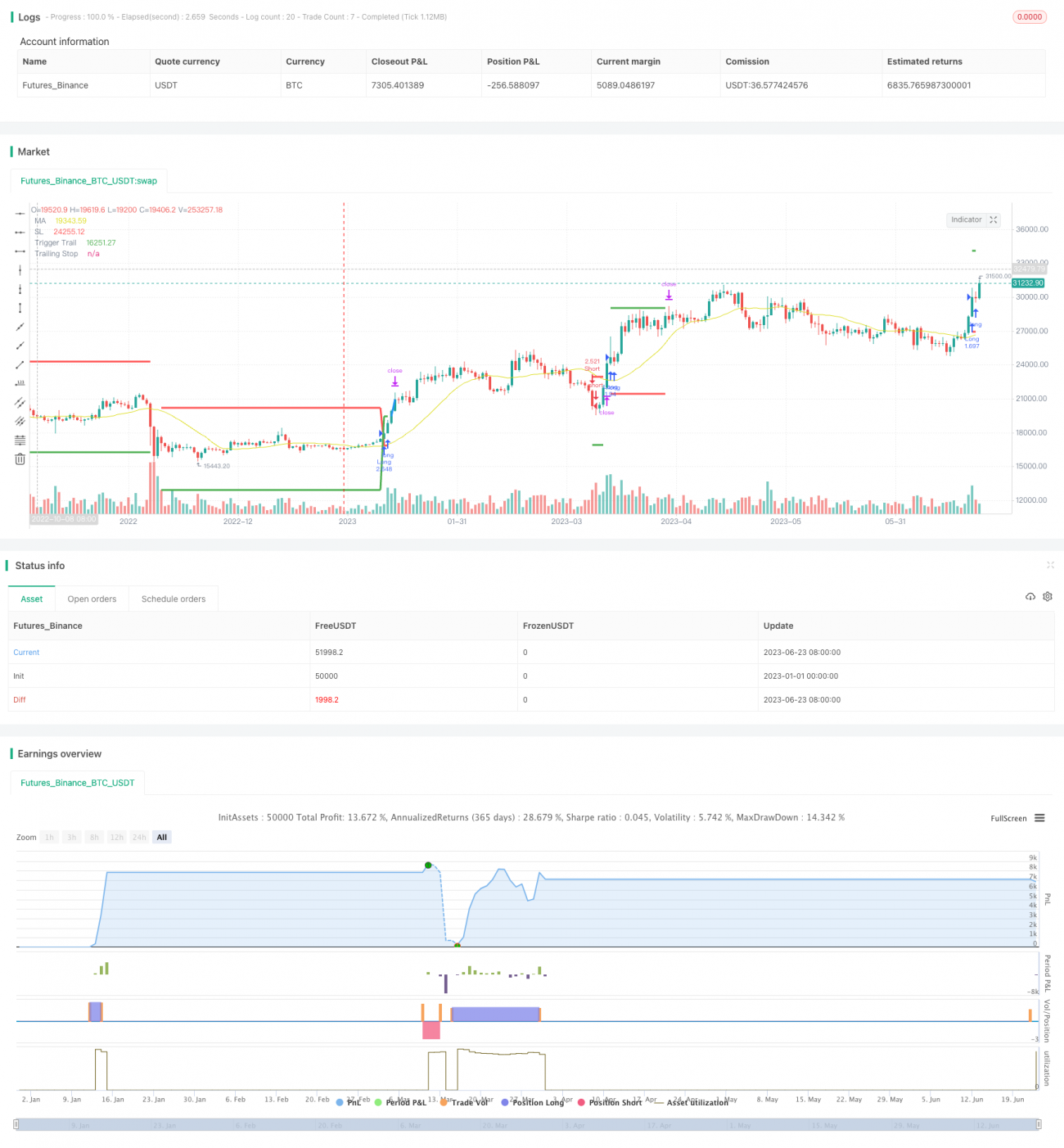
यह रणनीति RSI और भारित चलती औसत को जोड़ती है, जिससे ट्रेंड फॉलोइंग ट्रेडिंग की अनुमति मिलती है। RSI 60 से अधिक होने पर तेजी से बढ़ता है, और RSI 40 से कम होने पर तेजी से बढ़ता है, जबकि चलती औसत को ट्रेंड फॉलोइंग शर्तों को पूरा करने की आवश्यकता होती है। 40 चक्र RSI को ट्रेंड फॉलोइंग इंडिकेटर के रूप में उपयोग किया जाता है। भारित चलती औसत विभिन्न भारों के माध्यम से अल्पकालिक उतार-चढ़ाव के प्रभाव को कम करता है। रणनीति एक साथ स्टॉप लॉस और एक चलती स्टॉप सेट करती है ताकि जोखिम को नियंत्रित किया जा सके।
रणनीति पहले आरएसआई और भारित चलती औसत की गणना करती है। आरएसआई की लंबाई 20 चक्र है, भारित चलती औसत की लंबाई 20 है, और अल्पकालिक उतार-चढ़ाव के प्रभाव को कम करने के लिए भारी वजन सेट किया गया है। जब आरएसआई 60 से अधिक है और भारित चलती औसत में परिवर्तन की दर 1% से कम है, तो कई ऑपरेशन किए जाते हैं; जब आरएसआई 40 से कम है और भारित चलती औसत में परिवर्तन की दर 1% से अधिक है, तो शून्य ऑपरेशन किया जाता है।
एक बार जब आप एक अतिरिक्त स्टॉप करते हैं, तो आप एक ही समय में एक स्टॉप ऑर्डर और एक मोबाइल स्टॉप ऑर्डर सेट करते हैं। स्टॉप ऑर्डर वर्तमान मूल्य से 3 गुना एटीआर से दूर होता है; मोबाइल स्टॉप ऑर्डर वर्तमान मूल्य से 4 गुना एटीआर से पहले सक्रिय होता है, फिर 3% की दर से आगे बढ़ता है। जब कीमत स्टॉप ऑर्डर या मोबाइल स्टॉप ऑर्डर को टच करती है, तो संबंधित स्थिति बंद हो जाती है।
इस रणनीति में धन प्रबंधन के नियम भी शामिल किए गए हैं, जो एक निश्चित अनुपात के माध्यम से स्थिति को समायोजित करते हैं। जब भी लाभ या हानि एक निश्चित राशि तक पहुंचती है, तो एक निश्चित संख्या में लेनदेन की मात्रा में वृद्धि या कमी होती है।
इस रणनीति का समग्र लाभ यह है कि यह प्रवृत्ति का पालन करने में सक्षम है, जबकि जोखिम को नियंत्रित करने के लिए स्टॉप लॉस और मूव स्टॉप उपायों को लागू करता है, जिससे मजबूत स्थिति में बेहतर रिटर्न मिलता है।
इस रणनीति का मुख्य जोखिम आरएसआई संकेतक की विश्वसनीयता और यह है कि क्या स्टॉपलॉस को रोकना उचित है। यदि पैरामीटर को गलत तरीके से सेट किया जाता है, तो यह अनावश्यक रूप से सपाट हो सकता है या वहन क्षमता से अधिक नुकसान हो सकता है। इसके अलावा, जब स्टॉपलॉस या स्टॉपलॉस की कीमत को तोड़ दिया जाता है, तो स्टॉपलॉस को मजबूर किया जा सकता है और प्रवृत्ति को जारी रखने का अवसर खो दिया जाता है।
आरएसआई मापदंडों को अनुकूलित करने पर विचार किया जा सकता है, या अन्य संकेतकों का उपयोग करके निर्णय लेने में सहायता की जा सकती है। विभिन्न किस्मों और उतार-चढ़ाव के लिए स्टॉपलॉस और मोबाइल स्टॉपलॉस मापदंडों को समायोजित करें। अंत में, धन प्रबंधन नियमों को सावधानीपूर्वक सेट करें, जो जोखिम सहनशक्ति से अधिक जोखिम से बचने के लिए बहुत कट्टरपंथी नहीं हो सकते।
इस रणनीति को कई पहलुओं से अनुकूलित किया जा सकता है। सबसे पहले, अन्य तकनीकी संकेतकों की तलाश करें जो आरएसआई को पूरक या पुष्टि कर सकते हैं, जिससे संकेत की विश्वसनीयता में सुधार हो सके। दूसरा, स्टॉप-लॉस-मोबाइल-स्टॉप पैरामीटर को अनुकूलित करना बहुत महत्वपूर्ण है, जो कि विशिष्ट किस्म की विशेषताओं के अनुसार है। विभिन्न मापदंडों के लाभप्रद प्रभाव को ऐतिहासिक डेटा पर परीक्षण किया जा सकता है। धन प्रबंधन को अन्य प्रकार के तरीकों के लिए भी अनुकूलित किया जा सकता है। अंत में, स्थिति खोलने और स्थिति बढ़ाने की शर्तों को और भी अनुकूलित किया जा सकता है, जब रुझान मजबूत होता है, तो स्थिति को उचित रूप से जोड़ा जाता है।
RSI ट्रेंड ट्रैकिंग रणनीति की समग्र सोच स्पष्ट है, इसका केंद्र RSI का उपयोग करके ट्रेंड की दिशा का आकलन करने में है, और यह निर्णय की सटीकता को बढ़ाने के लिए एक भारित चलती औसत की सहायता करता है। रणनीति का लाभ यह है कि यह ट्रेंड को ट्रैक करने और लाभ को अधिकतम करने के लिए लॉक करने में सक्षम है, जबकि जोखिम को नियंत्रित करने के लिए स्टॉप और फंड मैनेजमेंट भी सेट किया गया है। लेकिन RSI संकेतक की कम विश्वसनीयता और पैरामीटर सेटिंग्स में अनुकूलन के लिए जगह है। हम स्टॉप सिग्नल संकेतक, नुकसान के लिए चलती स्टॉप पैरामीटर और फंड मैनेजमेंट के तरीकों को अनुकूलित करने से शुरू कर सकते हैं, जिससे रणनीति विभिन्न किस्मों के लिए अधिक उपयुक्त हो और बेहतर परिणाम प्राप्त हो सके।
||
This strategy combines the RSI indicator and weighted moving average for trend following trading. It goes long when RSI is above 60 and goes short when RSI is below 40, with the moving average verifying the trend condition. The 40-period RSI acts as a trend following indicator. The weighted moving average uses different weights to reduce the impact of short-term fluctuations. The strategy also employs stop loss and trailing take profit to control risks.
The strategy firstly calculates the RSI and weighted moving average. The RSI length is 20 periods and the weighted MA length is 20 with higher weights that reduce the impact of short-term volatility. It goes long when RSI is above 60 and weighted MA rate of change is below -1%. It goes short when RSI is below 40 and weighted MA rate of change is above 1%.
After opening long or short, stop loss and trailing take profit orders are placed simultaneously. The stop loss is set at 3 ATR from the current price. The initial trailing take profit activation is 4 ATR away, and trails in 3% increments. When price hits either stop loss or trailing take profit activation, the position will be closed.
The strategy also incorporates money management rules based on the fixed fractional position sizing approach. Whenever PNL hits a fixed amount, the order size is increased or decreased by a fixed amount.
The overall edge is the ability to follow trends, while taking stop loss and trailing take profit measures to control risks, thus capturing significant gains in strong trends.
The main risks come from the reliability of RSI signals and the stop loss/trailing take profit settings. Incorrect parameters may result in unnecessary closing of trades or losses beyond risk appetite. Breaking stop loss/take profit may also force unwarranted stop outs, losing the chance to continue trend trading.
Solutions include optimizing RSI parameters or adding other indicators for signal confirmation. Adjust stop/trailing take profit levels based on different products and volatility conditions. Also be prudent with money management rules to avoid excessive risks.
There are many aspects to optimize. First is identifying other indicators to supplement RSI signals. Next critical step is optimizing stop loss/trailing take profit parameters based on historical performance. Money management can also switch to other types. Finally, entry, add-on conditions can be enhanced to pyramiding positions in strong trends.
The RSI trend following strategy has clear logic, using RSI for trend direction and weighted MA for confirmation. Its strength lies in trend trading, maximizing profits with stops/money management controlling risks. But RSI reliability and parameter optimization need improvement. We can look into enhancing signal indicators, stop/trailing parameters, money management methods etc to make the strategy more robust across different products.
[/trans]
/*backtest
start: 2023-01-01 00:00:00
end: 2023-06-24 00:00:00
period: 1d
basePeriod: 1h
exchanges: [{"eid":"Futures_Binance","currency":"BTC_USDT"}]
*/
// This source code is subject to the terms of the Mozilla Public License 2.0 at https://mozilla.org/MPL/2.0/
// © gsanson66
//This code is based on RSI and a backed weighted MA
//@version=5
strategy("RSI + MA BACKTESTING", overlay=true, initial_capital=1000, default_qty_type=strategy.fixed, commission_type=strategy.commission.percent, commission_value=0.18)
//------------------------FUNCTIONS---------------------------//
//@function which calculate a retro weighted moving average to minimize the impact of short term reversal
rwma(source, length) =>
sum = 0.0
denominator = 0.0
weight = 0.0
weight_x = 100/(4+(length-4)*1.30)
weight_y = 1.30*weight_x
for i=0 to length - 1
if i <= 3
weight := weight_x
else
weight := weight_y
sum := sum + source[i] * weight
denominator := denominator + weight
rwma = sum/denominator
//@function which permits the user to choose a moving average type
ma(source, length, type) =>
switch type
"SMA" => ta.sma(source, length)
"RWMA" => rwma(source, length)
//@function Displays text passed to `txt` when called.
debugLabel(txt, color) =>
label.new(bar_index, high, text = txt, color=color, style = label.style_label_lower_right, textcolor = color.black, size = size.small)
//@function which looks if the close date of the current bar falls inside the date range
inBacktestPeriod(start, end) => (time >= start) and (time <= end)
//--------------------------------USER INPUTS-------------------------------//
//Technical parameters
rsiLengthInput = input.int(20, minval=1, title="RSI Length", group="RSI Settings")
maTypeInput = input.string("RWMA", title="MA Type", options=["SMA", "RWMA"], group="MA Settings", inline="1")
maLenghtInput = input.int(20, minval=1, title="MA Length", group="MA Settings", inline="1")
rsiLongSignalValue = input.int(60, minval=1, maxval=99, title="RSI Long Signal", group="Strategy parameters", inline="3")
rsiShortSignalValue = input.int(40, minval=1, maxval=99, title="RSI Short Signal", group="Strategy parameters", inline="3")
rocMovAverLongSignalValue = input.float(-1, maxval=0, title="ROC MA Long Signal", group="Strategy parameters", inline="4")
rocMovAverShortSignalValue = input.float(1, minval=0, title="ROC MA Short Signal", group="Strategy parameters", inline="4")
//TP Activation and Trailing TP
takeProfitActivationInput = input.float(4, minval=1.0, title="TP activation in multiple of ATR", group="Strategy parameters")
trailingStopInput = input.float(3, minval=0, title="Trailing TP in percentage", group="Strategy parameters")
//Money Management
fixedRatio = input.int(defval=400, minval=1, title="Fixed Ratio Value ($)", group="Money Management")
increasingOrderAmount = input.int(defval=200, minval=1, title="Increasing Order Amount ($)", group="Money Management")
//Backtesting period
startDate = input(title="Start Date", defval=timestamp("1 Jan 2018 00:00:00"), group="Backtesting Period")
endDate = input(title="End Date", defval=timestamp("1 July 2024 00:00:00"), group="Backtesting Period")
strategy.initial_capital = 50000
//------------------------------VARIABLES INITIALISATION-----------------------------//
float rsi = ta.rsi(close, rsiLengthInput)
float ma = ma(close, maLenghtInput, maTypeInput)
float roc_ma = ((ma/ma[maLenghtInput]) - 1)*100
float atr = ta.atr(20)
var float trailingStopOffset = na
var float trailingStopActivation = na
var float trailingStop = na
var float stopLoss = na
var bool long = na
var bool short = na
var bool bufferTrailingStopDrawing = na
float theoreticalStopPrice = na
bool inRange = na
equity = strategy.equity - strategy.openprofit
var float capital_ref = strategy.initial_capital
var float cashOrder = strategy.initial_capital * 0.95
//------------------------------CHECKING SOME CONDITIONS ON EACH SCRIPT EXECUTION-------------------------------//
//Checking if the date belong to the range
inRange := true
//Checking performances of the strategy
if equity > capital_ref + fixedRatio
spread = (equity - capital_ref)/fixedRatio
nb_level = int(spread)
increasingOrder = nb_level * increasingOrderAmount
cashOrder := cashOrder + increasingOrder
capital_ref := capital_ref + nb_level*fixedRatio
if equity < capital_ref - fixedRatio
spread = (capital_ref - equity)/fixedRatio
nb_level = int(spread)
decreasingOrder = nb_level * increasingOrderAmount
cashOrder := cashOrder - decreasingOrder
capital_ref := capital_ref - nb_level*fixedRatio
//Checking if we close all trades in case where we exit the backtesting period
if strategy.position_size!=0 and not inRange
debugLabel("END OF BACKTESTING PERIOD : we close the trade", color=color.rgb(116, 116, 116))
strategy.close_all()
bufferTrailingStopDrawing := false
stopLoss := na
trailingStopActivation := na
trailingStop := na
short := false
long := false
//------------------------------STOP LOSS AND TRAILING STOP ACTIVATION----------------------------//
// We handle the stop loss and trailing stop activation
if (low <= stopLoss or high >= trailingStopActivation) and long
if high >= trailingStopActivation
bufferTrailingStopDrawing := true
else if low <= stopLoss
long := false
stopLoss := na
trailingStopActivation := na
if (low <= trailingStopActivation or high >= stopLoss) and short
if low <= trailingStopActivation
bufferTrailingStopDrawing := true
else if high >= stopLoss
short := false
stopLoss := na
trailingStopActivation := na
//-------------------------------------TRAILING STOP--------------------------------------//
// If the traling stop is activated, we manage its plotting with the bufferTrailingStopDrawing
if bufferTrailingStopDrawing and long
theoreticalStopPrice := high - trailingStopOffset * syminfo.mintick
if na(trailingStop)
trailingStop := theoreticalStopPrice
else if theoreticalStopPrice > trailingStop
trailingStop := theoreticalStopPrice
else if low <= trailingStop
trailingStop := na
bufferTrailingStopDrawing := false
long := false
if bufferTrailingStopDrawing and short
theoreticalStopPrice := low + trailingStopOffset * syminfo.mintick
if na(trailingStop)
trailingStop := theoreticalStopPrice
else if theoreticalStopPrice < trailingStop
trailingStop := theoreticalStopPrice
else if high >= trailingStop
trailingStop := na
bufferTrailingStopDrawing := false
short := false
//---------------------------------LONG CONDITION--------------------------//
if rsi >= 60 and roc_ma <= rocMovAverLongSignalValue and inRange and not long
if short
bufferTrailingStopDrawing := false
stopLoss := na
trailingStopActivation := na
trailingStop := na
short := false
trailingStopActivation := close + takeProfitActivationInput*atr
trailingStopOffset := (trailingStopActivation * trailingStopInput/100) / syminfo.mintick
stopLoss := close - 3*atr
long := true
qty = cashOrder/close
strategy.entry("Long", strategy.long, qty)
strategy.exit("Exit Long", "Long", stop = stopLoss, trail_price = trailingStopActivation,
trail_offset = trailingStopOffset)
//--------------------------------SHORT CONDITION-------------------------------//
if rsi <= 40 and roc_ma >= rocMovAverShortSignalValue and inRange and not short
if long
bufferTrailingStopDrawing := false
stopLoss := na
trailingStopActivation := na
trailingStop := na
long := false
trailingStopActivation := close - takeProfitActivationInput*atr
trailingStopOffset := (trailingStopActivation * trailingStopInput/100) / syminfo.mintick
stopLoss := close + 3*atr
short := true
qty = cashOrder/close
strategy.entry("Short", strategy.short, qty)
strategy.exit("Exit Short", "Short", stop = stopLoss, trail_price = trailingStopActivation,
trail_offset = trailingStopOffset)
//--------------------------------PLOTTING ELEMENT---------------------------------//
// Plotting of element in the graph
plotchar(rsi, "RSI", "", location.top, color.rgb(0, 214, 243))
plot(ma, "MA", color.rgb(219, 219, 18))
plotchar(roc_ma, "ROC MA", "", location.top, color=color.orange)
// Visualizer trailing stop and stop loss movement
plot(stopLoss, "SL", color.red, 3, plot.style_linebr)
plot(trailingStopActivation, "Trigger Trail", color.green, 3, plot.style_linebr)
plot(trailingStop, "Trailing Stop", color.blue, 3, plot.style_linebr)