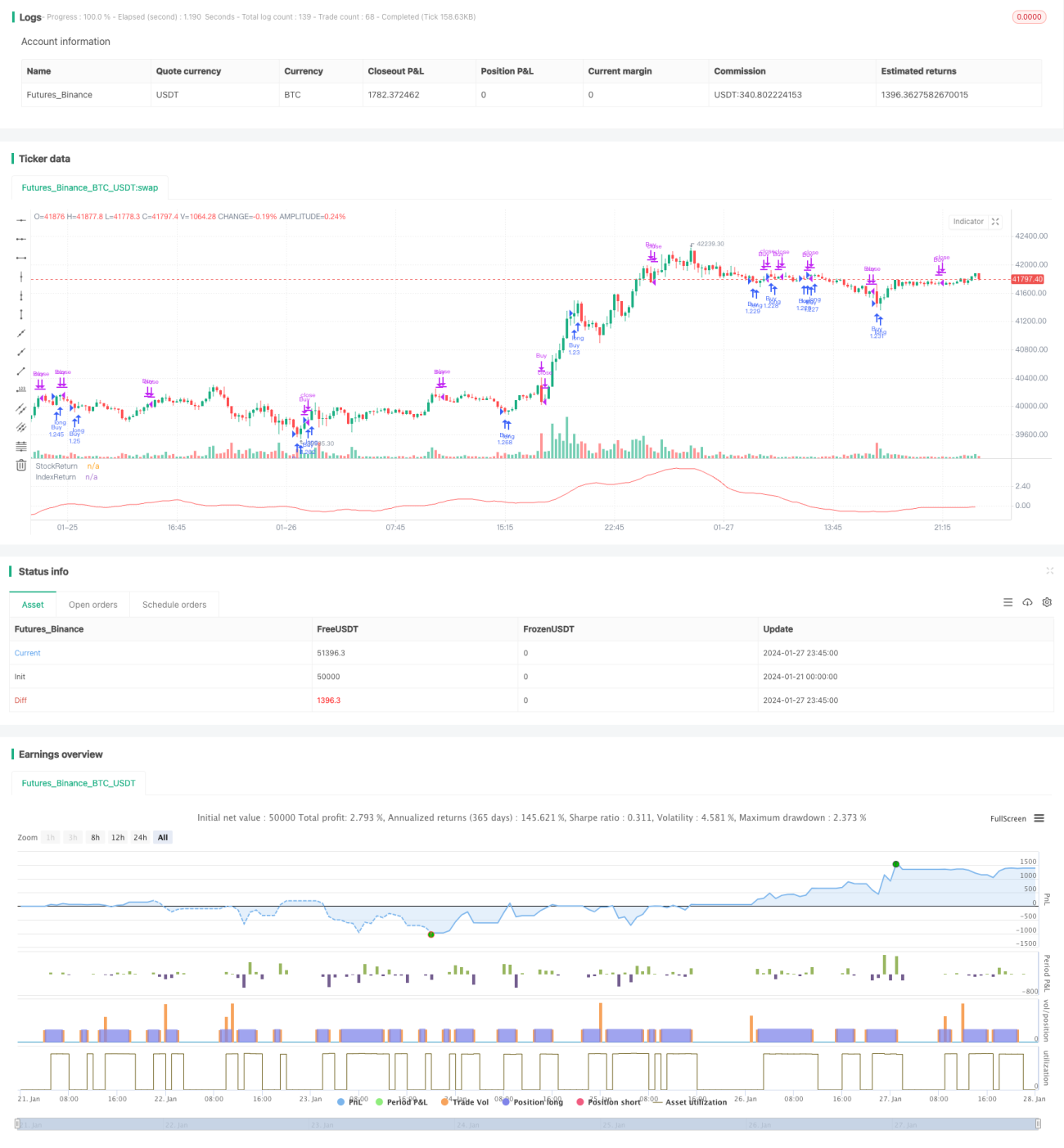
相対動力の戦略は,株と指数の動力を比較して,大市場に対する株の強さを判断する.株の動力が大市場より高いときに買い,株の動力が大市場より低いときに売って,株の成長ピークを捕捉する.
この戦略は,各株の強さと大株の弱さを見極め,以下のように論理的に考えます.
この論理を踏まえれば,株が成長のピークを突破したときに購入し,その成長の勢いが衰退したときに売って,その成長のピークの余剰利益に鍵をかけることができます.
相対的な動量戦略は,主に以下の利点がある.
この戦略にはリスクがあります.
これらのリスクは,合理的なストップ・ストップ・損失,適切なパラメータの調整などの方法によって制御できます.
相対的な動量策は,以下の点で最適化できます.
相対動量戦略は,各株の相対的に大きなポケットの成長ピークを捕捉することによって,効率的に余分な利益を得ることができます.この戦略は,シンプルで明確な買賣論理,操作の容易さの利点があり,パラメータ最適化とリスク管理により,優れた効果を得ることができます.
/*backtest
start: 2024-01-21 00:00:00
end: 2024-01-28 00:00:00
period: 15m
basePeriod: 5m
exchanges: [{"eid":"Futures_Binance","currency":"BTC_USDT"}]
*/
// This source code is subject to the terms of the Mozilla Public License 2.0 at https://mozilla.org/MPL/2.0/
// © HeWhoMustNotBeNamed
//@version=4
strategy("Relative Returns Strategy", overlay=false, initial_capital = 100000, default_qty_type = strategy.percent_of_equity, default_qty_value = 100, commission_type = strategy.commission.percent, pyramiding = 1, commission_value = 0.01, calc_on_order_fills = true)
index_ticker=input("BTC_USDT:swap")
Loopback = input(40, step=20)
useStopAndIndexReturns = input(true)
useStopAndIndexReturnsMa = input(true)
useDifference = not useStopAndIndexReturns
MAType = input(title="Moving Average Type", defval="sma", options=["ema", "sma", "hma", "rma", "vwma", "wma"])
MALength = input(10, minval=10,step=10)
i_startTime = input(defval = timestamp("01 Jan 2010 00:00 +0000"), title = "Backtest Start Time", type = input.time)
i_endTime = input(defval = timestamp("01 Jan 2099 00:00 +0000"), title = "Backtest End Time", type = input.time)
inDateRange = true
f_secureSecurity(_symbol, _res, _src, _offset) => security(_symbol, _res, _src[_offset], lookahead = barmerge.lookahead_on)
f_getMovingAverage(source, MAType, length)=>
ma = sma(source, length)
if(MAType == "ema")
ma := ema(source,length)
if(MAType == "hma")
ma := hma(source,length)
if(MAType == "rma")
ma := rma(source,length)
if(MAType == "vwma")
ma := vwma(source,length)
if(MAType == "wma")
ma := wma(source,length)
ma
index = f_secureSecurity(index_ticker, '1D', close, 0)
stock_return = (close - close[Loopback])*100/close
index_return = (index - index[Loopback])*100/index
stock_return_ma = f_getMovingAverage(stock_return, MAType, MALength)
index_return_ma = f_getMovingAverage(index_return, MAType, MALength)
relativeReturns = stock_return - index_return
relativeReturns_ma = f_getMovingAverage(relativeReturns, MAType, MALength)
plot(useStopAndIndexReturns ? useStopAndIndexReturnsMa ? stock_return_ma : stock_return : na, title="StockReturn", color=color.green, linewidth=1)
plot(useStopAndIndexReturns ? useStopAndIndexReturnsMa ? index_return_ma : index_return : na, title="IndexReturn", color=color.red, linewidth=1)
plot(useDifference?relativeReturns:na, title="Relative-Returns", color=color.blue, linewidth=1)
plot(useDifference?relativeReturns_ma:na, title="MA", color=color.red, linewidth=1)
buyCondition = (useStopAndIndexReturns ? useStopAndIndexReturnsMa ? stock_return_ma > index_return_ma : stock_return > index_return : relativeReturns > relativeReturns_ma)
closeBuyCondition = (useStopAndIndexReturns ? useStopAndIndexReturnsMa ? stock_return_ma < index_return_ma : stock_return < index_return : relativeReturns < relativeReturns_ma)
strategy.entry("Buy", strategy.long, when=buyCondition and inDateRange, oca_name="oca")
strategy.close("Buy", when=closeBuyCondition)