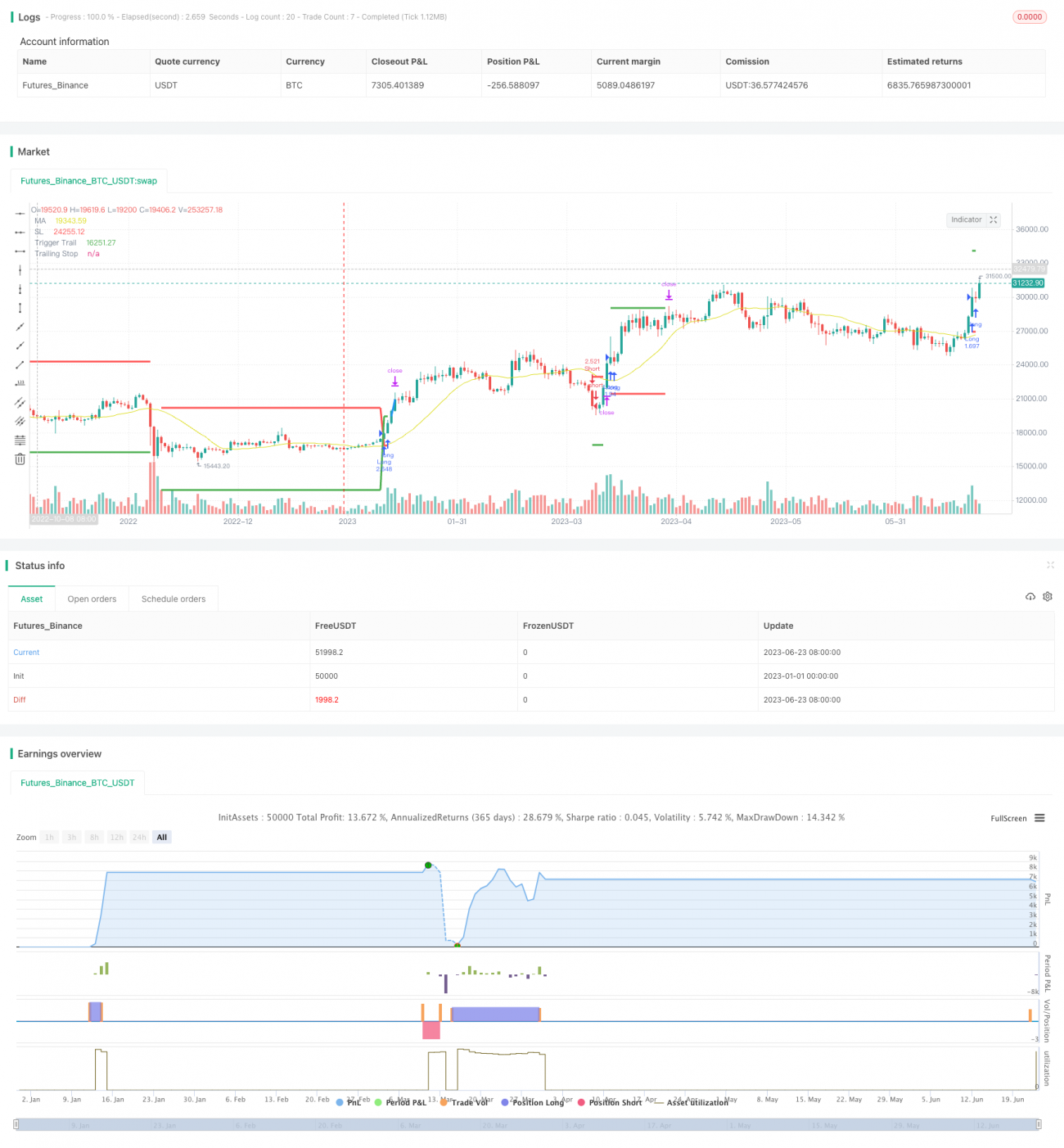
Chiến lược này kết hợp chỉ số RSI và đường trung bình di chuyển có trọng lượng để thực hiện giao dịch theo xu hướng. Khi RSI cao hơn 60 thì bullish, khi RSI thấp hơn 40 thì hoành tráng, đồng thời yêu cầu đường trung bình di chuyển đáp ứng các điều kiện xu hướng. Sử dụng RSI 40 chu kỳ làm chỉ số theo xu hướng.
Chiến lược này đầu tiên tính RSI và trung bình di chuyển trọng lượng. RSI dài 20 chu kỳ, trung bình di chuyển trọng lượng dài 20, đặt trọng lượng lớn hơn để giảm tác động của biến động ngắn hạn.
Sau khi thực hiện nhiều thời gian mở rộng, sẽ đồng thời thiết lập lệnh dừng lỗ và lệnh dừng di động. Đặt lệnh dừng lỗ cách xa giá hiện tại 3 lần ATR; Đặt lệnh dừng di động kích hoạt giá ban đầu cách xa giá hiện tại 4 lần ATR, sau đó di chuyển với tỷ lệ 3%. Khi giá chạm vào giá dừng lỗ hoặc giá kích hoạt dừng di động, sẽ đóng vị trí tương ứng.
Chiến lược này cũng bổ sung các quy tắc quản lý tiền, điều chỉnh vị trí thông qua quy tắc tỷ lệ cố định. Mỗi khi lợi nhuận hoặc lỗ đạt đến một số tiền cố định, tăng hoặc giảm số lượng giao dịch cố định.
Lợi thế tổng thể của chiến lược này là có thể theo dõi xu hướng, đồng thời sử dụng các biện pháp dừng lỗ và di chuyển để kiểm soát rủi ro, từ đó thu được lợi nhuận tốt hơn trong tình huống mạnh mẽ.
Rủi ro chính của chiến lược này là độ tin cậy của chỉ số RSI và tính hợp lý của thiết lập dừng chân di động. Nếu các tham số được thiết lập không đúng, có thể dẫn đến mất mát không cần thiết hoặc vượt quá khả năng chịu đựng. Ngoài ra, có thể bị buộc dừng lại khi phá vỡ giá dừng hoặc giá dừng, mất cơ hội tiếp tục theo dõi xu hướng.
Có thể xem xét tối ưu hóa các tham số RSI, hoặc thay đổi các chỉ số khác để hỗ trợ phán đoán. Điều chỉnh tham số dừng lỗ di động để phù hợp với các giống và tình huống biến động khác nhau. Cuối cùng, hãy cẩn thận thiết lập các quy tắc quản lý tiền, không nên quá quyết liệt để tránh vượt quá khả năng chịu rủi ro.
Chiến lược này có thể được tối ưu hóa từ nhiều khía cạnh. Đầu tiên là tìm các chỉ số kỹ thuật khác có thể hỗ trợ hoặc xác nhận các chỉ số RSI, tăng độ tin cậy tín hiệu. Thứ hai, tối ưu hóa các tham số dừng lỗ di động theo đặc điểm của từng loại rất quan trọng.
Chiến lược theo dõi xu hướng RSI có ý tưởng tổng thể rõ ràng, cốt lõi là sử dụng RSI để xác định xu hướng và hỗ trợ tăng cường độ chính xác của xu hướng bằng cách tăng trọng lượng trung bình di chuyển. Ưu điểm của chiến lược là có thể theo dõi xu hướng và tối đa hóa lợi nhuận, đồng thời thiết lập dừng lỗ và quản lý tài chính để kiểm soát rủi ro.
||
This strategy combines the RSI indicator and weighted moving average for trend following trading. It goes long when RSI is above 60 and goes short when RSI is below 40, with the moving average verifying the trend condition. The 40-period RSI acts as a trend following indicator. The weighted moving average uses different weights to reduce the impact of short-term fluctuations. The strategy also employs stop loss and trailing take profit to control risks.
The strategy firstly calculates the RSI and weighted moving average. The RSI length is 20 periods and the weighted MA length is 20 with higher weights that reduce the impact of short-term volatility. It goes long when RSI is above 60 and weighted MA rate of change is below -1%. It goes short when RSI is below 40 and weighted MA rate of change is above 1%.
After opening long or short, stop loss and trailing take profit orders are placed simultaneously. The stop loss is set at 3 ATR from the current price. The initial trailing take profit activation is 4 ATR away, and trails in 3% increments. When price hits either stop loss or trailing take profit activation, the position will be closed.
The strategy also incorporates money management rules based on the fixed fractional position sizing approach. Whenever PNL hits a fixed amount, the order size is increased or decreased by a fixed amount.
The overall edge is the ability to follow trends, while taking stop loss and trailing take profit measures to control risks, thus capturing significant gains in strong trends.
The main risks come from the reliability of RSI signals and the stop loss/trailing take profit settings. Incorrect parameters may result in unnecessary closing of trades or losses beyond risk appetite. Breaking stop loss/take profit may also force unwarranted stop outs, losing the chance to continue trend trading.
Solutions include optimizing RSI parameters or adding other indicators for signal confirmation. Adjust stop/trailing take profit levels based on different products and volatility conditions. Also be prudent with money management rules to avoid excessive risks.
There are many aspects to optimize. First is identifying other indicators to supplement RSI signals. Next critical step is optimizing stop loss/trailing take profit parameters based on historical performance. Money management can also switch to other types. Finally, entry, add-on conditions can be enhanced to pyramiding positions in strong trends.
The RSI trend following strategy has clear logic, using RSI for trend direction and weighted MA for confirmation. Its strength lies in trend trading, maximizing profits with stops/money management controlling risks. But RSI reliability and parameter optimization need improvement. We can look into enhancing signal indicators, stop/trailing parameters, money management methods etc to make the strategy more robust across different products.
[/trans]
/*backtest
start: 2023-01-01 00:00:00
end: 2023-06-24 00:00:00
period: 1d
basePeriod: 1h
exchanges: [{"eid":"Futures_Binance","currency":"BTC_USDT"}]
*/
// This source code is subject to the terms of the Mozilla Public License 2.0 at https://mozilla.org/MPL/2.0/
// © gsanson66
//This code is based on RSI and a backed weighted MA
//@version=5
strategy("RSI + MA BACKTESTING", overlay=true, initial_capital=1000, default_qty_type=strategy.fixed, commission_type=strategy.commission.percent, commission_value=0.18)
//------------------------FUNCTIONS---------------------------//
//@function which calculate a retro weighted moving average to minimize the impact of short term reversal
rwma(source, length) =>
sum = 0.0
denominator = 0.0
weight = 0.0
weight_x = 100/(4+(length-4)*1.30)
weight_y = 1.30*weight_x
for i=0 to length - 1
if i <= 3
weight := weight_x
else
weight := weight_y
sum := sum + source[i] * weight
denominator := denominator + weight
rwma = sum/denominator
//@function which permits the user to choose a moving average type
ma(source, length, type) =>
switch type
"SMA" => ta.sma(source, length)
"RWMA" => rwma(source, length)
//@function Displays text passed to `txt` when called.
debugLabel(txt, color) =>
label.new(bar_index, high, text = txt, color=color, style = label.style_label_lower_right, textcolor = color.black, size = size.small)
//@function which looks if the close date of the current bar falls inside the date range
inBacktestPeriod(start, end) => (time >= start) and (time <= end)
//--------------------------------USER INPUTS-------------------------------//
//Technical parameters
rsiLengthInput = input.int(20, minval=1, title="RSI Length", group="RSI Settings")
maTypeInput = input.string("RWMA", title="MA Type", options=["SMA", "RWMA"], group="MA Settings", inline="1")
maLenghtInput = input.int(20, minval=1, title="MA Length", group="MA Settings", inline="1")
rsiLongSignalValue = input.int(60, minval=1, maxval=99, title="RSI Long Signal", group="Strategy parameters", inline="3")
rsiShortSignalValue = input.int(40, minval=1, maxval=99, title="RSI Short Signal", group="Strategy parameters", inline="3")
rocMovAverLongSignalValue = input.float(-1, maxval=0, title="ROC MA Long Signal", group="Strategy parameters", inline="4")
rocMovAverShortSignalValue = input.float(1, minval=0, title="ROC MA Short Signal", group="Strategy parameters", inline="4")
//TP Activation and Trailing TP
takeProfitActivationInput = input.float(4, minval=1.0, title="TP activation in multiple of ATR", group="Strategy parameters")
trailingStopInput = input.float(3, minval=0, title="Trailing TP in percentage", group="Strategy parameters")
//Money Management
fixedRatio = input.int(defval=400, minval=1, title="Fixed Ratio Value ($)", group="Money Management")
increasingOrderAmount = input.int(defval=200, minval=1, title="Increasing Order Amount ($)", group="Money Management")
//Backtesting period
startDate = input(title="Start Date", defval=timestamp("1 Jan 2018 00:00:00"), group="Backtesting Period")
endDate = input(title="End Date", defval=timestamp("1 July 2024 00:00:00"), group="Backtesting Period")
strategy.initial_capital = 50000
//------------------------------VARIABLES INITIALISATION-----------------------------//
float rsi = ta.rsi(close, rsiLengthInput)
float ma = ma(close, maLenghtInput, maTypeInput)
float roc_ma = ((ma/ma[maLenghtInput]) - 1)*100
float atr = ta.atr(20)
var float trailingStopOffset = na
var float trailingStopActivation = na
var float trailingStop = na
var float stopLoss = na
var bool long = na
var bool short = na
var bool bufferTrailingStopDrawing = na
float theoreticalStopPrice = na
bool inRange = na
equity = strategy.equity - strategy.openprofit
var float capital_ref = strategy.initial_capital
var float cashOrder = strategy.initial_capital * 0.95
//------------------------------CHECKING SOME CONDITIONS ON EACH SCRIPT EXECUTION-------------------------------//
//Checking if the date belong to the range
inRange := true
//Checking performances of the strategy
if equity > capital_ref + fixedRatio
spread = (equity - capital_ref)/fixedRatio
nb_level = int(spread)
increasingOrder = nb_level * increasingOrderAmount
cashOrder := cashOrder + increasingOrder
capital_ref := capital_ref + nb_level*fixedRatio
if equity < capital_ref - fixedRatio
spread = (capital_ref - equity)/fixedRatio
nb_level = int(spread)
decreasingOrder = nb_level * increasingOrderAmount
cashOrder := cashOrder - decreasingOrder
capital_ref := capital_ref - nb_level*fixedRatio
//Checking if we close all trades in case where we exit the backtesting period
if strategy.position_size!=0 and not inRange
debugLabel("END OF BACKTESTING PERIOD : we close the trade", color=color.rgb(116, 116, 116))
strategy.close_all()
bufferTrailingStopDrawing := false
stopLoss := na
trailingStopActivation := na
trailingStop := na
short := false
long := false
//------------------------------STOP LOSS AND TRAILING STOP ACTIVATION----------------------------//
// We handle the stop loss and trailing stop activation
if (low <= stopLoss or high >= trailingStopActivation) and long
if high >= trailingStopActivation
bufferTrailingStopDrawing := true
else if low <= stopLoss
long := false
stopLoss := na
trailingStopActivation := na
if (low <= trailingStopActivation or high >= stopLoss) and short
if low <= trailingStopActivation
bufferTrailingStopDrawing := true
else if high >= stopLoss
short := false
stopLoss := na
trailingStopActivation := na
//-------------------------------------TRAILING STOP--------------------------------------//
// If the traling stop is activated, we manage its plotting with the bufferTrailingStopDrawing
if bufferTrailingStopDrawing and long
theoreticalStopPrice := high - trailingStopOffset * syminfo.mintick
if na(trailingStop)
trailingStop := theoreticalStopPrice
else if theoreticalStopPrice > trailingStop
trailingStop := theoreticalStopPrice
else if low <= trailingStop
trailingStop := na
bufferTrailingStopDrawing := false
long := false
if bufferTrailingStopDrawing and short
theoreticalStopPrice := low + trailingStopOffset * syminfo.mintick
if na(trailingStop)
trailingStop := theoreticalStopPrice
else if theoreticalStopPrice < trailingStop
trailingStop := theoreticalStopPrice
else if high >= trailingStop
trailingStop := na
bufferTrailingStopDrawing := false
short := false
//---------------------------------LONG CONDITION--------------------------//
if rsi >= 60 and roc_ma <= rocMovAverLongSignalValue and inRange and not long
if short
bufferTrailingStopDrawing := false
stopLoss := na
trailingStopActivation := na
trailingStop := na
short := false
trailingStopActivation := close + takeProfitActivationInput*atr
trailingStopOffset := (trailingStopActivation * trailingStopInput/100) / syminfo.mintick
stopLoss := close - 3*atr
long := true
qty = cashOrder/close
strategy.entry("Long", strategy.long, qty)
strategy.exit("Exit Long", "Long", stop = stopLoss, trail_price = trailingStopActivation,
trail_offset = trailingStopOffset)
//--------------------------------SHORT CONDITION-------------------------------//
if rsi <= 40 and roc_ma >= rocMovAverShortSignalValue and inRange and not short
if long
bufferTrailingStopDrawing := false
stopLoss := na
trailingStopActivation := na
trailingStop := na
long := false
trailingStopActivation := close - takeProfitActivationInput*atr
trailingStopOffset := (trailingStopActivation * trailingStopInput/100) / syminfo.mintick
stopLoss := close + 3*atr
short := true
qty = cashOrder/close
strategy.entry("Short", strategy.short, qty)
strategy.exit("Exit Short", "Short", stop = stopLoss, trail_price = trailingStopActivation,
trail_offset = trailingStopOffset)
//--------------------------------PLOTTING ELEMENT---------------------------------//
// Plotting of element in the graph
plotchar(rsi, "RSI", "", location.top, color.rgb(0, 214, 243))
plot(ma, "MA", color.rgb(219, 219, 18))
plotchar(roc_ma, "ROC MA", "", location.top, color=color.orange)
// Visualizer trailing stop and stop loss movement
plot(stopLoss, "SL", color.red, 3, plot.style_linebr)
plot(trailingStopActivation, "Trigger Trail", color.green, 3, plot.style_linebr)
plot(trailingStop, "Trailing Stop", color.blue, 3, plot.style_linebr)