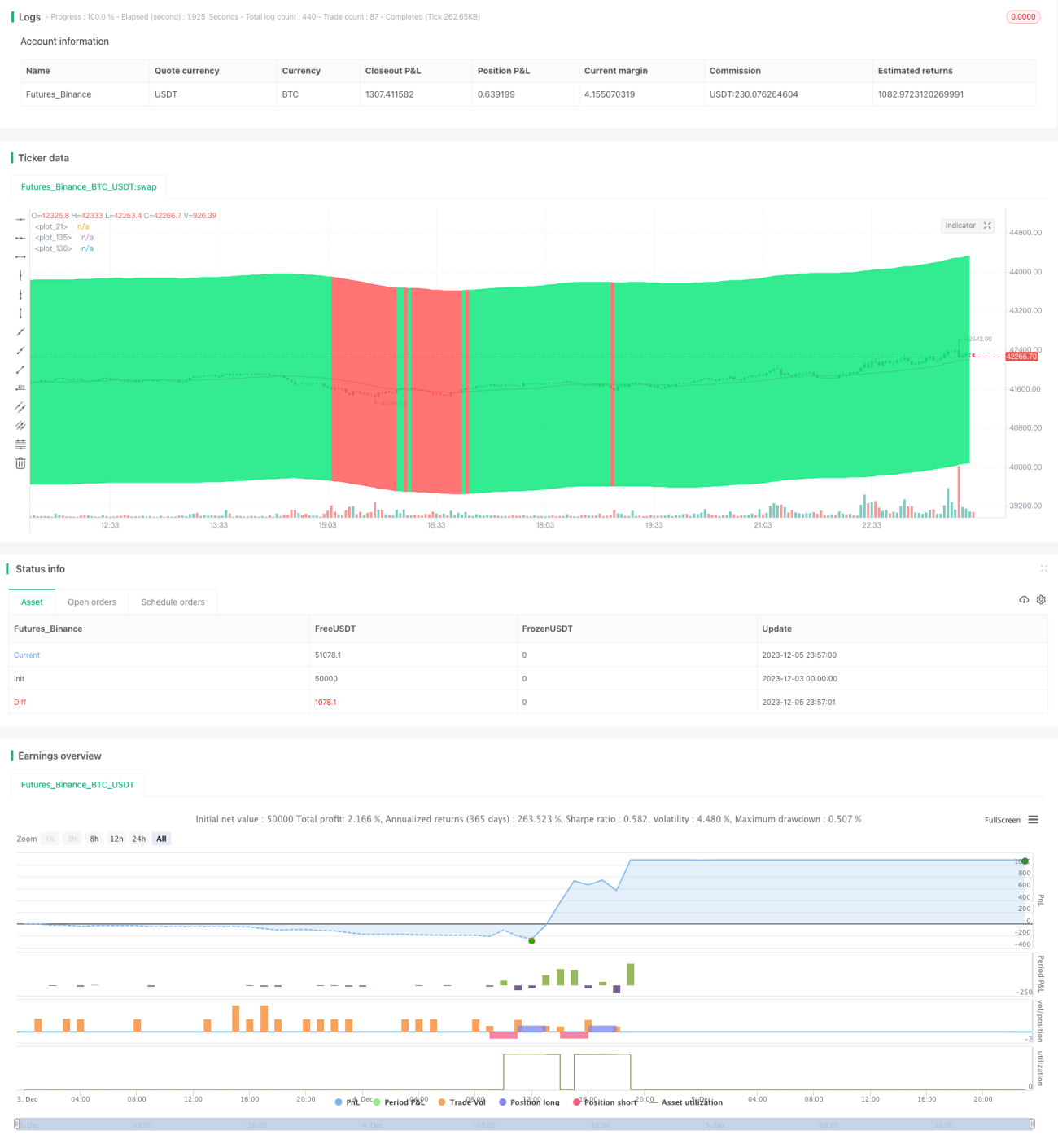
Die Hauptidee dieser Strategie ist es, die Markttrends dynamisch zu verfolgen, zu kaufen, wenn die Tendenz aufwärts geht, und zu verkaufen, wenn die Tendenz abwärts geht. Sie beurteilt die Richtung der Tendenz durch die Berechnung einer Kombination aus mehreren Indikatoren, z. B. lineare Regression, modifizierter Hull Moving Average usw.
Diese Strategie verwendet mehrere technische Indikatoren, um die Richtung des Trends zu bestimmen. Zuerst berechnet sie einen Bereichskanal, dessen obere und untere Grenze auf Basis eines einfachen Moving Averages von close und eines Eingabeparameters berechnet wird. Dann berechnet sie einen modifizierten Hull Moving Average, der den Trend vermutlich genauer abbildet.
Um falsche Signale zu reduzieren, wurden auch mehrere Filter für die Strategie entwickelt. Zum Beispiel wird die EMA verwendet, um zu beurteilen, ob es sich um einen Abwärtstrend handelt, und ein Fensterindikator wird verwendet, um zu beurteilen, ob sich der RSI verändert hat. Diese Filter verhindern die Erzeugung von Handelssignalen in einem bewegten Umfeld.
In Bezug auf den Einstieg und den Stop-Loss zeichnet die Strategie den letzten Eröffnungspreis auf und legt einen Stop-Loss-Prozentsatz fest. Wenn beispielsweise der Preis für die letzte Eröffnung der Position 100 US-Dollar beträgt, wird ein Stop-Target von 102 US-Dollar und ein Stop-Loss-Preis von 95 US-Dollar festgelegt. Dies ermöglicht eine dynamische Verfolgung.
Diese Strategie hat folgende Vorteile:
Die Strategie birgt auch einige Risiken:
Um Risiken zu kontrollieren, können Sie Stop-Loss, Trail Stop oder Optionen einsetzen, um Gewinne zu sperren. Darüber hinaus müssen Sie die Parameterkombinationen wiederholt testen, um einen zuverlässigen Parameterbereich zu finden. Schließlich müssen Sie sich auch auf die Zeit konzentrieren, in der der Indikator berechnet wird, um die Echtzeit des Signals zu erreichen.
Diese Strategie kann in folgenden Bereichen optimiert werden:
In der Optimierung muss die Rückmessung und die Simulation der Transaktionen genutzt werden, um die Signalqualität und die Strategie-Stabilität zu bewerten. Nur nachgewiesene Optimierungssysteme können in der Praxis eingesetzt werden.
Diese Strategie ist insgesamt eine gute Trend-Tracking-Strategie. Sie verwendet mehrere Indikatoren, um Trends zu beurteilen, setzt Filter ein, um Fehlsignale zu reduzieren, und kann automatisch die Stop-Loss-Tracking-Trends anpassen. Wenn die Parameter richtig eingestellt sind, kann sie den mittleren Longline-Trend erfolgreich erfassen.
/*backtest
start: 2023-12-03 00:00:00
end: 2023-12-06 00:00:00
period: 3m
basePeriod: 1m
exchanges: [{"eid":"Futures_Binance","currency":"BTC_USDT"}]
*/
// This source code is subject to the terms of the Mozilla Public License 2.0 at https://mozilla.org/MPL/2.0/
// © RafaelZioni
//@version=4
strategy(title = " BTC 15 min", overlay = true, pyramiding=1,initial_capital = 10000, default_qty_type= strategy.percent_of_equity, default_qty_value = 20, calc_on_order_fills=false, slippage=0,commission_type=strategy.commission.percent,commission_value=0.075)
strat_dir_input = input(title="Strategy Direction", defval="all", options=["long", "short", "all"])
strat_dir_value = strat_dir_input == "long" ? strategy.direction.long : strat_dir_input == "short" ? strategy.direction.short : strategy.direction.all
strategy.risk.allow_entry_in(strat_dir_value)
price = close
length8 = input(30,title = 'length of channel')
upmult = input(title = 'upper percent',type=input.float, step=0.1, defval=5)
lowmult = input(title = 'lower percent',type=input.float, step=0.1, defval=5)
basis = sma(close, length8)
vup = upmult * price / 100
vlow = lowmult * price / 100
upper = basis + vup
lower = basis - vlow
plot(basis, color=color.red)
//
fastLength = input(3, title="Fast filter length ", minval=1)
slowLength = input(21,title="Slow filter length", minval=1)
source=close
v1=ema(source,fastLength)
v2=ema(source,slowLength)
//
leng=1
p1=close[1]
len55 = 10
//taken from https://www.tradingview.com/script/Ql1FjjfX-security-free-MTF-example-JD/
HTF = input("1D", type=input.resolution)
ti = change( time(HTF) ) != 0
T_c = fixnan( ti ? close : na )
vrsi = rsi(cum(change(T_c) * volume), leng)
pp=wma(vrsi,len55)
d=(vrsi[1]-pp[1])
len100 = 10
x=ema(d,len100)
//
zx=x/-1
col=zx > 0? color.lime : color.orange
//
tf10 = input("1", title = "Timeframe", type = input.resolution, options = ["1", "5", "15", "30", "60","120", "240","360","720", "D", "W"])
length = input(50, title = "Period", type = input.integer)
shift = input(1, title = "Shift", type = input.integer)
hma(_src, _length)=>
wma((2 * wma(_src, _length / 2)) - wma(_src, _length), round(sqrt(_length)))
hma3(_src, _length)=>
p = length/2
wma(wma(close,p/3)*3 - wma(close,p/2) - wma(close,p),p)
b =security(syminfo.tickerid, tf10, hma3(close[1], length)[shift])
//plot(a,color=color.gray)
//plot(b,color=color.yellow)
close_price = close[0]
len = input(25)
linear_reg = linreg(close_price, len, 0)
buy=crossover(linear_reg, b)
sell=crossunder(linear_reg, b) or crossunder(close[1],upper)
//
src2=low
src3=high
Min =input(15)
leni = timeframe.isintraday and timeframe.multiplier >= 1 ?
Min / timeframe.multiplier * 7 :
timeframe.isintraday and timeframe.multiplier < 60 ?
60 / timeframe.multiplier * 24 * 7 : 7
l1 = wma(src2,leni)
h1 = wma(src3,leni)
//
m=(h1+l1)/2
//
len5 = 100
src5=m
//
multi = 2
mean = ema(src5, len5)
stddev = multi * stdev(src5, len5)
b5 = mean + stddev
s5 = mean - stddev
var bool long = na
var bool short = na
long :=crossover(src5, s5)
short := crossunder(src5, b5)
var float last_open_long = na
var float last_open_short = na
last_open_long := long ? close : nz(last_open_long[1])
last_open_short := short ? close : nz(last_open_short[1])
entry_value =last_open_long
entry_value1=last_open_short
r=100
//
highb = highest(entry_value1, r)
lowb = lowest(entry_value, r)
d5 = highb - lowb
me = (highb + lowb) / 2
h4 = highb - d5 * 0.236
c3 = highb - d5 * 0.382
c4 = highb - d5 * 0.618
l4 = highb - d5 * 0.764
//
col2 = close >= me ? color.lime : color.red
p5 = plot(upper, color=col2)
p2 = plot(lower, color=col2)
fill(p5, p2,color=col2)
// Conditions
longCond = bool(na)
shortCond = bool(na)
longCond := crossover(zx,0) or buy
shortCond := sell
// Count your long short conditions for more control with Pyramiding
sectionLongs = 0
sectionLongs := nz(sectionLongs[1])
sectionShorts = 0
sectionShorts := nz(sectionShorts[1])
if longCond
sectionLongs := sectionLongs + 1
sectionShorts := 0
sectionShorts
if shortCond
sectionLongs := 0
sectionShorts := sectionShorts + 1
sectionShorts
// Pyramiding
pyrl = 1
// These check to see your signal and cross references it against the pyramiding settings above
longCondition = longCond and sectionLongs <= pyrl
shortCondition = shortCond and sectionShorts <= pyrl
// Get the price of the last opened long or short
last_open_longCondition = float(na)
last_open_shortCondition = float(na)
last_open_longCondition := longCondition ? open : nz(last_open_longCondition[1])
last_open_shortCondition := shortCondition ? open : nz(last_open_shortCondition[1])
// Check if your last postion was a long or a short
last_longCondition = float(na)
last_shortCondition = float(na)
last_longCondition := longCondition ? time : nz(last_longCondition[1])
last_shortCondition := shortCondition ? time : nz(last_shortCondition[1])
in_longCondition = last_longCondition > last_shortCondition
in_shortCondition = last_shortCondition > last_longCondition
// Take profit
isTPl = true
//isTPs = input(false, "Take Profit Short")
tp = input(2, "Exit Profit %", type=input.float)
long_tp = isTPl and crossover(high, (1 + tp / 100) * last_open_longCondition) and longCondition == 0 and in_longCondition == 1
//short_tp = isTPs and crossunder(low, (1 - tp / 100) * last_open_shortCondition) and
//shortCondition == 0 and in_shortCondition == 1
// Stop Loss
isSLl = input(true,"buy Loss Long")
//isSLs = input(false, "buy Loss Short")
sl = 0.0
sl := input(5, " rebuy %", type=input.float)
long_sl = isSLl and crossunder(low, (1 - sl / 100) * last_open_longCondition) and
longCondition == 0 and in_longCondition == 1
//short_sl = isSLs and crossover(high, (1 + sl / 100) * last_open_shortCondition) and
//shortCondition == 0 and in_shortCondition == 1
//
// Conditions
longCond5 = bool(na)
shortCond5 = bool(na)
longCond5 := longCondition
shortCond5 := long_tp
//
sectionLongs5 = 0
sectionLongs5 := nz(sectionLongs5[1])
sectionShorts5 = 0
sectionShorts5 := nz(sectionShorts5[1])
if longCond5
sectionLongs5 := sectionLongs5 + 1
sectionShorts5 := 0
sectionShorts5
if shortCond5
sectionLongs5 := 0
sectionShorts5 := sectionShorts5 + 1
sectionShorts5
//
pyr5 = 1
longCondition5 = longCond5 and sectionLongs5 <= pyr5
shortCondition5 = shortCond5 and sectionShorts5 <= pyr5
// Get the price of the last opened long or short
last_open_longCondition5 = float(na)
last_open_shortCondition5 = float(na)
last_open_longCondition5 := longCondition5 ? open : nz(last_open_longCondition5[1])
last_open_shortCondition5 := shortCondition5 ? open : nz(last_open_shortCondition5[1])
last_longCondition5 = float(na)
last_shortCondition5 = float(na)
last_longCondition5 := longCondition5 ? time : nz(last_longCondition5[1])
last_shortCondition5 := shortCondition5 ? time : nz(last_shortCondition5[1])
in_longCondition5 = last_longCondition5 > last_shortCondition5
in_shortCondition5 = last_shortCondition5 > last_longCondition5
//
filter=input(true)
g(v, p) => round(v * (pow(10, p))) / pow(10, p)
risk = input(100)
leverage = input(1)
c = g((strategy.equity * leverage / open) * (risk / 100), 4)
//
l =(v1 > v2 or filter == false ) and longCondition or long_sl
//
//l = longCondition or long_sl
s=shortCondition5
if l
strategy.entry("buy", strategy.long,c)
if s
strategy.entry("sell", strategy.short,c)
per(pcnt) =>
strategy.position_size != 0 ? round(pcnt / 100 * strategy.position_avg_price / syminfo.mintick) : float(na)
stoploss=input(title=" stop loss", defval=5, minval=0.01)
los = per(stoploss)
q1=input(title=" qty_percent1", defval=50, minval=1)
q2=input(title=" qty_percent2", defval=50, minval=1)
tp10=input(title=" Take profit1", defval=1, minval=0.01)
tp20=input(title=" Take profit2", defval=2, minval=0.01)
strategy.exit("x1", qty_percent = q1, profit = per(tp10), loss = los)
strategy.exit("x2", qty_percent = q2, profit = per(tp20), loss = los)