An Adaptive ATR-ADX Trend Strategy V2

Overview
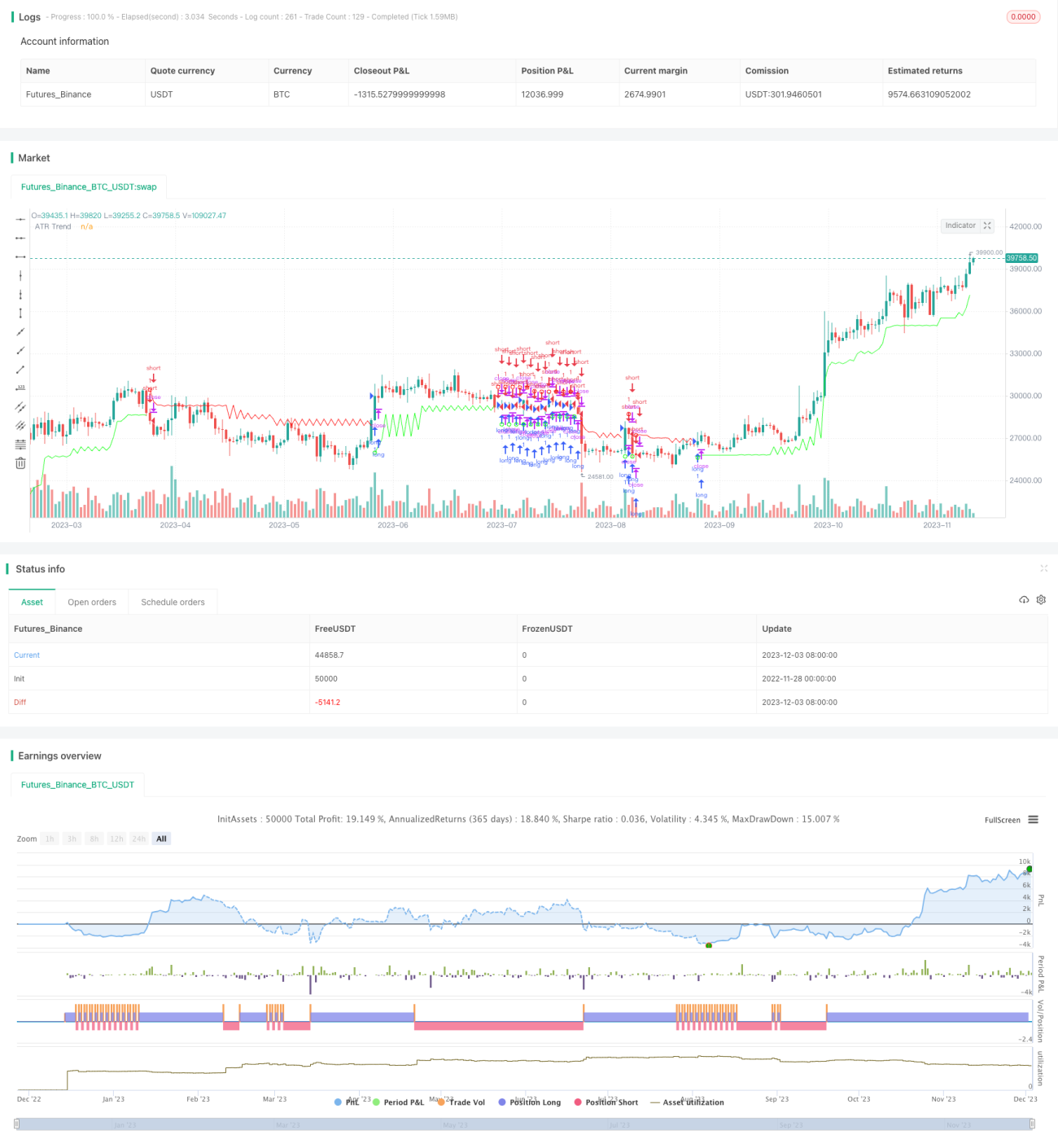
This is a trend following strategy that combines the ATR indicator and the ADX indicator. It dynamically adjusts the ATR multiplier according to market trend conditions to achieve better trend tracking.
Strategy Logic
The strategy is mainly based on the ATR indicator and the ADX indicator.
Firstly, it calculates the True Range (ATR) and ADX. ATR reflects the volatility of the market while ADX judges the trend strength.
Secondly, it determines the current trend direction according to the difference between DI+ and DI- in the ADX indicator. If DI+ is higher than DI-, it is an uptrend. If DI- is higher than DI+, it is a downtrend.
Then, when ADX is rising, it uses a larger ATR multiplier (m1). When ADX is falling, it uses a smaller ATR multiplier (m2) to achieve dynamic adjustment. This is the core of the strategy.
Finally, combined with ATR and the midpoint of price, it calculates the upper and lower bands to determine the trend direction. When price breaks through the upper band, it goes long. When price breaks through the lower band, it goes short.
So the strategy incorporates ATR and ADX, and by dynamically adjusting ATR parameters, it can better capture trends for trading.
Advantage Analysis
The strategy has several obvious advantages:
- Able to dynamically adjust parameters for better trend capturing
- Combines ATR and ADX for more comprehensive judgment
- Expects controlled drawdowns
- Simple implementation and easy to understand
Therefore, this is a very practical trend following strategy with good drawdown control. Worth recommending.
Risk Analysis
The strategy also has some risks:
- ADX has lagging issues, may miss trend reversal points
- Improper ATR size selection can lead to insufficient profit or oversized stop loss
- Rapid breakout against bands caused by black swan events can lead to losses
So parameter optimization and risk control need attention. Also, black swan events can have greater impact.
Optimization Directions
The strategy can be optimized in the following aspects:
- Optimize parameters of ATR and ADX for better trend capturing
- Add other indicators for confirmation to avoid ADX lagging issues
- Build dynamic stop loss mechanisms to control single trade loss
- Adjust position sizing for different market environments
So there is still much room for optimization by adjusting parameters and mechanisms according to the problems.
Conclusion
In general, this Adaptive ATR-ADX Trend Strategy V2 performs very well. By dynamically adjusting ATR parameters, it captures trends nicely. Also, combining two indicators in ATR and ADX makes it more robust. But we still need to pay attention to risk control and optimization to prevent lagging and oversized losses. Overall, the strategy is well worth learning and applying.
- 1