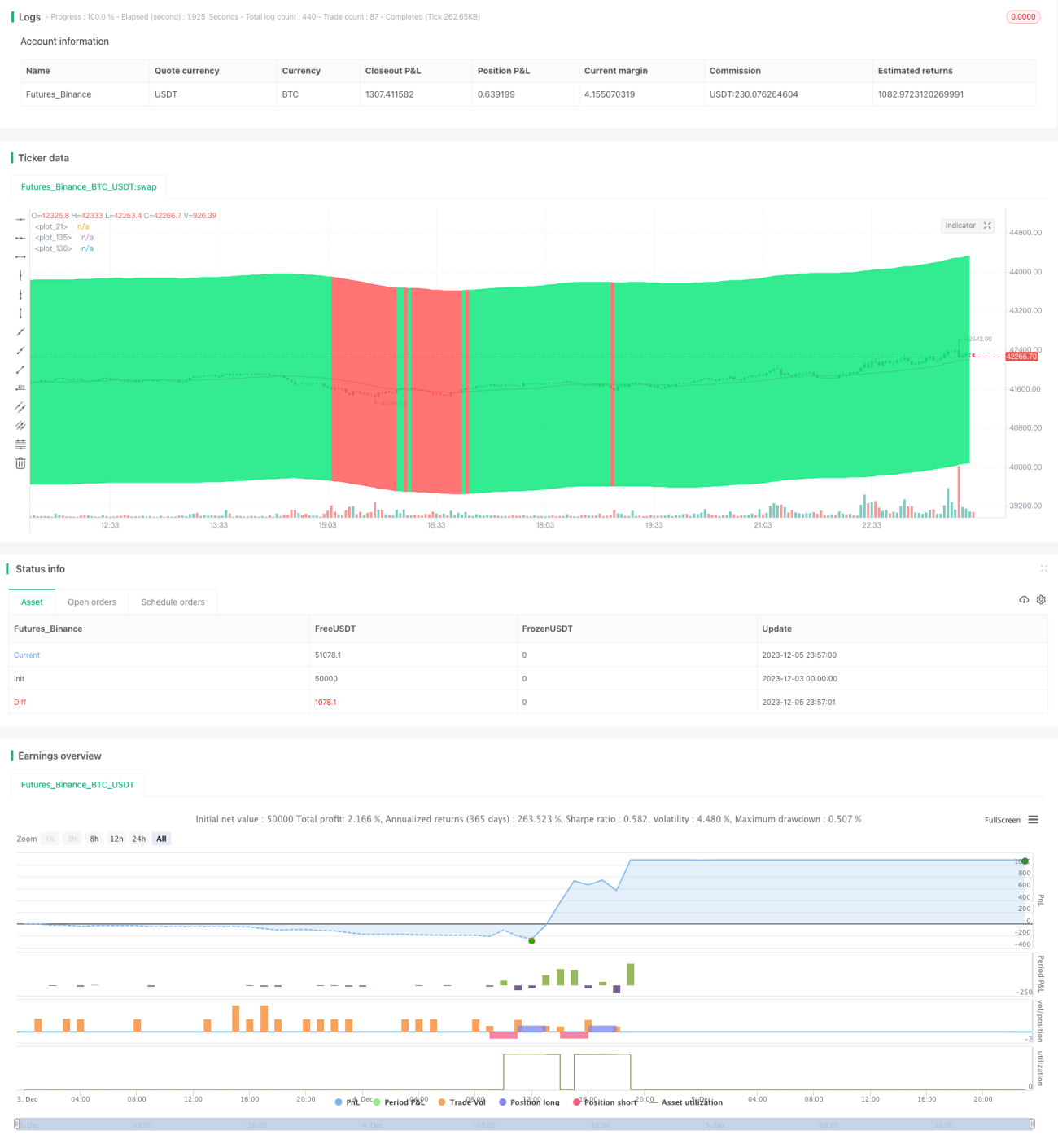
L’idée principale de cette stratégie est de suivre les tendances du marché de manière dynamique, en achetant quand la tendance est à la hausse et en vendant quand la tendance est à la baisse. Elle juge la direction de la tendance en calculant une combinaison de plusieurs indicateurs, tels que la régression linéaire, la moyenne mobile modifiée de Hull, etc.
Cette stratégie utilise plusieurs indicateurs techniques pour juger de la direction de la tendance. Tout d’abord, elle calcule un canal de portée, dont la limite supérieure et inférieure est calculée à partir d’une moyenne mobile simple de close et d’un paramètre d’entrée. Ensuite, elle calcule une moyenne mobile de Hull modifiée, qui est considérée comme une représentation plus précise de la tendance.
Afin de réduire les signaux erronés, la stratégie a également conçu plusieurs filtres. Par exemple, l’utilisation d’EMA pour déterminer s’il est en baisse et l’utilisation d’un indicateur de fenêtre pour déterminer les variations du RSI. Ces filtres peuvent éviter de générer des signaux de négociation dans des conditions de choc.
En termes d’entrée et de stop-loss, la stratégie enregistre le dernier prix d’ouverture et définit un pourcentage de stop-loss. Par exemple, si le dernier prix d’ouverture est de 100 \(, un objectif de stop-loss est de 102 \) et le prix de stop-loss de 95 $. Cela permet un suivi dynamique.
Cette stratégie présente les avantages suivants:
Cette stratégie comporte aussi des risques:
Pour contrôler le risque, il est possible de définir un stop loss, un trail stop ou de bloquer les bénéfices en utilisant des options. En outre, il est nécessaire de tester à plusieurs reprises les combinaisons de paramètres pour trouver une plage de paramètres fiable. Enfin, il est également important de se concentrer sur le temps de calcul de l’indicateur et de rechercher la réalité des signaux.
Cette stratégie peut être optimisée dans les domaines suivants:
Dans le processus d’optimisation, il est nécessaire d’exploiter pleinement les transactions de retracement et de simulation pour évaluer la qualité du signal et la stabilité de la stratégie. Seuls des solutions d’optimisation bien vérifiées peuvent être appliquées sur le terrain.
Cette stratégie est généralement une bonne stratégie de suivi de la tendance. Elle utilise plusieurs indicateurs pour juger de la tendance. Elle utilise des filtres pour réduire les signaux erronés.
/*backtest
start: 2023-12-03 00:00:00
end: 2023-12-06 00:00:00
period: 3m
basePeriod: 1m
exchanges: [{"eid":"Futures_Binance","currency":"BTC_USDT"}]
*/
// This source code is subject to the terms of the Mozilla Public License 2.0 at https://mozilla.org/MPL/2.0/
// © RafaelZioni
//@version=4
strategy(title = " BTC 15 min", overlay = true, pyramiding=1,initial_capital = 10000, default_qty_type= strategy.percent_of_equity, default_qty_value = 20, calc_on_order_fills=false, slippage=0,commission_type=strategy.commission.percent,commission_value=0.075)
strat_dir_input = input(title="Strategy Direction", defval="all", options=["long", "short", "all"])
strat_dir_value = strat_dir_input == "long" ? strategy.direction.long : strat_dir_input == "short" ? strategy.direction.short : strategy.direction.all
strategy.risk.allow_entry_in(strat_dir_value)
price = close
length8 = input(30,title = 'length of channel')
upmult = input(title = 'upper percent',type=input.float, step=0.1, defval=5)
lowmult = input(title = 'lower percent',type=input.float, step=0.1, defval=5)
basis = sma(close, length8)
vup = upmult * price / 100
vlow = lowmult * price / 100
upper = basis + vup
lower = basis - vlow
plot(basis, color=color.red)
//
fastLength = input(3, title="Fast filter length ", minval=1)
slowLength = input(21,title="Slow filter length", minval=1)
source=close
v1=ema(source,fastLength)
v2=ema(source,slowLength)
//
leng=1
p1=close[1]
len55 = 10
//taken from https://www.tradingview.com/script/Ql1FjjfX-security-free-MTF-example-JD/
HTF = input("1D", type=input.resolution)
ti = change( time(HTF) ) != 0
T_c = fixnan( ti ? close : na )
vrsi = rsi(cum(change(T_c) * volume), leng)
pp=wma(vrsi,len55)
d=(vrsi[1]-pp[1])
len100 = 10
x=ema(d,len100)
//
zx=x/-1
col=zx > 0? color.lime : color.orange
//
tf10 = input("1", title = "Timeframe", type = input.resolution, options = ["1", "5", "15", "30", "60","120", "240","360","720", "D", "W"])
length = input(50, title = "Period", type = input.integer)
shift = input(1, title = "Shift", type = input.integer)
hma(_src, _length)=>
wma((2 * wma(_src, _length / 2)) - wma(_src, _length), round(sqrt(_length)))
hma3(_src, _length)=>
p = length/2
wma(wma(close,p/3)*3 - wma(close,p/2) - wma(close,p),p)
b =security(syminfo.tickerid, tf10, hma3(close[1], length)[shift])
//plot(a,color=color.gray)
//plot(b,color=color.yellow)
close_price = close[0]
len = input(25)
linear_reg = linreg(close_price, len, 0)
buy=crossover(linear_reg, b)
sell=crossunder(linear_reg, b) or crossunder(close[1],upper)
//
src2=low
src3=high
Min =input(15)
leni = timeframe.isintraday and timeframe.multiplier >= 1 ?
Min / timeframe.multiplier * 7 :
timeframe.isintraday and timeframe.multiplier < 60 ?
60 / timeframe.multiplier * 24 * 7 : 7
l1 = wma(src2,leni)
h1 = wma(src3,leni)
//
m=(h1+l1)/2
//
len5 = 100
src5=m
//
multi = 2
mean = ema(src5, len5)
stddev = multi * stdev(src5, len5)
b5 = mean + stddev
s5 = mean - stddev
var bool long = na
var bool short = na
long :=crossover(src5, s5)
short := crossunder(src5, b5)
var float last_open_long = na
var float last_open_short = na
last_open_long := long ? close : nz(last_open_long[1])
last_open_short := short ? close : nz(last_open_short[1])
entry_value =last_open_long
entry_value1=last_open_short
r=100
//
highb = highest(entry_value1, r)
lowb = lowest(entry_value, r)
d5 = highb - lowb
me = (highb + lowb) / 2
h4 = highb - d5 * 0.236
c3 = highb - d5 * 0.382
c4 = highb - d5 * 0.618
l4 = highb - d5 * 0.764
//
col2 = close >= me ? color.lime : color.red
p5 = plot(upper, color=col2)
p2 = plot(lower, color=col2)
fill(p5, p2,color=col2)
// Conditions
longCond = bool(na)
shortCond = bool(na)
longCond := crossover(zx,0) or buy
shortCond := sell
// Count your long short conditions for more control with Pyramiding
sectionLongs = 0
sectionLongs := nz(sectionLongs[1])
sectionShorts = 0
sectionShorts := nz(sectionShorts[1])
if longCond
sectionLongs := sectionLongs + 1
sectionShorts := 0
sectionShorts
if shortCond
sectionLongs := 0
sectionShorts := sectionShorts + 1
sectionShorts
// Pyramiding
pyrl = 1
// These check to see your signal and cross references it against the pyramiding settings above
longCondition = longCond and sectionLongs <= pyrl
shortCondition = shortCond and sectionShorts <= pyrl
// Get the price of the last opened long or short
last_open_longCondition = float(na)
last_open_shortCondition = float(na)
last_open_longCondition := longCondition ? open : nz(last_open_longCondition[1])
last_open_shortCondition := shortCondition ? open : nz(last_open_shortCondition[1])
// Check if your last postion was a long or a short
last_longCondition = float(na)
last_shortCondition = float(na)
last_longCondition := longCondition ? time : nz(last_longCondition[1])
last_shortCondition := shortCondition ? time : nz(last_shortCondition[1])
in_longCondition = last_longCondition > last_shortCondition
in_shortCondition = last_shortCondition > last_longCondition
// Take profit
isTPl = true
//isTPs = input(false, "Take Profit Short")
tp = input(2, "Exit Profit %", type=input.float)
long_tp = isTPl and crossover(high, (1 + tp / 100) * last_open_longCondition) and longCondition == 0 and in_longCondition == 1
//short_tp = isTPs and crossunder(low, (1 - tp / 100) * last_open_shortCondition) and
//shortCondition == 0 and in_shortCondition == 1
// Stop Loss
isSLl = input(true,"buy Loss Long")
//isSLs = input(false, "buy Loss Short")
sl = 0.0
sl := input(5, " rebuy %", type=input.float)
long_sl = isSLl and crossunder(low, (1 - sl / 100) * last_open_longCondition) and
longCondition == 0 and in_longCondition == 1
//short_sl = isSLs and crossover(high, (1 + sl / 100) * last_open_shortCondition) and
//shortCondition == 0 and in_shortCondition == 1
//
// Conditions
longCond5 = bool(na)
shortCond5 = bool(na)
longCond5 := longCondition
shortCond5 := long_tp
//
sectionLongs5 = 0
sectionLongs5 := nz(sectionLongs5[1])
sectionShorts5 = 0
sectionShorts5 := nz(sectionShorts5[1])
if longCond5
sectionLongs5 := sectionLongs5 + 1
sectionShorts5 := 0
sectionShorts5
if shortCond5
sectionLongs5 := 0
sectionShorts5 := sectionShorts5 + 1
sectionShorts5
//
pyr5 = 1
longCondition5 = longCond5 and sectionLongs5 <= pyr5
shortCondition5 = shortCond5 and sectionShorts5 <= pyr5
// Get the price of the last opened long or short
last_open_longCondition5 = float(na)
last_open_shortCondition5 = float(na)
last_open_longCondition5 := longCondition5 ? open : nz(last_open_longCondition5[1])
last_open_shortCondition5 := shortCondition5 ? open : nz(last_open_shortCondition5[1])
last_longCondition5 = float(na)
last_shortCondition5 = float(na)
last_longCondition5 := longCondition5 ? time : nz(last_longCondition5[1])
last_shortCondition5 := shortCondition5 ? time : nz(last_shortCondition5[1])
in_longCondition5 = last_longCondition5 > last_shortCondition5
in_shortCondition5 = last_shortCondition5 > last_longCondition5
//
filter=input(true)
g(v, p) => round(v * (pow(10, p))) / pow(10, p)
risk = input(100)
leverage = input(1)
c = g((strategy.equity * leverage / open) * (risk / 100), 4)
//
l =(v1 > v2 or filter == false ) and longCondition or long_sl
//
//l = longCondition or long_sl
s=shortCondition5
if l
strategy.entry("buy", strategy.long,c)
if s
strategy.entry("sell", strategy.short,c)
per(pcnt) =>
strategy.position_size != 0 ? round(pcnt / 100 * strategy.position_avg_price / syminfo.mintick) : float(na)
stoploss=input(title=" stop loss", defval=5, minval=0.01)
los = per(stoploss)
q1=input(title=" qty_percent1", defval=50, minval=1)
q2=input(title=" qty_percent2", defval=50, minval=1)
tp10=input(title=" Take profit1", defval=1, minval=0.01)
tp20=input(title=" Take profit2", defval=2, minval=0.01)
strategy.exit("x1", qty_percent = q1, profit = per(tp10), loss = los)
strategy.exit("x2", qty_percent = q2, profit = per(tp20), loss = los)