平滑移動平均戦略


作成日: 2023-11-06 10:29:24 最終変更日: 2023-11-06 10:29:24
コピー: 0 クリック数: 786
1
フォロー
1617
フォロワー

平滑移動平均戦略

概要

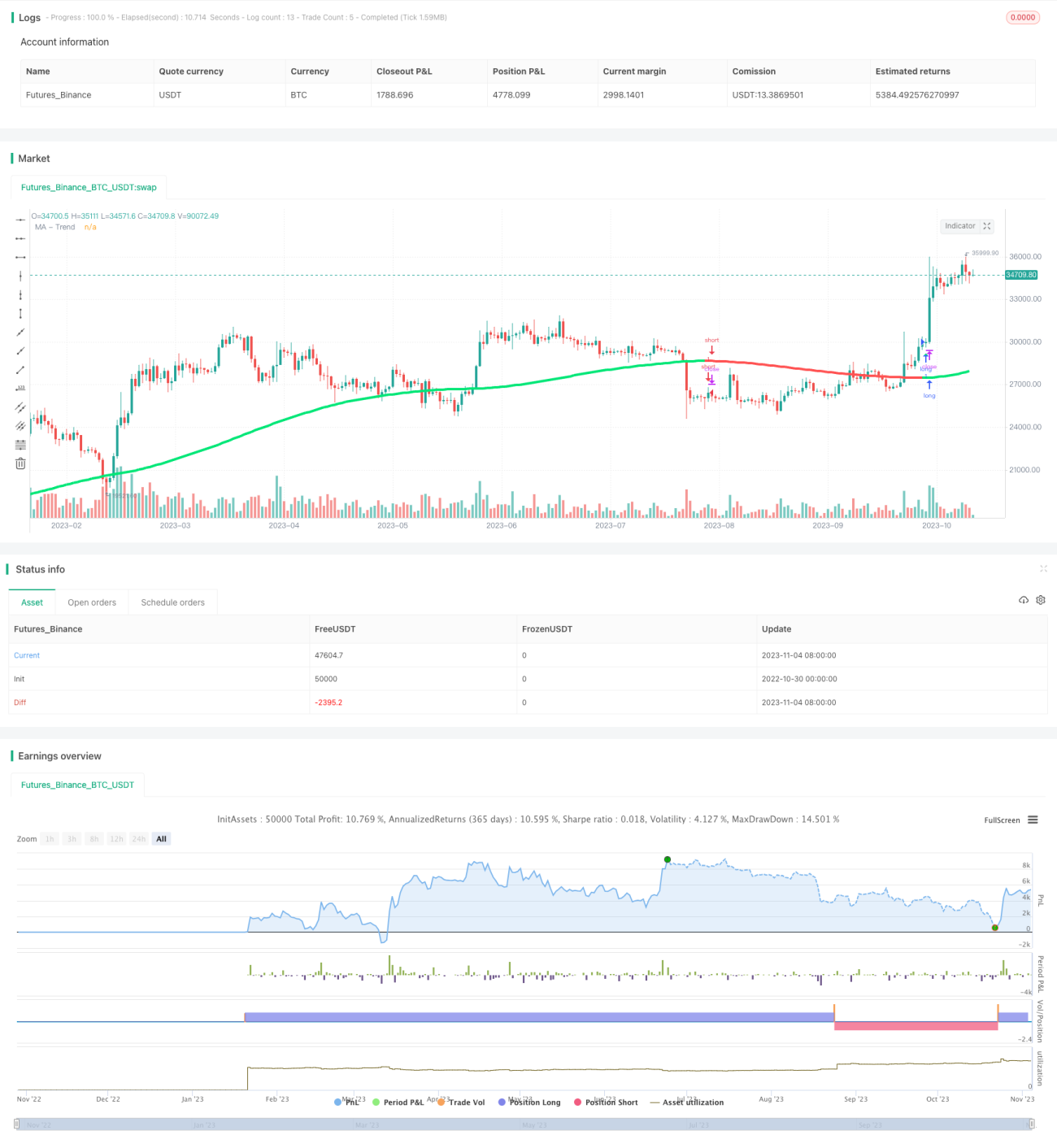
この戦略は,さまざまな移動平均を組み合わせて,シンプルなトレンド追跡戦略を実現する. 戦略は,同時に,ノイズをフィルターする機能を持つ.

戦略原則

この戦略は,まず,終了価格を平滑化して,Heiken Ashiの終了価格を使用するかどうかを選択します. その後,smoothMA関数が呼び出され,平滑移動平均を複数回重ねて実行されます.smoothMA関数は,まず,SMA,EMA,DEMAなどのさまざまな種類の移動平均を生成する変数関数を呼び出します.変数関数が指定されたタイプと長さの移動平均を生成した後,smoothMAは,リケメンタルで複数回重ねて実行され,多重平滑を実現します.

優位分析

  • 移動平均の重複により,市場騒音を効率的に排除し,トレンドを識別できます.
  • SMA,EMA,DEMAなどの複数の移動平均型をサポートし,柔軟な組み合わせを使用できます.
  • 偽の突破をフィルタリングするハイケン・アシ技術が搭載されている.
  • 戦略はシンプルで使いやすく,実行しやすい.
  • 移動平均の長さ,タイプ,滑り回数をカスタマイズすることができ,異なる品種に対して最適化パラメータを使用できます.

リスク分析

  • 移動平均の重複は,トレンドの初期変化を逃す可能性のある遅延を生じます.
  • 単純な移動平均のシステムを使うだけで,地震の状況で効率的に利益を得ることはできません.
  • 取引コストを考慮せずに,実際の取引の取引コストは収益性を低下させる.
  • 損失拡大の危険性がある.

MACD,KDJなどの他の指標と組み合わせることで,トレンドシグナルをより正確に識別することが考えられます. 移動平均パラメータを最適化し,遅れを軽減します. 合理的なストップ・ローズレベルを設定し,単一損失を制御します. 同時に,取引頻度を制御し,取引コストを減らすことに注意してください.

最適化の方向

  • 移動平均の組み合わせの長さやタイプを試して最適なパラメータを見つけることができます.
  • 戦略に他の技術指標を加えることで,より体系的な入場と出場のルールを形成することも考えられます.
  • 戦略に影響を及ぼす主要なマクロイベントを回避するために,取引時間を設定できます.
  • 品種特性に合わせてパラメータを調整して,最適なパラメータの組み合わせを探せます.
  • ストップ・ロースとストップ・ストップのレベルを設定し,取引リスクをコントロールできます.

要約する

この戦略は,複数の移動平均を重ねてトレンド追跡を実現し,市場騒音を効果的に排除することができる. 利点は,使いやすいこと,パラメータを柔軟に調整できる点である. しかし,移動平均システムのみを使用する利潤能力の制限の問題が残っている. 他の技術指標の組み合わせと使用することを検討し,取引リスクを制御し,パラメータを最適化し,戦略の効率性を向上させることができる.

ストラテジーソースコード
/*backtest
start: 2022-10-30 00:00:00
end: 2023-11-05 00:00:00
period: 1d
basePeriod: 1h
exchanges: [{"eid":"Futures_Binance","currency":"BTC_USDT"}]
*/

//@version=4
// Copyright (c) 2007-present Jurik Research and Consulting. All rights reserved.
// Copyright (c) 2018-present, Alex Orekhov (everget)
// Thanks to everget for code for more advanced moving averages
// Smooth Moving Average [STRATEGY] @PuppyTherapy script may be freely distributed under the MIT license.
strategy( title="Smooth Moving Average [STRATEGY] @PuppyTherapy", overlay=true )

// ---- CONSTANTS ----
lsmaOffset = 1
almaOffset = 0.85
almaSigma  = 6
phase = 2
power = 2

// ---- GLOBAL FUNCTIONS ----
kama(src, len)=>
    xvnoise = abs(src - src[1])
    nfastend = 0.666
    nslowend = 0.0645
    nsignal = abs(src - src[len])
    nnoise = sum(xvnoise, len)
    nefratio = iff(nnoise != 0, nsignal / nnoise, 0)
    nsmooth = pow(nefratio * (nfastend - nslowend) + nslowend, 2)
    nAMA = 0.0
    nAMA := nz(nAMA[1]) + nsmooth * (src - nz(nAMA[1]))

t3(src, len)=>
    xe1_1 = ema(src,    len)
    xe2_1 = ema(xe1_1,  len)
    xe3_1 = ema(xe2_1,  len)
    xe4_1 = ema(xe3_1,  len)
    xe5_1 = ema(xe4_1,  len)
    xe6_1 = ema(xe5_1,  len)
    b_1 = 0.7
    c1_1 = -b_1*b_1*b_1
    c2_1 = 3*b_1*b_1+3*b_1*b_1*b_1
    c3_1 = -6*b_1*b_1-3*b_1-3*b_1*b_1*b_1
    c4_1 = 1+3*b_1+b_1*b_1*b_1+3*b_1*b_1
    nT3Average_1 = c1_1 * xe6_1 + c2_1 * xe5_1 + c3_1 * xe4_1 + c4_1 * xe3_1
    
// The general form of the weights of the (2m + 1)-term Henderson Weighted Moving Average
getWeight(m, j) =>
    numerator = 315 * (pow(m + 1, 2) - pow(j, 2)) * (pow(m + 2, 2) - pow(j, 2)) * (pow(m + 3, 2) - pow(j, 2)) * (3 * pow(m + 2, 2) - 11 * pow(j, 2) - 16)
    denominator = 8 * (m + 2) * (pow(m + 2, 2) - 1) * (4 * pow(m + 2, 2) - 1) * (4 * pow(m + 2, 2) - 9) * (4 * pow(m + 2, 2) - 25)

    denominator != 0
         ? numerator / denominator
         : 0

hwma(src, termsNumber) =>
    sum = 0.0
    weightSum = 0.0
    
    termMult = (termsNumber - 1) / 2

    for i = 0 to termsNumber - 1
        weight = getWeight(termMult, i - termMult)
        sum := sum + nz(src[i]) * weight
        weightSum := weightSum + weight

    sum / weightSum

get_jurik(length, phase, power, src)=>
    phaseRatio = phase < -100 ? 0.5 : phase > 100 ? 2.5 : phase / 100 + 1.5
    beta = 0.45 * (length - 1) / (0.45 * (length - 1) + 2)
    alpha = pow(beta, power)
    jma = 0.0
    e0 = 0.0
    e0 := (1 - alpha) * src + alpha * nz(e0[1])
    e1 = 0.0
    e1 := (src - e0) * (1 - beta) + beta * nz(e1[1])
    e2 = 0.0
    e2 := (e0 + phaseRatio * e1 - nz(jma[1])) * pow(1 - alpha, 2) + pow(alpha, 2) * nz(e2[1])
    jma := e2 + nz(jma[1])

variant(src, type, len ) =>
    v1 = sma(src, len)                                                  // Simple
    v2 = ema(src, len)                                                  // Exponential
    v3 = 2 * v2 - ema(v2, len)                                          // Double Exponential
    v4 = 3 * (v2 - ema(v2, len)) + ema(ema(v2, len), len)               // Triple Exponential
    v5 = wma(src, len)                                                  // Weighted
    v6 = vwma(src, len)                                                 // Volume Weighted
    v7 = na(v5[1]) ? sma(src, len) : (v5[1] * (len - 1) + src) / len    // Smoothed
    v8 = wma(2 * wma(src, len / 2) - wma(src, len), round(sqrt(len)))   // Hull
    v9 = linreg(src, len, lsmaOffset)                                   // Least Squares
    v10 = alma(src, len, almaOffset, almaSigma)                         // Arnaud Legoux
    v11 = kama(src, len)                                                // KAMA
    ema1 = ema(src, len)
    ema2 = ema(ema1, len)
    v13 = t3(src, len)                                                  // T3
    v14 = ema1+(ema1-ema2)                                              // Zero Lag Exponential
    v15 = hwma(src, len)                                                // Henderson Moving average thanks to  @everget
    ahma = 0.0
    ahma := nz(ahma[1]) + (src - (nz(ahma[1]) + nz(ahma[len])) / 2) / len //Ahrens Moving Average 
    v16 = ahma
    v17 = get_jurik( len, phase, power, src) 
    type=="EMA"?v2 : type=="DEMA"?v3 : type=="TEMA"?v4 : type=="WMA"?v5 : type=="VWMA"?v6 :
     type=="SMMA"?v7 : type=="Hull"?v8 : type=="LSMA"?v9 : type=="ALMA"?v10 : type=="KAMA"?v11 :
     type=="T3"?v13 : type=="ZEMA"?v14 : type=="HWMA"?v15 : type=="AHMA"?v16 : type=="JURIK"?v17 : v1

smoothMA(c, maLoop, type, len) =>
	ma_c = 0.0
	if maLoop == 1
		ma_c := variant(c, type, len)
	if maLoop == 2
		ma_c := variant(variant(c ,type, len),type, len)
	if maLoop == 3
		ma_c := variant(variant(variant(c ,type, len),type, len),type, len)
	if maLoop == 4
		ma_c := variant(variant(variant(variant(c ,type, len),type, len),type, len),type, len)
	if maLoop == 5
		ma_c := variant(variant(variant(variant(variant(c ,type, len),type, len),type, len),type, len),type, len)
	ma_c

// Smoothing HA Function
smoothHA( o, h, l, c ) =>
    hao = 0.0
    hac = ( o + h + l + c ) / 4
    hao := na(hao[1])?(o + c / 2 ):(hao[1] + hac[1])/2
    hah = max(h, max(hao, hac))
    hal = min(l, min(hao, hac))
	[hao, hah, hal, hac]

// ---- Main Selection ----
haSmooth   = input(false, title=" Use HA as source ? " )
length     = input(60, title=" MA1 Length", minval=1, maxval=1000)
maLoop     = input(2, title=" Nr. of MA1 Smoothings ", minval=1, maxval=5)
type       = input("EMA", title="MA Type", options=["SMA", "EMA", "DEMA", "TEMA", "WMA", "VWMA", "SMMA", "Hull", "LSMA", "ALMA", "KAMA", "ZEMA", "HWMA", "AHMA", "JURIK", "T3"])

// ---- BODY SCRIPT ----
[ ha_open, ha_high, ha_low, ha_close ] = smoothHA(open, high, low, close)

_close_ma = haSmooth ? ha_close : close

_close_smoothed_ma = smoothMA( _close_ma, maLoop, type, length)

maColor = _close_smoothed_ma > _close_smoothed_ma[1] ? color.lime : color.red
plot(_close_smoothed_ma, title= "MA - Trend",  color=maColor, transp=85, linewidth = 4)

long     = _close_smoothed_ma > _close_smoothed_ma[1] and _close_smoothed_ma[1] < _close_smoothed_ma[2]
short    = _close_smoothed_ma < _close_smoothed_ma[1] and _close_smoothed_ma[1] > _close_smoothed_ma[2]

plotshape( short , title="Short", color=color.red,  transp=80, style=shape.triangledown, location=location.abovebar, size=size.small)
plotshape( long ,  title="Long",  color=color.lime, transp=80, style=shape.triangleup,   location=location.belowbar, size=size.small)

//* Backtesting Period Selector | Component *//
//* Source: https://www.tradingview.com/script/eCC1cvxQ-Backtesting-Period-Selector-Component *//
testStartYear   = input(2018, "Backtest Start Year",minval=1980)
testStartMonth  = input(1, "Backtest Start Month",minval=1,maxval=12)
testStartDay    = input(1, "Backtest Start Day",minval=1,maxval=31)
testPeriodStart = timestamp(testStartYear,testStartMonth,testStartDay,0,0)
testStopYear    = 9999 //input(9999, "Backtest Stop Year",minval=1980)
testStopMonth   = 12 // input(12, "Backtest Stop Month",minval=1,maxval=12)
testStopDay     = 31 //input(31, "Backtest Stop Day",minval=1,maxval=31)
testPeriodStop  = timestamp(testStopYear,testStopMonth,testStopDay,0,0)
testPeriod() => time >= testPeriodStart and time <= testPeriodStop ? true : false

if testPeriod() and long
    strategy.entry( "long", strategy.long )

if testPeriod() and short
    strategy.entry( "short", strategy.short )