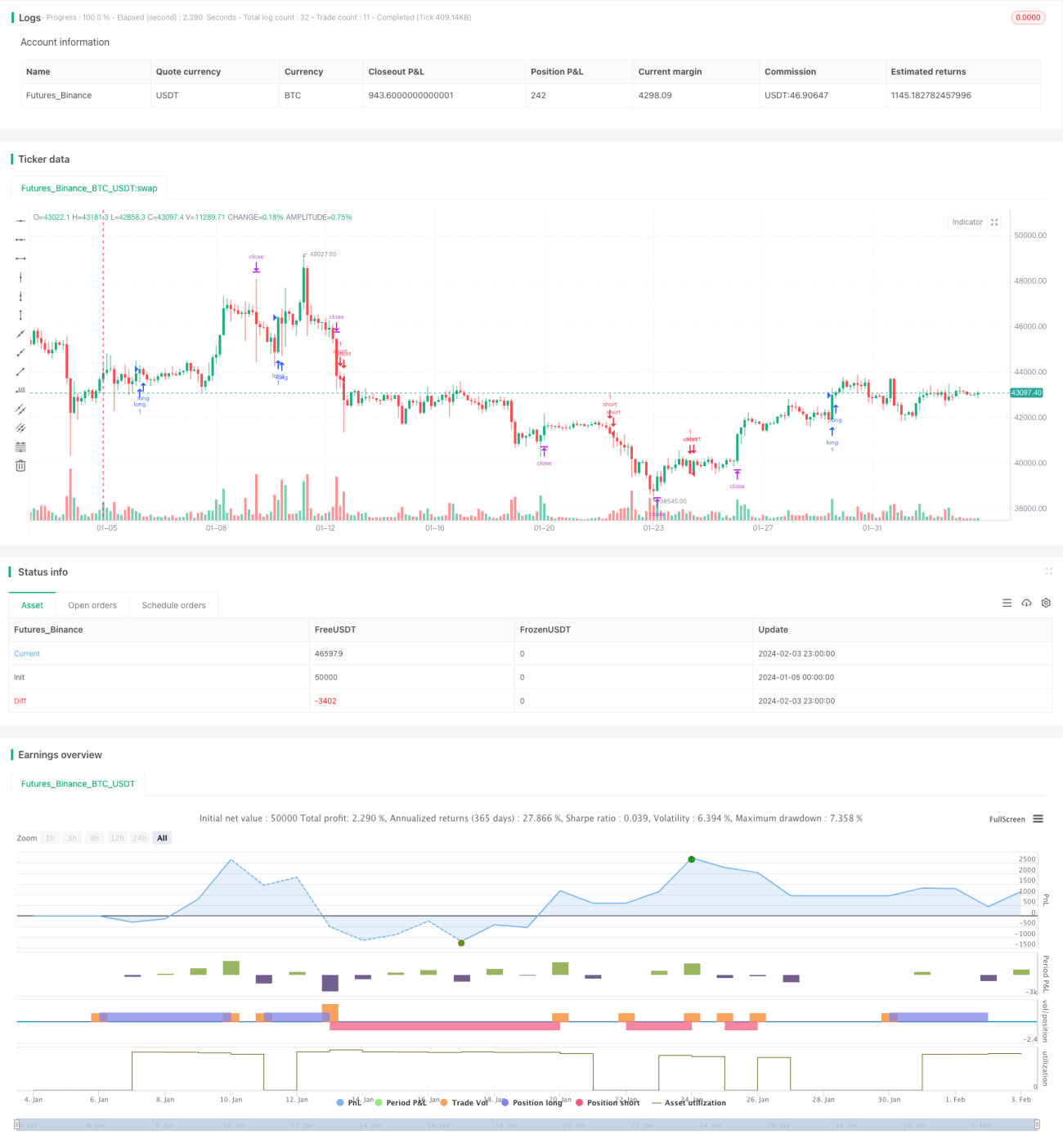
Teoria do Retorno Índice de Volatilidade Estratégia Quantitativa


Data de criação: 2024-02-05 13:54:34 última modificação: 2024-02-05 13:54:34
cópia: 0 Cliques: 583
1
focar em
1617
Seguidores

Teoria do Retorno Índice de Volatilidade Estratégia Quantitativa

Visão geral

Esta estratégia usa um método de classificação de indicadores técnicos para escolher dinamicamente o momento de compra e venda, comparando com a média móvel. A estratégia contém posições longas e vazias, que podem ser ativadas ou fechadas de forma personalizada. A estratégia é favorável a negociações de longo prazo de baixo risco.

Princípio da estratégia

Esta estratégia combina várias técnicas de avaliação de indicadores técnicos para avaliar a atualização do mercado em tempo real. Consiste principalmente nos seguintes passos:

  1. Calcule várias médias móveis, incluindo SMA, EMA, Hull MA e VWMA, entre outras. Avalie o nível de vazio comparando com o preço atual.
  2. Calcular uma série de indicadores de vibração, incluindo RSI, CCI, MACD, William indicador% R, indicadores aleatórios, etc. Julgar a variação de vazio no indicador de vibração e avaliar o nível de vazio.
  3. A combinação dos dois indicadores acima, resultando em um sinal de operação final. Um valor absoluto do sinal superior a 0,5 é um sinal forte e 0,1-0,5 é um sinal fraco.
  4. Dependendo do sinal de operação final, a estratégia pode fazer mais ou fazer menos. Ao mesmo tempo, configure o stop loss e o stop-loss para sair da lógica.

A vantagem da estratégia é que o método de classificação de indicadores pode julgar o momento do mercado de forma mais abrangente e tem maior confiabilidade do que um único indicador. Além disso, é possível escolher livremente a categoria de indicadores de classificação por meio de parâmetros personalizados, permitindo a personalização da estratégia.

Análise de vantagens

  1. A combinação de vários indicadores técnicos permite uma avaliação mais abrangente e confiável do tempo de mercado
  2. A utilização de configurações de stop loss e stop loss dinâmicas ajuda a reduzir o risco de perdas
  3. Componentes de classificação de indicadores personalizáveis, que permitem a personalização das estratégias
  4. Apoio a mais e menos, adaptando-se a um ambiente de mercado mais amplo
  5. Opção de abrir ou não uma direção de negociação, reduzindo o número de transações desnecessárias

Análise de Riscos

  1. Os indicadores de avaliação, como base de decisão, são, em si mesmos, bastante subjetivos.
  2. Alguns indicadores de convulsão são imprecisos para determinar altos e baixos de inovação
  3. É necessário avaliar detalhadamente a ponderação dos indicadores técnicos para otimizar a pontuação
  4. A quantidade de indicadores aumenta o volume de operações de estratégia e pode afetar a eficiência operacional
  5. Atenção aos ganhos e perdas gerais em operações de longo prazo para evitar transações excessivas

Para os riscos acima mencionados, a principal solução é otimizar a ponderação dos indicadores de pontuação, testando repetidamente os parâmetros favoráveis com base nos dados históricos; além disso, reduzir adequadamente o número de indicadores de pontuação também pode melhorar a eficiência operacional.

Direção de otimização

A estratégia pode ser melhorada em alguns aspectos:

  1. Avaliar a eficácia de cada indicador técnico e otimizar a seleção de indicadores no método de pontuação
  2. Ajuste de pontuação dos indicadores técnicos e dos limites de força de sinal
  3. Optimizar os parâmetros do Stop Loss Stop para controlar ainda mais o risco de transação
  4. De acordo com as características de diferentes variedades, configure o melhor valor de parâmetro indicador
  5. Aumentar os sinais de pontuação dos indicadores de julgamento por meio de meios como a aprendizagem de máquina

Através da otimização de parâmetros, a estratégia pode ser adaptada de forma específica a mais variedades de mercado, resultando em melhores taxas de retorno de receita.

Resumir

Esta estratégia utiliza um método de classificação de indicadores tecnológicos para avaliar o momento em que o mercado está mais aberto. A estratégia possui vantagens como a personalização da seleção de indicadores, o stop loss dinâmico e a opção de abrir a direção de negociação. O risco está centrado principalmente na subjetividade da própria metodologia de classificação e na falha de alguns indicadores.

Código-fonte da estratégia
/*backtest
start: 2024-01-05 00:00:00
end: 2024-02-04 00:00:00
period: 3h
basePeriod: 15m
exchanges: [{"eid":"Futures_Binance","currency":"BTC_USDT"}]
*/

//@version=4
strategy(title="Ratings", shorttitle="Ratings", default_qty_type = strategy.percent_of_equity, default_qty_value = 100, commission_value = 0.1, overlay=true)

//Settings
useLong = input(true, title = "Long")
useShort = input(true, title = "Short")
res = input("", title="Indicator Timeframe", type=input.resolution)
ratingSignal = input(defval = "All", title = "Rating is based on", options = ["MAs", "Oscillators", "All"])
startTime = input(defval = timestamp("01 Jan 2000 00:00 +0000"), title = "Start Time", type = input.time, inline = "time1")
finalTime = input(defval = timestamp("31 Dec 2099 23:59 +0000"), title = "Final Time", type = input.time, inline = "time1")
trueTime = true

// Awesome Oscillator
AO() => 
    sma(hl2, 5) - sma(hl2, 34)
// Stochastic RSI
StochRSI() =>
    rsi1 = rsi(close, 14)
    K = sma(stoch(rsi1, rsi1, rsi1, 14), 3)
    D = sma(K, 3)
    [K, D]
// Ultimate Oscillator
tl() => close[1] < low ? close[1]: low
uo(ShortLen, MiddlLen, LongLen) =>
    Value1 = sum(tr, ShortLen)
    Value2 = sum(tr, MiddlLen)
    Value3 = sum(tr, LongLen)
    Value4 = sum(close - tl(), ShortLen)
    Value5 = sum(close - tl(), MiddlLen)
    Value6 = sum(close - tl(), LongLen)
    float UO = na
    if Value1 != 0 and Value2 != 0 and Value3 != 0
        var0 = LongLen / ShortLen
        var1 = LongLen / MiddlLen
        Value7 = (Value4 / Value1) * (var0)
        Value8 = (Value5 / Value2) * (var1)
        Value9 = (Value6 / Value3)
        UO := (Value7 + Value8 + Value9) / (var0 + var1 + 1)
    UO
// Ichimoku Cloud
donchian(len) => avg(lowest(len), highest(len))
ichimoku_cloud() =>
    conversionLine = donchian(9)
    baseLine = donchian(26)
    leadLine1 = avg(conversionLine, baseLine)
    leadLine2 = donchian(52)
    [conversionLine, baseLine, leadLine1, leadLine2]
    
calcRatingMA(ma, src) => na(ma) or na(src) ? na : (ma == src ? 0 : ( ma < src ? 1 : -1 ))
calcRating(buy, sell) => buy ? 1 : ( sell ? -1 : 0 )
calcRatingAll() =>
    //============== MA =================
    SMA10 = sma(close, 10)
    SMA20 = sma(close, 20)
    SMA30 = sma(close, 30)
    SMA50 = sma(close, 50)
    SMA100 = sma(close, 100)
    SMA200 = sma(close, 200)
    
    EMA10 = ema(close, 10)
    EMA20 = ema(close, 20)
    EMA30 = ema(close, 30)
    EMA50 = ema(close, 50)
    EMA100 = ema(close, 100)
    EMA200 = ema(close, 200)
    
    HullMA9 = hma(close, 9)
    
    // Volume Weighted Moving Average (VWMA)
    VWMA = vwma(close, 20)
    
    [IC_CLine, IC_BLine, IC_Lead1, IC_Lead2] = ichimoku_cloud()
    
    // ======= Other =============
    // Relative Strength Index, RSI
    RSI = rsi(close,14)
    
    // Stochastic
    lengthStoch = 14
    smoothKStoch = 3
    smoothDStoch = 3
    kStoch = sma(stoch(close, high, low, lengthStoch), smoothKStoch)
    dStoch = sma(kStoch, smoothDStoch)
    
    // Commodity Channel Index, CCI
    CCI = cci(close, 20)
    
    // Average Directional Index
    float adxValue = na, float adxPlus = na, float adxMinus = na
    [P, M, V] = dmi(14, 14)
    adxValue := V
    adxPlus := P
    adxMinus := M
    // Awesome Oscillator
    ao = AO()
    
    // Momentum
    Mom = mom(close, 10)
    // Moving Average Convergence/Divergence, MACD
    [macdMACD, signalMACD, _] = macd(close, 12, 26, 9)
    // Stochastic RSI
    [Stoch_RSI_K, Stoch_RSI_D] = StochRSI()
    // Williams Percent Range
    WR = wpr(14)
    
    // Bull / Bear Power
    BullPower = high - ema(close, 13)
    BearPower = low - ema(close, 13)
    // Ultimate Oscillator
    UO = uo(7,14,28)
    if not na(UO)
        UO := UO * 100
    ////////////////////////////////////////////////////////////////////////////////////////////////////////////////////////
    
    PriceAvg = ema(close, 50)
    DownTrend = close < PriceAvg
    UpTrend = close > PriceAvg
    // calculate trading recommendation based on SMA/EMA
    float ratingMA = 0
    float ratingMAC = 0
    
    if not na(SMA10)
        ratingMA := ratingMA + calcRatingMA(SMA10, close)
        ratingMAC := ratingMAC + 1
    if not na(SMA20)
        ratingMA := ratingMA + calcRatingMA(SMA20, close)
        ratingMAC := ratingMAC + 1
    if not na(SMA30)
        ratingMA := ratingMA + calcRatingMA(SMA30, close)
        ratingMAC := ratingMAC + 1
    if not na(SMA50)
        ratingMA := ratingMA + calcRatingMA(SMA50, close)
        ratingMAC := ratingMAC + 1
    if not na(SMA100)
        ratingMA := ratingMA + calcRatingMA(SMA100, close)
        ratingMAC := ratingMAC + 1
    if not na(SMA200)
        ratingMA := ratingMA + calcRatingMA(SMA200, close)
        ratingMAC := ratingMAC + 1
    if not na(EMA10)
        ratingMA := ratingMA + calcRatingMA(EMA10, close)
        ratingMAC := ratingMAC + 1
    if not na(EMA20)
        ratingMA := ratingMA + calcRatingMA(EMA20, close)
        ratingMAC := ratingMAC + 1
    if not na(EMA30)
        ratingMA := ratingMA + calcRatingMA(EMA30, close)
        ratingMAC := ratingMAC + 1
    if not na(EMA50)
        ratingMA := ratingMA + calcRatingMA(EMA50, close)
        ratingMAC := ratingMAC + 1
    if not na(EMA100)
        ratingMA := ratingMA + calcRatingMA(EMA100, close)
        ratingMAC := ratingMAC + 1
    if not na(EMA200)
        ratingMA := ratingMA + calcRatingMA(EMA200, close)
        ratingMAC := ratingMAC + 1
    
    if not na(HullMA9)
        ratingHullMA9 = calcRatingMA(HullMA9, close)
        ratingMA := ratingMA + ratingHullMA9
        ratingMAC := ratingMAC + 1
    
    if not na(VWMA)
        ratingVWMA = calcRatingMA(VWMA, close)
        ratingMA := ratingMA + ratingVWMA
        ratingMAC := ratingMAC + 1
    
    float ratingIC = na
    if not (na(IC_Lead1) or na(IC_Lead2) or na(close) or na(close[1]) or na(IC_BLine) or na(IC_CLine))
        ratingIC := calcRating(
         IC_Lead1 > IC_Lead2 and close > IC_Lead1 and close < IC_BLine and close[1] < IC_CLine and close > IC_CLine,
         IC_Lead2 > IC_Lead1 and close < IC_Lead2 and close > IC_BLine and close[1] > IC_CLine and close < IC_CLine)
    if not na(ratingIC)
        ratingMA := ratingMA + ratingIC
        ratingMAC := ratingMAC + 1
    
    ratingMA := ratingMAC > 0 ? ratingMA / ratingMAC : na
    
    float ratingOther = 0
    float ratingOtherC = 0
    
    ratingRSI = RSI
    if not(na(ratingRSI) or na(ratingRSI[1]))
        ratingOtherC := ratingOtherC + 1
        ratingOther := ratingOther + calcRating(ratingRSI < 30 and ratingRSI[1] < ratingRSI, ratingRSI > 70 and ratingRSI[1] > ratingRSI)
    
    if not(na(kStoch) or na(dStoch) or na(kStoch[1]) or na(dStoch[1]))
        ratingOtherC := ratingOtherC + 1
        ratingOther := ratingOther + calcRating(kStoch < 20 and dStoch < 20 and kStoch > dStoch and kStoch[1] < dStoch[1], kStoch > 80 and dStoch > 80 and kStoch < dStoch and kStoch[1] > dStoch[1])
    
    ratingCCI = CCI
    if not(na(ratingCCI) or na(ratingCCI[1]))
        ratingOtherC := ratingOtherC + 1
        ratingOther := ratingOther + calcRating(ratingCCI < -100 and ratingCCI > ratingCCI[1], ratingCCI > 100 and ratingCCI < ratingCCI[1])
    
    if not(na(adxValue) or na(adxPlus[1]) or na(adxMinus[1]) or na(adxPlus) or na(adxMinus))
        ratingOtherC := ratingOtherC + 1
        ratingOther := ratingOther + calcRating(adxValue > 20 and adxPlus[1] < adxMinus[1] and adxPlus > adxMinus, adxValue > 20 and adxPlus[1] > adxMinus[1] and adxPlus < adxMinus)
    
    if not(na(ao) or na(ao[1]))
        ratingOtherC := ratingOtherC + 1
        ratingOther := ratingOther + calcRating(crossover(ao,0) or (ao > 0 and ao[1] > 0 and ao > ao[1] and ao[2] > ao[1]), crossunder(ao,0) or (ao < 0 and ao[1] < 0 and ao < ao[1] and ao[2] < ao[1]))
    
    if not(na(Mom) or na(Mom[1]))
        ratingOtherC := ratingOtherC + 1
        ratingOther := ratingOther + calcRating(Mom > Mom[1], Mom < Mom[1])
    
    if not(na(macdMACD) or na(signalMACD))
        ratingOtherC := ratingOtherC + 1
        ratingOther := ratingOther + calcRating(macdMACD > signalMACD, macdMACD < signalMACD)
    
    float ratingStoch_RSI = na
    if not(na(DownTrend) or na(UpTrend) or na(Stoch_RSI_K) or na(Stoch_RSI_D) or na(Stoch_RSI_K[1]) or na(Stoch_RSI_D[1]))
        ratingStoch_RSI := calcRating(
         DownTrend and Stoch_RSI_K < 20 and Stoch_RSI_D < 20 and Stoch_RSI_K > Stoch_RSI_D and Stoch_RSI_K[1] < Stoch_RSI_D[1],
         UpTrend and Stoch_RSI_K > 80 and Stoch_RSI_D > 80 and Stoch_RSI_K < Stoch_RSI_D and Stoch_RSI_K[1] > Stoch_RSI_D[1])
    if not na(ratingStoch_RSI)
        ratingOtherC := ratingOtherC + 1
        ratingOther := ratingOther + ratingStoch_RSI
    
    float ratingWR = na
    if not(na(WR) or na(WR[1]))
        ratingWR := calcRating(WR < -80 and WR > WR[1], WR > -20 and WR < WR[1])
    if not na(ratingWR)
        ratingOtherC := ratingOtherC + 1
        ratingOther := ratingOther + ratingWR
    
    float ratingBBPower = na
    if not(na(UpTrend) or na(DownTrend) or na(BearPower) or na(BearPower[1]) or na(BullPower) or na(BullPower[1]))
        ratingBBPower := calcRating(
         UpTrend and BearPower < 0 and BearPower > BearPower[1],
         DownTrend and BullPower > 0 and BullPower < BullPower[1])
    if not na(ratingBBPower)
        ratingOtherC := ratingOtherC + 1
        ratingOther := ratingOther + ratingBBPower
    
    float ratingUO = na
    if not(na(UO))
        ratingUO := calcRating(UO > 70, UO < 30)
    if not na(ratingUO)
        ratingOtherC := ratingOtherC + 1
        ratingOther := ratingOther + ratingUO
    
    ratingOther := ratingOtherC > 0 ? ratingOther / ratingOtherC : na
    
    float ratingTotal = 0
    float ratingTotalC = 0
    if not na(ratingMA)
        ratingTotal := ratingTotal + ratingMA
        ratingTotalC := ratingTotalC + 1
    if not na(ratingOther)
        ratingTotal := ratingTotal + ratingOther
        ratingTotalC := ratingTotalC + 1
    ratingTotal := ratingTotalC > 0 ? ratingTotal / ratingTotalC : na
    
    [ratingTotal, ratingOther, ratingMA, ratingOtherC, ratingMAC]
[ratingTotal, ratingOther, ratingMA, ratingOtherC, ratingMAC]  = security(syminfo.tickerid, res, calcRatingAll())
StrongBound = 0.5
WeakBound = 0.1
getSignal(ratingTotal, ratingOther, ratingMA) =>
    float _res = ratingTotal
    if ratingSignal == "MAs"
        _res := ratingMA
    if ratingSignal == "Oscillators"
        _res := ratingOther
    _res
tradeSignal = getSignal(ratingTotal, ratingOther, ratingMA)

dynSLpoints(factor) => factor * atr(14) / syminfo.mintick

//Trading
lotLong = useLong and trueTime ? na : 0
lotShort = useShort and trueTime ? na : 0
strategy.entry("long", strategy.long, lotLong, when = tradeSignal > StrongBound)
strategy.entry("short", strategy.short, lotShort, when = tradeSignal < -StrongBound)
strategy.exit("sl/tp", loss = dynSLpoints(3), trail_points = dynSLpoints(5), trail_offset = dynSLpoints(2))

//Cancel all
if time > finalTime
    strategy.close_all()
    strategy.cancel("long")
    strategy.cancel("short")