Momentum Indicator Long Short Strategy

Overview
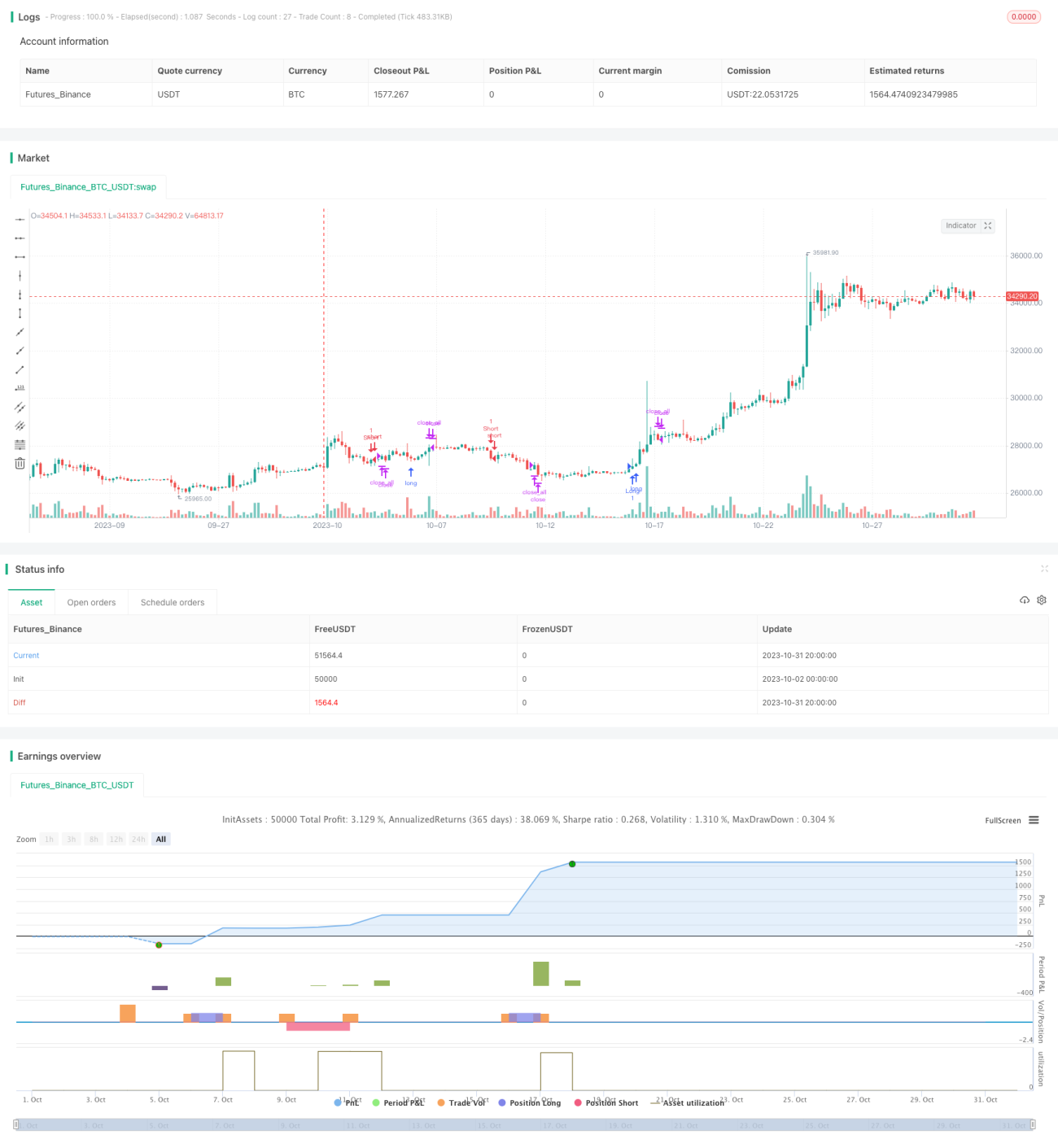
This strategy utilizes momentum indicators including Average Directional Index (ADX), Directional Movement Index (DMI) and Commodity Channel Index (CCI) to determine trend direction and follow trends. It enters positions when ADX and trend indicators confirm a trend, and CCI is overextended.
Strategy Logic
-
Calculate ADX, DMI and CCI indicators.
- ADX measures trend strength. A high ADX indicates a strong trend.
- DMI includes DI+ and DI-. DI+ shows uptrend strength while DI- shows downtrend strength. If DI+ is greater than DI-, it's an uptrend, and vice versa.
- CCI judges overbought/oversold levels. Below -100 is oversold while above 100 is overbought.
-
Determine trend direction.
- When DI+ crosses above DI-, an uptrend is identified.
- When DI- crosses below DI+, a downtrend is identified.
-
Enter positions.
- When uptrend forms, ADX is high, and CCI < -100, go long.
- When downtrend forms, ADX is high, and CCI > 100, go short.
-
Exit positions with stop loss.
- When long, exit when DI- crosses below DI+.
- When short, exit when DI+ crosses above DI-.
Advantage Analysis
-
ADX filters out trading during weak trends.
-
DMI reduces mistakes in trend identification.
-
Entering on CCI overextension improves timing and reduces risk.
-
Combining momentum indicators improves accuracy.
-
Stop loss limits loss per trade.
Risks and Hedging
-
Whipsaws when ADX drops. Raise ADX threshold to ensure strong enough trend.
-
DMI lags trend early stage. Add other analysis to identify opportunity.
-
High CCI trading frequency. Widen CCI range to filter noise.
-
Consider market neutral strategy when long and short, to hedge overall position risk.
Optimization Directions
-
Optimize ADX parameters to balance noise filtering and catching trend.
-
Optimize DMI parameters to balance lag and sensitivity.
-
Optimize CCI parameters to balance trading frequency and catching reversals.
-
Test adding or modifying indicators for better combos. E.g. MACD, KDJ.
-
Test on different products to find best fit.
-
Optimize position sizing to control risk while maintaining trend tracking.
Conclusion
The strategy logically uses ADX for trend, DMI for direction and CCI for reversals. But parameters need optimization and position sizing for risk control. Properly tuned and applied to trending products, it can deliver steady returns. Traders should dynamically adjust for changing markets.
/*backtest
start: 2023-10-02 00:00:00
end: 2023-11-01 00:00:00
period: 4h
basePeriod: 15m
exchanges: [{"eid":"Futures_Binance","currency":"BTC_USDT"}]
*/

//@version=4
strategy("ADX Strategy", currency = "USD", initial_capital = 1000, overlay=true)
adxlen = input(9, title="ADX Smoothing")
dilen = input(14, title="DI Length")- 1