Stratégie de capture de moyenne mobile exponentielle double


Date de création: 2023-12-13 15:28:50 Dernière modification: 2023-12-13 15:28:50
Copier: 0 Nombre de clics: 618
1
Suivre
1621
Abonnés

Stratégie de capture de moyenne mobile exponentielle double

Aperçu

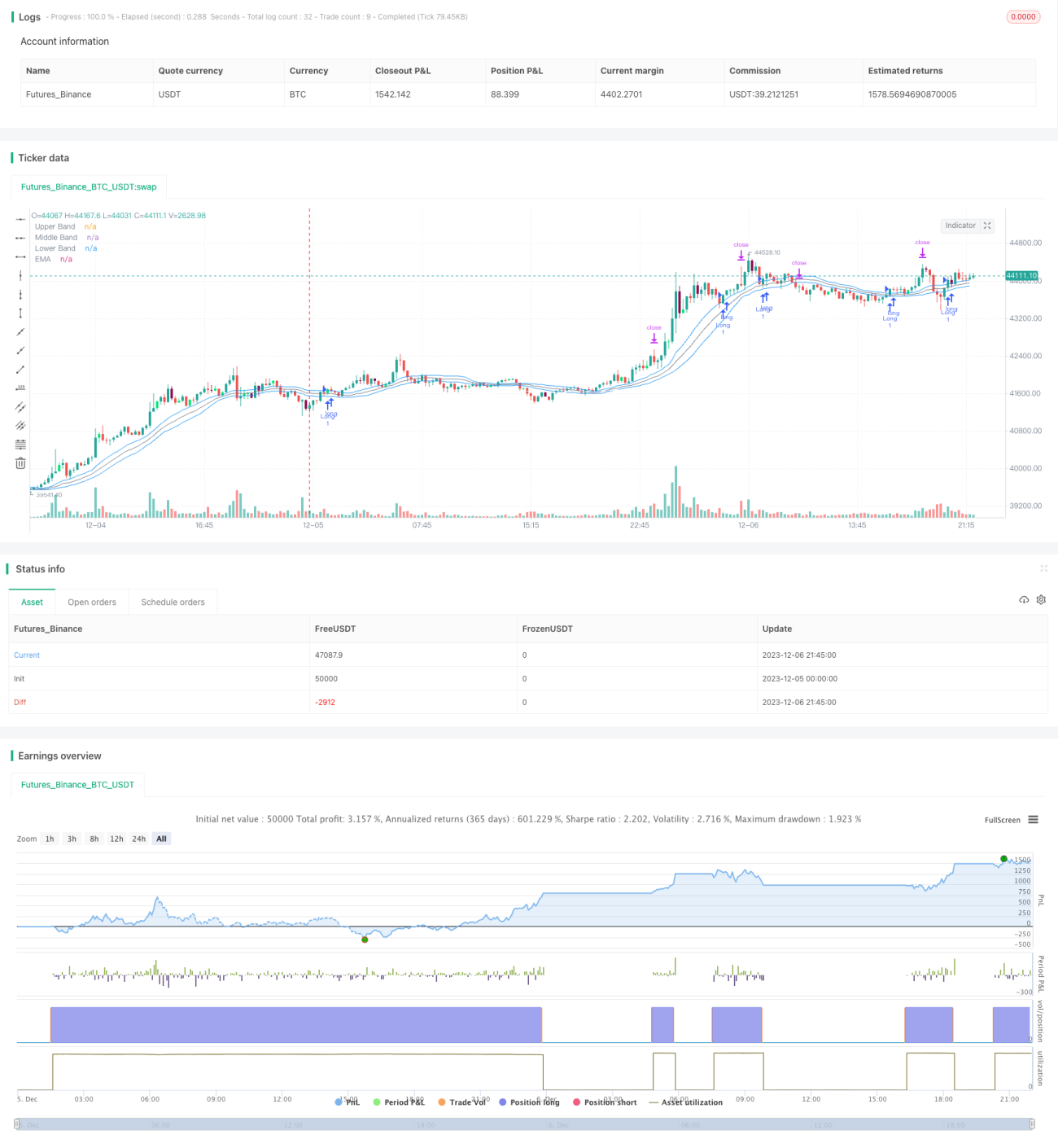
Cette stratégie utilise l’indicateur de moyenne à deux indices pour déterminer la direction de la tendance du marché, en combinaison avec l’indicateur de la ceinture de Brin pour déterminer le phénomène de survente et de survente, réaliser un achat et une vente à bas prix, et se retirer avec profit.

Principe de stratégie

Cette stratégie utilise une moyenne binaire pour juger de la tendance générale du marché, et une courbe de Brin pour juger du moment d’entrée spécifique.

L’algorithme de la moyenne bi-indicative consiste à calculer une moyenne indicielle à court terme et une moyenne indicielle à long terme, respectivement, lorsque la ligne à court terme franchit la ligne à long terme de bas en haut, devenant un signal positif; lorsque la ligne à court terme franchit la ligne à long terme de haut en bas, un signal négatif.

L’indicateur de la bande de Brin détermine si le prix est en survente ou en survente. La bande de Brin est la moyenne mobile du cours de clôture de n jours et la bande de largeur est la marge de la différence standard de n jours avant la moyenne mobile.

Les règles de cette politique sont les suivantes: Faire plus lorsque la courte moyenne franchit la longue moyenne de bas en haut et que le prix de clôture franchit la bande de Brin et monte en piste; Faire plus lorsque la courte moyenne franchit la longue moyenne de haut en bas et que le prix de clôture franchit la bande de Brin et monte en piste.

Le point d’arrêt après le plus est le prix le plus bas au cours des n jours précédents, et le point d’arrêt est 1,6 fois le prix d’ouverture; le point d’arrêt après la liquidation est le prix le plus élevé au cours des n jours précédents, et le point d’arrêt est 1,6 fois le prix d’ouverture.

En outre, la stratégie prend en compte l’indicateur de la surabondance d’EMA pour juger de la tendance générale et éviter les positions négatives.

Analyse des avantages

  1. L’utilisation de la moyenne binaire pour juger de la tendance générale, la courbe de Bryn pour juger des points d’achat et de vente spécifiques, l’indicateur s’accompagne de manière raisonnable;
  2. Faire plusieurs points de stop-loss avant l’adoption du prix le plus bas de n jours, faire du stop-loss avant l’adoption du prix le plus élevé de n jours, contribue à réduire la probabilité que le stop-loss soit poursuivi;
  3. Le point d’arrêt est 1,6 fois supérieur au prix d’ouverture, ce qui permet d’obtenir suffisamment de bénéfices.
  4. En tenant compte de l’indicateur de tendance générale de l’EMA, il est possible de réduire les pertes systémiques en évitant de prendre des positions à contre-courant.

Analyse des risques

  1. Une mauvaise optimisation des paramètres de la bande de Brindes peut entraîner une fréquence de transaction trop élevée ou une rareté des signaux.
  2. Le fait d’être trop indulgent avec ses points d’arrêt pourrait entraîner des pertes plus importantes.
  3. Les points d’arrêt trop décontractés risquent de ne pas être plus savoureux.

Optimiser les combinaisons de paramètres de la bande de Brin, tester différents niveaux d’arrêt de perte et sélectionner les paramètres optimaux pour les risques ci-dessus.

Direction d’optimisation

  1. Optimiser les paramètres de la bande de Bryn pour trouver la meilleure combinaison de paramètres;
  2. tester différents paramètres d’amplitude d’arrêt pour réduire la probabilité que l’arrêt soit poursuivi;
  3. Testez différents paramètres de multiplicateur de stop pour obtenir plus de bénéfices.

Résumer

Cette stratégie utilise une moyenne bi-indicielle pour juger de l’évolution générale du marché, les courbes de Brent pour juger du moment de l’achat et de la vente spécifique, et elle a une bonne performance dans les données de retracement. Les meilleurs résultats sont attendus grâce à l’optimisation des paramètres et à la modification des règles. Son mécanisme d’arrêt de perte peut également être porté à d’autres stratégies, avec une valeur de référence.

Code source de la stratégie
/*backtest
start: 2023-12-05 00:00:00
end: 2023-12-06 22:00:00
period: 15m
basePeriod: 5m
exchanges: [{"eid":"Futures_Binance","currency":"BTC_USDT"}]
*/

// This close code is subject to the terms of the Mozilla Public License 2.0 at https://mozilla.org/MPL/2.0/
// © AugustoErni

//@version=5
strategy('Bollinger Bands Modified (Stormer)', overlay=true)

bbL                   = input.int(20, title='BB Length/Comprimento da Banda de Bollinger', minval=1, step=1, tooltip='Calculate the length of bollinger bands./Calcula o comprimento das bandas de bollinger.')
mult                  = input.float(0.38, title='BB Standard Deviation/Desvio Padrão da Banda de Bollinger', minval=0.01, step=0.01, tooltip='Calculate the standard deviation of bollinger bands./Calcula o desvio padrão das bandas de bollinger.')
emaL                  = input.int(80, title='EMA Length/Comprimento da Média Móvel Exponencial', minval=1, step=1, tooltip='Calculate the length of EMA./Calcula o comprimento da EMA.')
highestHighL          = input.int(7, title='Highest High Length/Comprimento da Alta Maior', minval=1, step=1, tooltip='Fetches the highest high candle from length input. Use to set stop loss for short position./Obtém a vela de maior alta com base na medida fornecida. Usa para definir o stop loss para uma posição curta.')
lowestLowL            = input.int(7, title='Lowest Low Length/Comprimento da Baixa Menor', minval=1, step=1, tooltip='Fetches the lowest low candle from length input. Use to set stop loss for long position./Obter a vela de menor baixa com base na medida fornecida. Usa para definir o stop loss para uma posição longa.')
targetFactor          = input.float(1.6, title='Target Take Profit/Objetivo de Lucro Alvo', minval=0.1, step=0.1, tooltip='Calculate the take profit factor when entry position./Calcula o fator do alvo lucro ao entrar na posição.')
emaTrend              = input.bool(true, title='Check Trend EMA/Verificar Tendência da Média Móvel Exponencial', tooltip='Use EMA as trend verify for opening position./Usa a EMA como verificação de tendência para abrir posição.')
crossoverCheck        = input.bool(false, title='Add Another Crossover Check/Adicionar Mais uma Verificação de Cruzamento Superior', tooltip='This option is to add one more veryfication attempt to check if price is crossover upper bollinger band./Esta opção é para adicionar uma verificação adicional para avaliar se o preço cruza a banda superior da banda de bollinger.')
crossunderCheck       = input.bool(false, title='Add Another Crossunder Check/Adicionar Mais uma Verificação de Cruzamento Inferior', tooltip='This option is to add one more veryfication attempt to check if price is crossunder lower bollinger band./Esta opção é para adicionar uma verificação adicional para avaliar se o preço cruza a banda inferior da banda de bollinger.')
insideBarPatternCheck = input.bool(true, title='Show Inside Bar Pattern/Mostrar Padrão de Inside Bar', tooltip='This option is to show possible inside bar pattern./Esta opção é para mostrar um possível padrão de inside bar.')

[middle, upper, lower] = ta.bb(close, bbL, mult)
ema                    = ta.ema(close, emaL)
highestHigh            = ta.highest(high, highestHighL)
lowestLow              = ta.lowest(low, lowestLowL)
isCrossover            = ta.crossover(close, upper) ? 1 : 0
isCrossunder           = ta.crossunder(close, lower) ? 1 : 0

isPrevBarHighGreaterCurBarHigh = high[1] > high ? 1 : 0
isPrevBarLowLesserCurBarLow    = low[1] < low ? 1 : 0
isInsideBar                    = isPrevBarHighGreaterCurBarHigh and isPrevBarLowLesserCurBarLow ? 1 : 0

isBarLong  = ((close - open) > 0) ? 1 : 0
isBarShort = ((close - open) < 0) ? 1 : 0

isLongCross  = crossoverCheck ? ((isBarLong and not isBarShort) and (open < upper and close > upper)) ? 1 : 0 : isCrossover ? 1 : 0
isShortCross = crossunderCheck ? ((isBarShort and not isBarLong) and (close < lower and open > lower)) ? 1 : 0 : isCrossunder ? 1 : 0

isCandleAboveEma = close > ema ? 1 : 0
isCandleBelowEma = close < ema ? 1 : 0

isLongCondition  = emaTrend ? isLongCross and isCandleAboveEma ? 1 : 0 : isLongCross
isShortCondition = emaTrend ? isShortCross and isCandleBelowEma ? 1 : 0 : isShortCross

isPositionNone  = strategy.position_size == 0 ? 1 : 0
isPositionLong  = strategy.position_size > 0 ? 1 : 0
isPositionShort = strategy.position_size < 0 ? 1 : 0

var float enterLong     = 0.0
var float stopLossLong  = 0.0
var float targetLong    = 0.0
var float enterShort    = 0.0
var float stopLossShort = 0.0
var float targetShort   = 0.0
var bool isLongEntry    = false
var bool isShortEntry   = false

if (isPositionNone)
    isLongEntry   := false
    isShortEntry  := false
    enterLong     := 0.0
    stopLossLong  := 0.0
    targetLong    := 0.0
    enterShort    := 0.0
    stopLossShort := 0.0
    targetShort   := 0.0
if (isPositionShort or isPositionNone)
    isLongEntry  := false
    enterLong    := 0.0
    stopLossLong := 0.0
    targetLong   := 0.0
if (isPositionLong or isPositionNone)
    isShortEntry  := false
    enterShort    := 0.0
    stopLossShort := 0.0
    targetShort   := 0.0
if (isPositionLong and isLongEntry)
    isLongEntry   := true
    isShortEntry  := false
    enterShort    := 0.0
    stopLossShort := 0.0
    targetShort   := 0.0
if (isPositionShort and isShortEntry)
    isShortEntry := true
    isLongEntry  := false
    enterLong    := 0.0
    stopLossLong := 0.0
    targetLong   := 0.0

if (isLongCondition and not isLongEntry)
    isLongEntry  := true
    enterLong    := close
    stopLossLong := lowestLow
    targetLong   := (enterLong + (math.abs(enterLong - stopLossLong) * targetFactor))
    alertMessage = '{ "side/lado": "buy", "entry/entrada": ' + str.tostring(enterLong) + ', "stop": ' + str.tostring(stopLossLong) + ', "target/alvo": ' + str.tostring(targetLong) + ' }'
    alert(alertMessage)
    strategy.entry('Long', strategy.long)
    strategy.exit('Exit Long', 'Long', stop=stopLossLong, limit=targetLong)

if (isShortCondition and not isShortEntry)
    isShortEntry  := true
    enterShort    := close
    stopLossShort := highestHigh
    targetShort   := (enterShort - (math.abs(enterShort - stopLossShort) * targetFactor))
    alertMessage = '{ "side/lado": "sell", "entry/entrada": ' + str.tostring(enterShort) + ', "stop": ' + str.tostring(stopLossShort) + ', "target/alvo": ' + str.tostring(targetShort) + ' }'
    alert(alertMessage)
    strategy.entry('Short', strategy.short)
    strategy.exit('Exit Short', 'Short', stop=stopLossShort, limit=targetShort)

plot(upper, title='Upper Band', color=color.blue)
plot(middle, title='Middle Band', color=color.gray)
plot(lower, title='Lower Band', color=color.blue)
plot(ema, title='EMA', color=color.white)

barcolor(insideBarPatternCheck and isInsideBar and isBarLong ? color.lime : insideBarPatternCheck and isInsideBar and isBarShort ? color.maroon : na, title='Inside Bar Color in Long Bar Long and in Short Bar Short/Cor do Inside Bar em Barra Longa Longa e em Barra Curta Curta')

tablePosition    = position.bottom_right
tableColumns     = 2
tableRows        = 5
tableFrameWidth  = 1
tableBorderColor = color.gray
tableBorderWidth = 1

tableInfoTrade = table.new(position=tablePosition, columns=tableColumns, rows=tableRows, frame_width=tableFrameWidth, border_color=tableBorderColor, border_width=tableBorderWidth)

table.cell(table_id=tableInfoTrade, column=0, row=0)
table.cell(table_id=tableInfoTrade, column=1, row=0)

table.cell(table_id=tableInfoTrade, column=0, row=1, text='Entry Side/Lado da Entrada', text_color=color.white)
table.cell(table_id=tableInfoTrade, column=0, row=2, text=isLongEntry ? 'LONG' : isShortEntry ? 'SHORT' : 'NONE/NENHUM', text_color=color.yellow)

table.cell(table_id=tableInfoTrade, column=1, row=1, text='Entry Price/Preço da Entrada', text_color=color.white)
table.cell(table_id=tableInfoTrade, column=1, row=2, text=isLongEntry ? str.tostring(enterLong) : isShortEntry ? str.tostring(enterShort) : 'NONE/NENHUM', text_color=color.blue)

table.cell(table_id=tableInfoTrade, column=0, row=3, text='Take Profit Price/Preço Alvo Lucro', text_color=color.white)
table.cell(table_id=tableInfoTrade, column=0, row=4, text=isLongEntry ? str.tostring(targetLong) : isShortEntry ? str.tostring(targetShort) : 'NONE/NENHUM', text_color=color.green)

table.cell(table_id=tableInfoTrade, column=1, row=3, text='Stop Loss Price/Preço Stop Loss', text_color=color.white)
table.cell(table_id=tableInfoTrade, column=1, row=4, text=isLongEntry ? str.tostring(stopLossLong) : isShortEntry ? str.tostring(stopLossShort) : 'NONE/NENHUM', text_color=color.red)