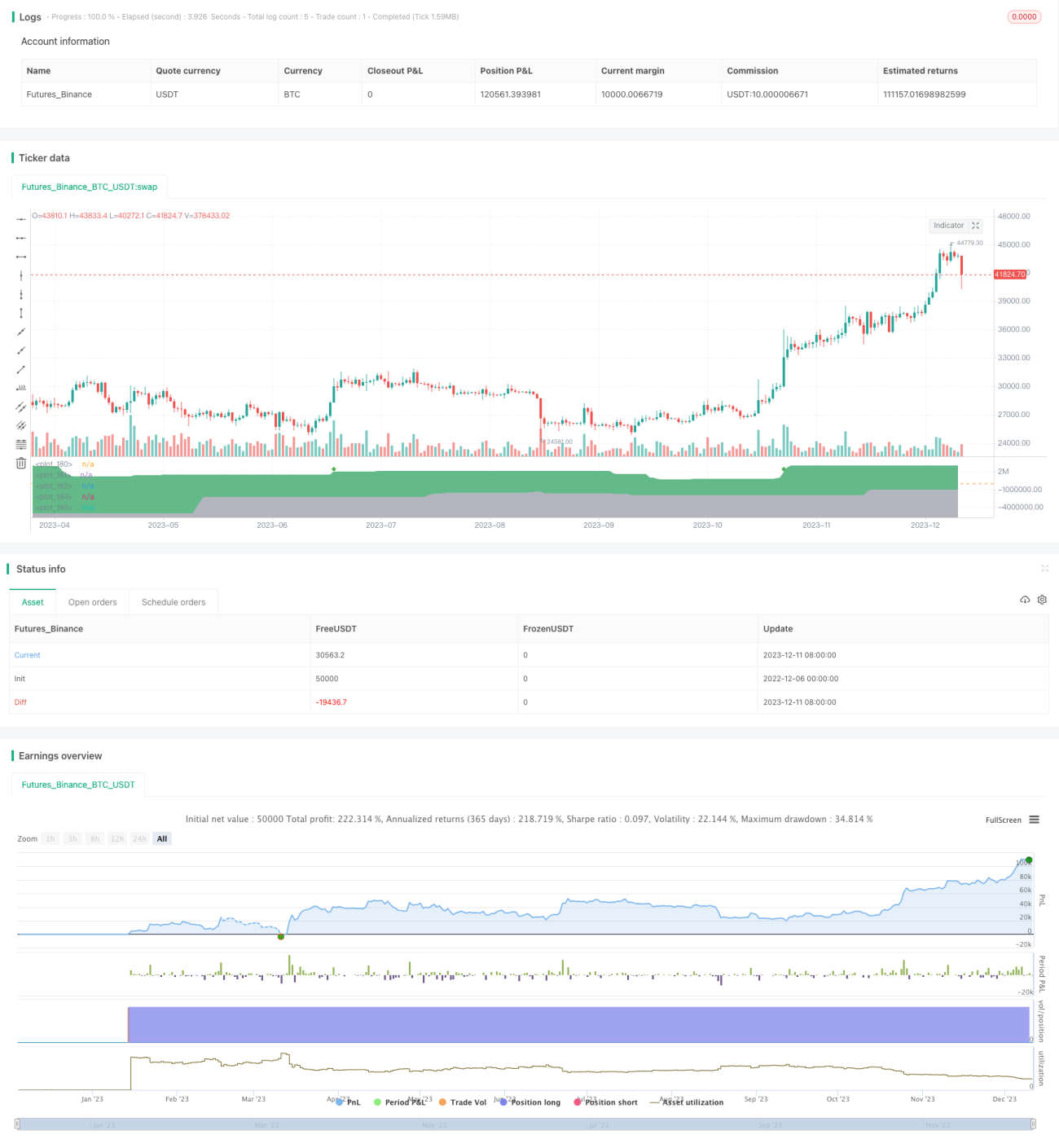
Cette stratégie est basée sur les indicateurs de canaux de prix Donchain et les indicateurs quantifiés OBV oscillateurs générés par des signaux polyvalents pour la négociation bidirectionnelle. Il utilise les indicateurs de canaux de prix pour déterminer la rupture de prix et le retournement, combiné avec les indicateurs quantifiés pour déterminer la force polyvalente, pour générer des signaux de négociation.
L’indicateur de canal de prix Donchain est utilisé pour déterminer les canaux de prix supérieurs et inférieurs. Le canal supérieur est calculé par le prix le plus élevé et le canal inférieur par le prix le plus bas.
Construire un oscillateur OBV avec des indicateurs quantifiés OBV et des indicateurs EMA pour déterminer la force de la tête vide. Lorsque l’oscillateur est supérieur à 0, la force de la tête vide est considérée comme supérieure à la force de la tête vide, et vice versa lorsque l’oscillateur est inférieur à 0.
Un signal de plus est généré lorsque le prix franchit le canal supérieur et que l’oscillateur est supérieur à 0. Un signal de moins est généré lorsque le prix franchit le canal inférieur et que l’oscillateur est inférieur à 0.
Lorsque le prix revient vers le canal inférieur, le cours est à la hausse; lorsque le prix revient vers le canal supérieur, le cours est à la baisse.
Il est important de ne pas se laisser induire en erreur par les événements de choc.
L’analyse de la force aérienne, combinée à des indicateurs quantitatifs, assure la cohérence de la direction des transactions avec les forces du marché.
Avec le trading bidirectionnel, vous pouvez profiter de la hausse ou de la baisse du marché.
Définir une stratégie de prévention des pertes et de contrôle des risques.
Une mauvaise configuration des paramètres du canal de prix peut entraîner un passage trop large ou trop étroit, des opportunités de transaction manquées ou des signaux erronés.
Une mauvaise configuration des paramètres de l’indicateur peut également entraîner un retard ou une avancée du signal.
Un événement soudain entraînant une anomalie de vitesse peut déclencher un arrêt de dommages-intérêts.
Les transactions bidirectionnelles nécessitent une gestion simultanée des positions en plus et en moins, ce qui est plus difficile.
Optimiser les paramètres du canal de prix pour trouver la meilleure combinaison de paramètres.
Les paramètres de l’oscillateur OBV doivent également être testés et optimisés pour garantir une évaluation précise et en temps opportun de la force aérienne.
On peut envisager d’améliorer la précision du signal en combinant avec d’autres indicateurs tels que MACD, KD et autres pour déterminer les tendances du marché.
Il est possible de tester l’efficacité de différentes méthodes d’arrêt, telles que le suivi des arrêts, les pourcentages d’arrêt.
Il est possible de tester différentes variétés pour trouver celles qui conviennent le mieux à la stratégie.
La stratégie est globalement une stratégie de négociation bidirectionnelle, combinant les tendances du marché et la force de la volatilité avec des indicateurs quantitatifs et des tendances de prix. La stratégie est claire et facile à comprendre. L’espace d’optimisation est également relativement grand.
/*backtest
start: 2022-12-06 00:00:00
end: 2023-12-12 00:00:00
period: 1d
basePeriod: 1h
exchanges: [{"eid":"Futures_Binance","currency":"BTC_USDT"}]
*/
// This source code is subject to the terms of the Mozilla Public License 2.0 at https://mozilla.org/MPL/2.0/
// © ahancock
//@version=4
strategy(
title = "Hancock - Filtered Volume OBV OSC [Strategy]",
initial_capital = 1000,
overlay = false,
commission_type = strategy.commission.percent,
commission_value= 0.075)
// Inputs
source = input(close, title = "Source", type = input.source)
use_volume_filter = input(true, title = "Use Volume Filter", type = input.bool)
vol_filter_length = input(20, title = "Volume Filter - Length", type = input.integer, minval = 1)
vol_filter_multiplier = input(1.2, title = "Volume Filter - Multiplier", type = input.float, minval = 0.1, step = 0.1)
use_osc = input(true, title = "Use Oscillator", type = input.bool)
osc_length = input(40, title = "Oscillator - Signal Length", type = input.integer, minval = 1)
channel_length = input(65, title = "Channel - Slow Length", minval = 5, maxval = 200, step = 5)
channel_percent = input(70, title = "Channel - Fast Length Percent", minval = 5, maxval = 100, step = 5)
trade_both = "Both", trade_long = "Long", trade_short = "Short"
trade_direction = input("Both", title = "Trade - Direction", options = [trade_both, trade_long, trade_short])
trade_leverage = input(2, title = "Trade - Leverage", type = input.integer, minval = 1, maxval = 100)
trade_stop = input(7.5, title = "Trade - Stop Loss %", type = input.float, minval = 0.5, step = 0.5, maxval = 100)
trade_trail_threshold = input(5, title = "Trade - Trail Stop Threshold %", type = input.float, minval = 0.5, step = 0.5, maxval = 100)
trade_trail = input(5, title = "Trade - Trail Stop Minimum %", type = input.float, minval = 0.5, step = 0.5, maxval = 100)
trade_risk = input(100, title = "Trade - Risk %", type = input.integer, step = 1, minval = 1, maxval = 100)
test_year = input(2019, "Test - Year", type = input.integer, minval = 1970, maxval = 2222)
test_month = input(01, "Test - Month", type = input.integer, minval = 1, maxval = 12)
test_day = input(01, "Test - Day", type = input.integer, minval = 1, maxval = 31)
// Functions
get_round(value, precision) => round(value * (pow(10, precision))) / pow(10, precision)
get_obv(values, filter_length, filter_multiplier, use_filter, osc_length, use_osc) =>
threshold = abs(avg(volume, filter_length) - (stdev(volume, filter_length) * filter_multiplier))
obv = 0.0
if (use_filter and volume < threshold)
obv := nz(obv[1])
else
obv := nz(obv[1]) + sign(change(values)) * volume
use_osc ? (obv - ema(obv, osc_length)) : obv
get_dc(high_values, low_values, length) =>
top = highest(high_values, length)
bot = lowest(low_values, length)
mid = bot + ((top - bot) / 2)
[top, mid, bot]
get_dcs(high_values, low_values, length, length_percent) =>
slow_length = length
fast_length = slow_length * length_percent / 100
[slow_top, slow_mid, slow_bot] =
get_dc(high_values, low_values, slow_length)
[fast_top, fast_mid, fast_bot] =
get_dc(high_values, low_values, fast_length)
[slow_top, slow_mid, slow_bot, fast_top, fast_mid, fast_bot]
// Strategy
obv = get_obv(
source,
vol_filter_length,
vol_filter_multiplier,
use_volume_filter,
osc_length,
use_osc)
[slow_top_price, _, slow_bot_price, fast_top_price, _, fast_bot_price] =
get_dcs(high, low, channel_length, channel_percent)
[slow_top_obv, _, slow_bot_obv, fast_top_obv, _, fast_bot_obv] =
get_dcs(obv, obv, channel_length, channel_percent)
enter_long_price = high > slow_top_price[1]
exit_long_price = low < fast_bot_price[1]
enter_short_price = low < slow_bot_price[1]
exit_short_price = high > fast_top_price[1]
enter_long_obv = obv > slow_top_obv[1] and (use_osc ? obv > 0 : true)
enter_short_obv = obv < fast_bot_obv[1] and (use_osc ? obv < 0 : true)
exit_long_obv = obv < slow_bot_obv[1]
exit_short_obv = obv > fast_top_obv[1]
// Trade Conditions
can_trade = true
enter_long_condition = enter_long_obv and enter_long_price
exit_long_condition = exit_long_obv and exit_long_price
enter_short_condition = enter_short_obv and enter_short_price
exit_short_condition = exit_short_obv and exit_short_price
position_signal = 0
position_signal :=
enter_long_condition ? 1 :
enter_short_condition ? -1 :
exit_long_condition or exit_short_condition ? 0 :
position_signal[1]
// Positions
test_time = timestamp(test_year, test_month, test_day, 0, 0)
if (time >= test_time and strategy.opentrades == 0)
contracts = get_round((strategy.equity * trade_leverage / close) * (trade_risk / 100), 4)
if (trade_direction == trade_both or trade_direction == trade_long)
strategy.entry(
"LONG",
strategy.long,
qty = contracts,
when = enter_long_condition)
if (trade_direction == trade_both or trade_direction == trade_short)
strategy.entry(
"SHORT",
strategy.short,
qty = contracts,
when = enter_short_condition)
in_long = strategy.position_size > 0
in_short = strategy.position_size < 0
float long_high = na
float short_low = na
long_high := in_long ? high >= nz(long_high[1], low) ? high : long_high[1] : na
short_low := in_short ? low <= nz(short_low[1], high) ? low : short_low[1] : na
long_change = abs(((long_high - strategy.position_avg_price) / strategy.position_avg_price) * 100)
short_change = abs(((short_low - strategy.position_avg_price) / strategy.position_avg_price) * 100)
threshold_difference = (strategy.position_avg_price / trade_leverage) * (trade_trail_threshold / 100)
long_trail_threshold = in_long ? strategy.position_avg_price + threshold_difference : na
short_trail_threshold = in_short ? strategy.position_avg_price - threshold_difference : na
long_trail = in_long and long_high > long_trail_threshold ?
long_high - (long_high / trade_leverage) * (trade_trail / 100) : na
short_trail = in_short and short_low < short_trail_threshold ?
short_low + (short_low / trade_leverage) * (trade_trail / 100) : na
stop_difference = (strategy.position_avg_price / trade_leverage) * (trade_stop / 100)
long_stop = in_long ? long_high > long_trail_threshold ? long_trail : strategy.position_avg_price - stop_difference : na
short_stop = in_short ? short_low < short_trail_threshold ? short_trail : strategy.position_avg_price + stop_difference : na
strategy.exit("S/L", "LONG",
stop = long_stop,
qty = abs(get_round(strategy.position_size, 4)))
strategy.exit("S/L", "SHORT",
stop = short_stop,
qty = abs(get_round(strategy.position_size, 4)))
strategy.close_all(when = abs(change(position_signal)) > 0)
// Plots
plotshape(enter_long_condition, "Enter Long", shape.diamond, location.top, color.green)
plotshape(exit_long_condition, "Exit Long", shape.diamond, location.top, color.red)
plotshape(enter_short_condition, "Enter Short", shape.diamond, location.bottom, color.green)
plotshape(exit_short_condition, "Exit Short", shape.diamond, location.bottom, color.red)
color_green = #63b987
color_red = #eb3d5c
hline(use_osc ? 0 : na)
plot(use_osc ? obv : na, color = color.silver, style = plot.style_area, transp = 90)
plot(obv, color = color.white, style = plot.style_line, linewidth = 2, transp = 0)
plot_slow_top = plot(slow_top_obv, color = color_green, linewidth = 2, transp = 60)
plot_slow_bot = plot(slow_bot_obv, color = color_green, linewidth = 2, transp = 60)
fill(plot_slow_top, plot_slow_bot, color = color_green, transp = 90)
plot_fast_top = plot(fast_top_obv, color = color_red, linewidth = 2, transp = 60)
plot_fast_bot = plot(fast_bot_obv, color = color_red, linewidth = 2, transp = 60)
fill(plot_fast_top, plot_fast_bot, color = color_red, transp = 90)