Dual Moving Average Line Capture Strategy

Overview
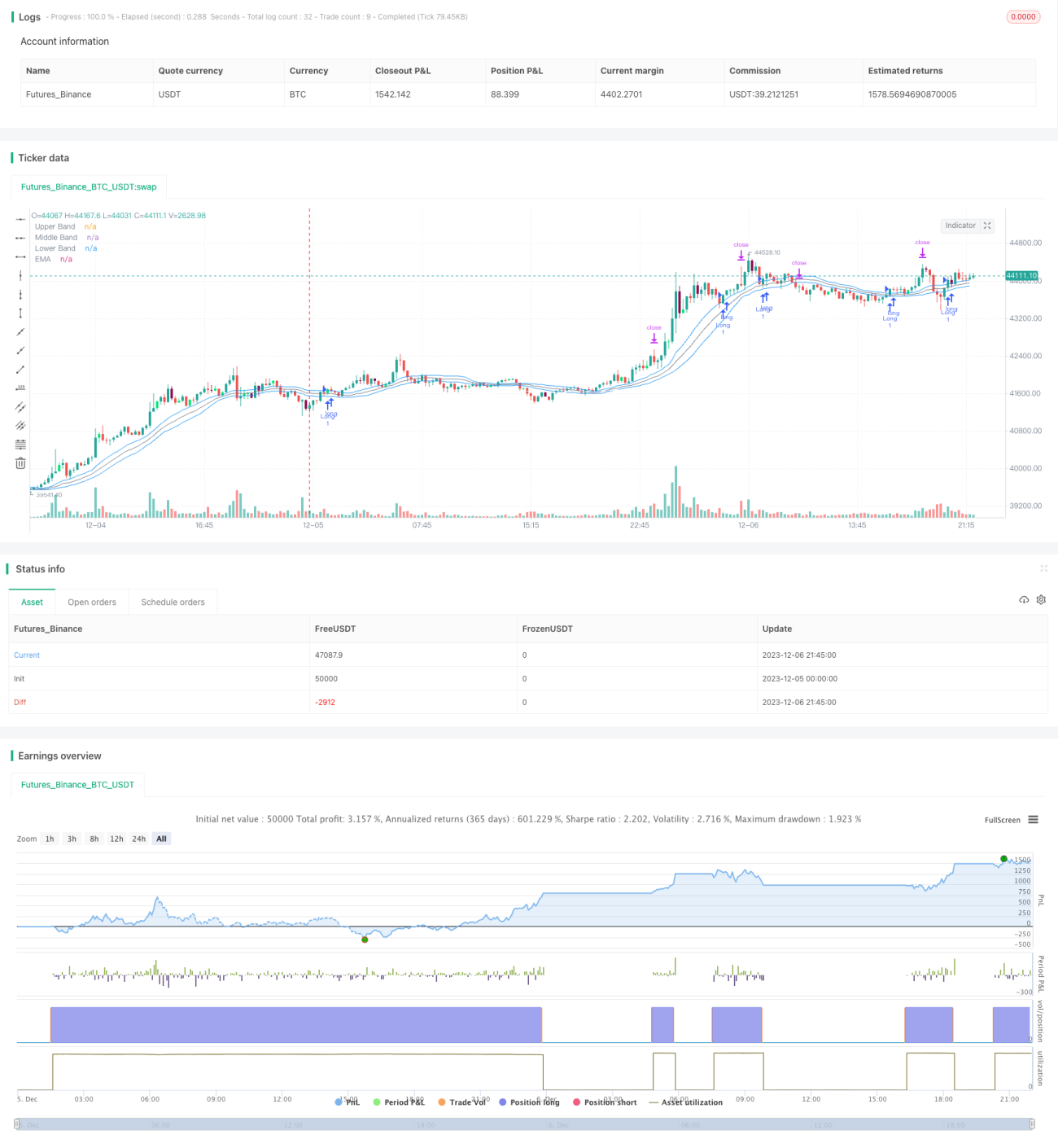
This strategy uses dual moving average lines to determine market trend direction combined with Bollinger Bands to identify overbought and oversold conditions, in order to achieve buying low and selling high for profit taking.
Strategy Logic
The strategy utilizes dual moving averages to ascertain overall market direction, while relying on Bollinger Bands for specific entry signals.
The dual moving average rule stipulates computing a short-term and a long-term exponential moving average line, with the short-term line crossing over the long-term line upward indicating a buy signal; the short-term line crossing downward through the long-term constitutes a sell signal.
The Bollinger Bands indicator determines whether prices are overbought or oversold. The middle band of Bollinger Bands is the moving average line of n-period closing prices, while the band width represents the standard deviation of the moving average over the past n periods. Prices approaching the upper band indicate an overbought condition and those nearing the lower band constitute an oversold situation.
The strategy rules are defined as:
When the short average line crosses over the long average line upward plus the closing price penetrating above the Bollinger upper band, go long. When the short line crosses downward through the long line plus the closing prices dropping below the Bollinger lower band, go short.
The stop loss after going long is set at the lowest low over the past n days, while take profit is placed at 1.6 times the entry price. The stop loss after a short sale is pegged to the highest high over n days past with take profit at 0.6 times the entry price.
In addition, the strategy considers the EMA trend index to avoid trend reversals.
Advantage Analysis
- Using dual moving averages to determine overall direction combined with Bollinger Bands to spotlight specific entry points represents a sensible indicator mix;
- Adopting the lowest low over n days as stop loss for longs and highest high over n days as stop loss for shorts helps diminish chances of stops being run;
- Fixing take profit target at 1.6 times entry price facilitates capturing adequate gains;
- Considering EMA trend index assists evading trades against major trend, reducing system losses.
Risk Analysis
- Inappropriate optimization of Bollinger Bands parameters may result in excessively frequent trading or insufficient signals;
- Excessively loose stop loss points invites larger losses;
- Excessively tight take profit restrictions forfeits larger gains.
To address the above risks, optimize combinations of Bollinger parameters and test different stop loss/ profit capture threshold levels to select optimal settings.
Optimization Direction
- Optimize Bollinger Bands input parameters to locate ideal combinations;
- Examine various stop loss increment parameters to diminish chances of stops being run;
- Test assorted take profit multiplier values to capture greater possible gains.
Conclusion
This strategy has performed creditably in backtests by confirming overall trend using dual moving averages and relying on Bollinger Bands for specific entry signals. Additional performance improvements may be anticipated through continued parameter optimization and rule modifications. The stop loss/profit taking mechanism is also transferable to other systems for adaption.
- 1