Estrategia de backtesting del oscilador arcoíris

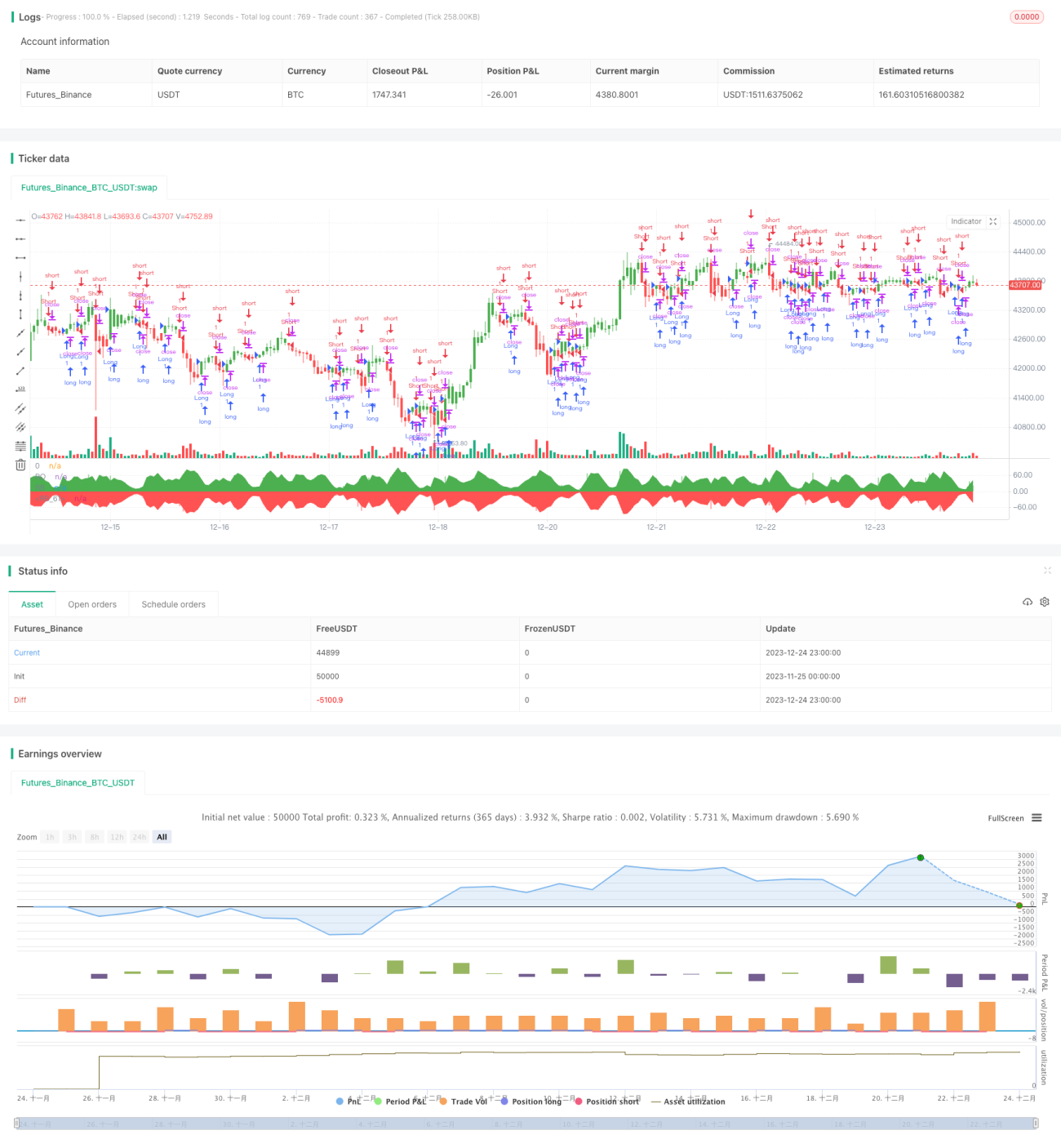
Resumen
La estrategia de backtesting del Oscilador Arcoíris es una estrategia de trading cuantitativa basada en el indicador del Oscilador Arcoíris. Esta estrategia determina la dirección y la fuerza de la tendencia del mercado calculando el grado de desviación entre el precio de la acción y su media móvil, y utiliza esta información para decidir posiciones largas o cortas.
Principio de la Estrategia
El indicador central de esta estrategia es el Oscilador Arcoíris (Rainbow Oscillator, RO), cuya fórmula de cálculo es la siguiente:
RO = 100 * ((Precio de cierre - Media móvil de 10 días) / (Máximo más alto - Mínimo más bajo))
Donde la media móvil de 10 días es la media móvil simple de los precios de cierre de 10 períodos. Este indicador refleja la desviación del precio con respecto a su propia media móvil. Cuando RO > 0, el precio está por encima de la media móvil, lo que indica una señal alcista; cuando RO < 0, el precio está por debajo de la media móvil, lo que indica una señal bajista.
La estrategia también calcula un indicador auxiliar: el Ancho de Banda (Bandwidth, RB), cuya fórmula es:
RB = 100 * ((Máximo de la media móvil - Mínimo de la media móvil) / (Máximo más alto - Mínimo más bajo))
RB refleja la anchura entre las medias móviles. Cuanto mayor es RB, mayor es la volatilidad del precio; por el contrario, cuanto menor es RB, más estable es el precio. El indicador RB se puede utilizar para juzgar la estabilidad del mercado.
Según los valores de RO y RB, la estrategia evalúa el grado de desviación del precio y la estabilidad del mercado, generando así señales de trading para posiciones largas y cortas.
Ventajas de la Estrategia
Esta estrategia presenta las siguientes ventajas:
- Se basa en dos indicadores para el juicio, evitando las limitaciones de un solo indicador.
- Puede evaluar simultáneamente la tendencia del precio y la estabilidad del mercado.
- Cálculo simple, fácil de entender e implementar.
- Indicadores visuales que forman un efecto "arcoíris", intuitivos y fáciles de leer.
Riesgos de la Estrategia
Esta estrategia también conlleva algunos riesgos:
- Una configuración inadecuada de los parámetros de RO y RB puede generar señales de trading erróneas.
- Las estrategias de doble media móvil son propensas a generar señales falsas y operaciones frecuentes.
- Una selección inadecuada del período de backtesting y del instrumento puede afectar el rendimiento de la estrategia.
- No se consideran los costos de transacción, por lo que el rendimiento en operaciones reales puede no ser óptimo.
Medidas correctivas:
- Optimizar los parámetros de los indicadores RO y RB.
- Añadir condiciones de filtro para evitar operaciones frecuentes.
- Elegir períodos de backtesting e instrumentos adecuados.
- Calcular y considerar los costos de transacción.
Optimización de la Estrategia
La estrategia también se puede optimizar en los siguientes aspectos:
- Agregar una función de suavizado al indicador RO para evitar fluctuaciones bruscas.
- Incorporar una estrategia de stop-loss para controlar las pérdidas individuales.
- Combinar con otros indicadores para realizar trading combinado, aumentando la probabilidad de ganancias.
- Agregar modelos de aprendizaje automático para realizar predicciones y evaluar la efectividad de los indicadores.
- Optimizar los parámetros para diferentes instrumentos, mejorando la adaptabilidad.
Conclusión
La estrategia de backtesting del Oscilador Arcoíris utiliza la relación de desviación entre el precio y su media móvil para determinar la tendencia y estabilidad del mercado, realizando así operaciones largas y cortas. Esta estrategia es intuitiva, fácil de leer, simple de implementar y tiene cierto valor práctico. Sin embargo, también presenta algunos riesgos. Es necesario optimizar los parámetros y las reglas de trading para reducir los riesgos y mejorar el rendimiento en operaciones reales.
/*backtest
start: 2023-11-25 00:00:00
end: 2023-12-25 00:00:00
period: 1h
basePeriod: 15m
exchanges: [{"eid":"Futures_Binance","currency":"BTC_USDT"}]
*/

//@version=2
////////////////////////////////////////////////////////////
//  Copyright by HPotter v1.0 18/03/2018
// Ever since the people concluded that stock market price movements are not - 1