Stratégie de suivi de tendance avec canal oscillant multi-timeframe

[trans]
Aperçu
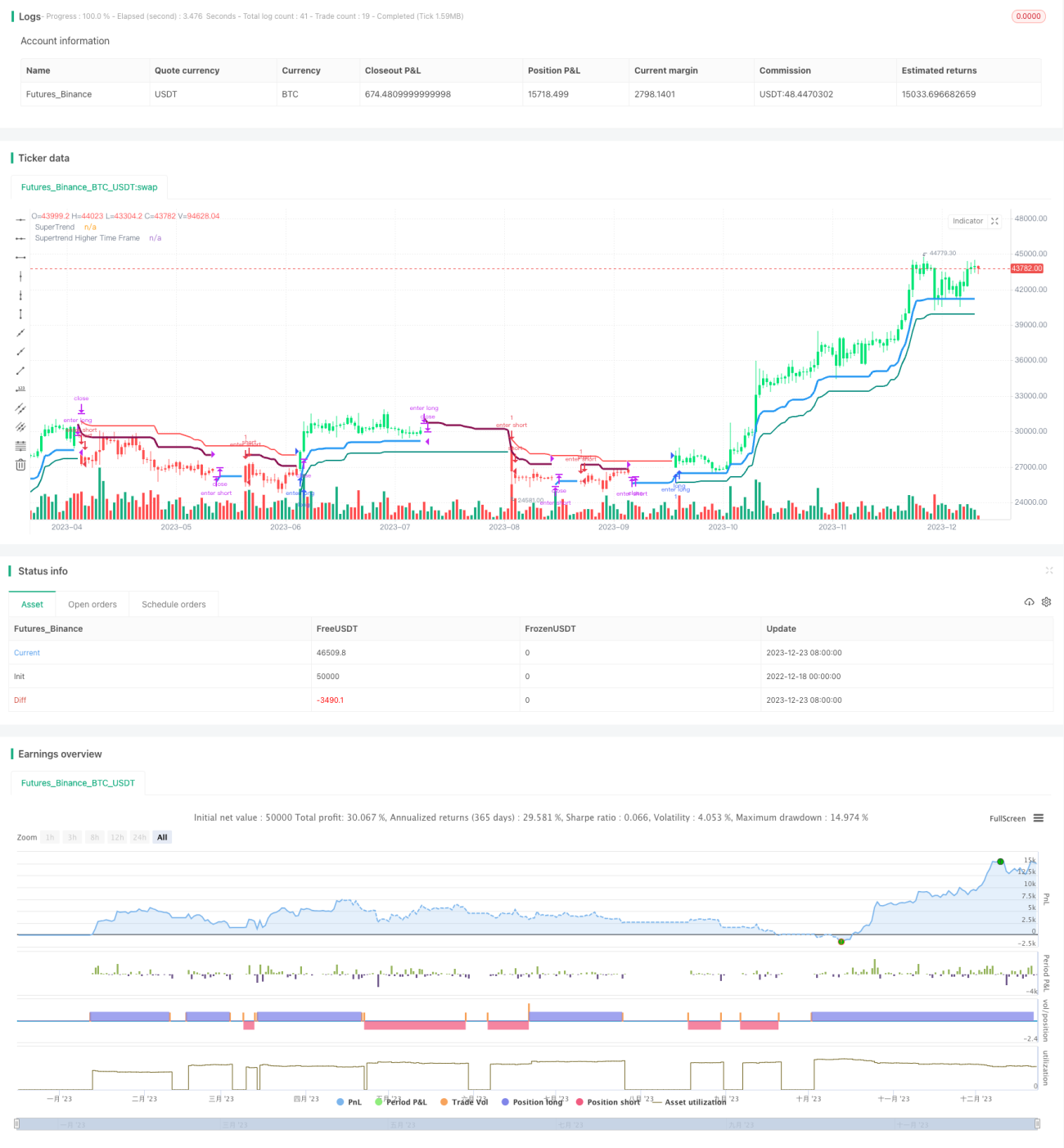
Cette stratégie est basée sur l'indicateur SuperTrend, combinée à l'analyse de tendance sur plusieurs périodes, et utilise la méthode des canaux oscillatoires pour identifier les points d'entrée.
Principe de la stratégie
- Utiliser l'indicateur SuperTrend traditionnel pour déterminer la direction de la tendance
- Ajouter le SuperTrend d'une période supérieure afin de s'assurer qu'une tendance existe également sur cette période plus élevée
- Déterminer la direction générale de la tendance à partir des indicateurs SuperTrend des deux périodes
- Identifier les points d'entrée spécifiques en fonction du franchissement des bornes supérieure et inférieure du canal oscillatoire par le prix
Analyse des avantages
- L'analyse multi-périodes rend le jugement de tendance plus fiable
- La combinaison de périodes haute et basse permet à la fois de capter la tendance majeure et de saisir les opportunités à court terme
- Le canal oscillatoire fixe des niveaux de stop-loss, ce qui facilite la gestion du risque
Risques et solutions
- Le SuperTrend présente un certain effet de retard, ce qui peut faire manquer les points de retournement de tendance
- Le risque de retard peut être réduit en optimisant les paramètres ou en combinant d'autres indicateurs pour détecter les changements de tendance
Pistes d'optimisation
- Optimiser les paramètres du SuperTrend pour réduire le retard
- Ajouter des filtres de tendance pour améliorer la précision du jugement de la tendance majeure
- Tester et choisir une méthode de stop-loss plus appropriée
Résumé
Cette stratégie intègre l'analyse multi-périodes et les indicateurs de suivi de tendance pour maîtriser la tendance principale tout en recherchant des points d'entrée spécifiques. Grâce à une optimisation continue, elle peut espérer générer des rendements excédentaires stables à long terme.
||
Overview
This strategy is based on the Supertrend indicator, combined with multiple timeframe market trend analysis, and adopts the oscillation channel method to identify entry opportunities.
Strategy Principle
- Use the traditional Supertrend indicator to determine the trend direction
- Add Supertrend of higher timeframe to ensure there is a trend in higher timeframe too
- Determine the overall trend direction based on the Supertrend indicators of two timeframes
- Identify specific entry opportunities based on the price breakout of the upper and lower rails of the oscillation channel
Advantage Analysis
- Multi-timeframe analysis makes trend judgment more reliable
- Combining high and low timeframes ensures catching the major trend while being able to capture short-term opportunities
- The oscillation channel setting stops loss points which helps risk control
Risks and Solutions
- The Supertrend itself has some lagging phenomenon, which may miss trend reversal points
- The lagging risk can be reduced by optimizing parameters or incorporating other indicators to assist in identifying trend changes
Optimization Directions
- Optimize Supertrend parameters to reduce lagging
- Add trend filtering indicators to ensure catching the major trend more accurately
- Test and select more appropriate stop loss methods
Summary
This strategy integrates multi-timeframe analysis and trend tracking indicators to grasp the major trend while seeking specific entry opportunities. With continuous optimization, it is expected to achieve long-term steady excess returns.
/*backtest
start: 2022-12-18 00:00:00
end: 2023-12-24 00:00:00
period: 1d
basePeriod: 1h
exchanges: [{"eid":"Futures_Binance","currency":"BTC_USDT"}]
*/

// This source code is subject to the terms of the Mozilla Public License 2.0 at https://mozilla.org/MPL/2.0/
// © ramki_simple
// Thanks to LonesomeTheBlue for the original code
//@version=4- 1