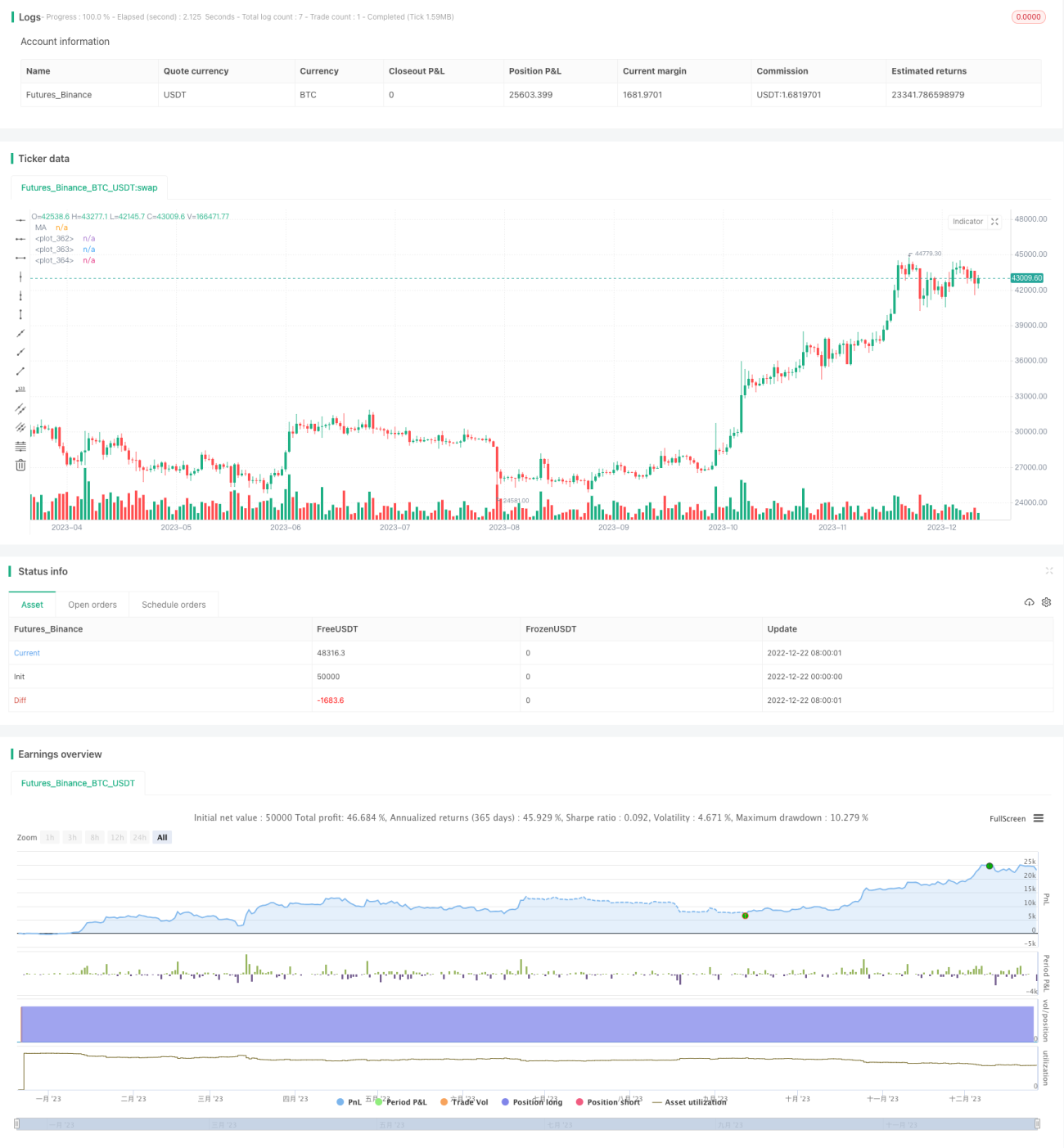
Stratégie de trading à court terme basée sur l'inversion de la moyenne mobile


Date de création: 2023-12-29 11:33:04 Dernière modification: 2023-12-29 11:33:04
Copier: 0 Nombre de clics: 678
1
Suivre
1623
Abonnés

Stratégie de trading à court terme basée sur l’inversion de la moyenne mobile

Aperçu

Une stratégie de courte ligne basée sur une inversion de la courte ligne est une stratégie de courte ligne basée sur une inversion de la courte ligne. Elle combine plusieurs indicateurs tels que les bandes de Brin, le RSI et le CCI pour capturer les variations de courte ligne des marchés financiers et atteindre les objectifs de négociation.

Cette stratégie est principalement utilisée pour les variétés à forte liquidité telles que les indices boursiers, les devises étrangères et les métaux précieux. Elle vise à maximiser les gains par tranche, tout en contrôlant le rapport risque/bénéfice de l’ensemble des transactions.

Principe de stratégie

  1. Utilisez les bandes de Brin pour déterminer la zone de dévaluation des prix. Considérez le short lorsque le prix est proche de la bande de Brin supérieure et le long lorsque le prix est proche de la bande de Brin inférieure.

  2. L’indicateur RSI peut être utilisé pour identifier efficacement les situations de survente.

  3. L’indicateur CCI détermine les signaux de revers des prix. L’indicateur CCI est plus sensible aux situations anormales et peut capturer efficacement les occasions de revers des prix.

  4. La position de la moyenne représente la zone principale du prix actuel, et la relation entre le prix et la moyenne reflète les changements de tendance potentiels.

  5. Une fois le signal d’entrée confirmé, le placement rapide de la position est pris en compte. Selon la situation de retrait, un arrêt de perte et une sortie sont définis, ce qui permet un taux de victoire élevé.

Avantages stratégiques

  1. Combinaison de plusieurs indicateurs pour une meilleure précision du signal

La stratégie de la courbe inverse utilise plusieurs indicateurs, tels que les bandes de Brin, le RSI et le CCI. Ces indicateurs sont plus sensibles aux variations de prix. L’utilisation combinée peut améliorer l’exactitude du signal et réduire les signaux erronés.

  1. Les règles d’entrée en bourse sont strictes pour éviter les chutes et les pertes.

La stratégie exige que les signaux d’indicateur et les prix soient synchronisés, évitant ainsi que les indicateurs se trompent. En même temps, elle exige que les prix soient clairement inversés, ce qui réduit les risques associés.

  1. Des mécanismes de prévention efficaces pour contrôler les pertes individuelles

Peu importe le nombre de prises de position, la stratégie définit une limite de perte plus stricte. Une fois que le prix franchit la limite de perte dans la direction négative, la stratégie s’arrête rapidement et évite une perte importante.

  1. Le but est de maximiser les profits de chaque transaction.

La stratégie consiste à définir deux objectifs de stop-loss et à réaliser des gains progressivement. En même temps, après le stop-loss, les stop-loss sont ajustés en petites étapes pour élargir chaque espace de profit.

Analyse des risques

  1. Les prix ont fortement fluctué, les arrêts de perte ont été déclenchés

En cas de fortes fluctuations des prix, la ligne de stop-loss peut être franchie, ce qui entraîne des pertes inutiles. Cela se produit généralement dans des fluctuations anormales des prix causées par des événements majeurs.

Il est possible de gérer ce risque en élargissant la marge de stop loss, tout en évitant les opérations pendant les événements majeurs.

  1. La chasse est trop dure, il n’y a pas de retour en arrière

Lorsque la tendance est trop forte, le cours monte trop vite et ne peut pas être renversé à temps. Si vous persistez à faire de la sous-traitance, vous risquez de poursuivre la baisse.

Dans ce cas, il faudra attendre que la hausse des prix diminue de manière significative pour envisager d’intervenir.

Direction d’optimisation

  1. Optimisation des paramètres de l’indicateur pour améliorer l’exactitude du signal

Il est possible de tester les résultats des retours sous différents ensembles de paramètres, en choisissant les meilleurs. Par exemple, les paramètres qui optimisent le RSI, les paramètres du CCI, etc.

  1. Les indicateurs quantitatifs combinés permettent de déterminer le moment de la reprise

Il est possible d’ajouter des indicateurs de quantité de trafic ou d’équivalence de la bande passante de Brin. Cela évite de générer des signaux erronés lorsque le prix n’est que légèrement ajusté.

  1. Optimiser les stratégies de stop-loss pour augmenter les bénéfices individuels

Il est possible de tester différents points d’arrêt et de stop-loss pour maximiser chaque gain. Il faut également équilibrer les risques afin d’éviter que le stop-loss ne soit facilement déclenché.

Résumer

La stratégie de rétroviseur moyen utilise un large éventail d’indicateurs de jugement, avec des signaux précis, des spécifications d’exploitation et des risques contrôlables. Elle s’applique aux variétés très sensibles aux changements du marché, à forte liquidité, capables de capturer les occasions de revirement des prix entre la bande de Bryn et la ligne de rétroviseur clé, pour réaliser des objectifs de négociation à bas prix.

Dans la pratique, il est toujours nécessaire de prêter attention à l’optimisation des paramètres de l’indicateur, tout en combinant la quantité d’indicateur permettant de déterminer le moment de la véritable inversion. De plus, une bonne gestion des risques est nécessaire pour faire face aux fortes fluctuations des prix. Si elle est utilisée correctement, la stratégie peut obtenir des rendements Alpha relativement stables.

Code source de la stratégie
/*backtest
start: 2022-12-22 00:00:00
end: 2023-12-28 00:00:00
period: 1d
basePeriod: 1h
exchanges: [{"eid":"Futures_Binance","currency":"BTC_USDT"}]
*/

// This source code is subject to the terms of the Mozilla Public License 2.0 at https://mozilla.org/MPL/2.0/
// © sg1999

//@version=4


// >>>>>strategy name
strategy(title = "CCI-RSI MR", shorttitle = "CCI-RSI MR", overlay = true)

// >>>>input variables

// 1. risk per trade as % of initial capital
risk_limit = input(title="Risk Limit (%)", type=input.float, minval=0.1, defval=2.0, step=0.1)

// 2. drawdown
Draw_down = input(title="Max Drawdown (x ATR)", type=input.float, minval=0.5, maxval=10, defval=2.0, step=0.1)

// 3. type of stop loss to be used
original_sl_type  = input(title="SL Based on", defval="Close Price", options=["Close Price","Last Traded Price"])

// 4. entry signal validity for bollinger strategies
dist_from_signal= input(title="Entry distance from signal", type=input.integer, minval=1, maxval=20, defval=3, step=1)

// 5. multiple exit points
exit_1_pft_pct          = input(title="1st exit when reward is", type=input.float, minval=0.5, maxval=100, defval=1.0, step=0.1)
exit_1_qty_pct          = input(title="1st exit quantity %", type=input.float, minval=1, maxval=100, defval=100, step=5)
exit_2_pft_pct          = input(title="2nd exit when reward is", type=input.float, minval=0.5, maxval=100, defval=1.5, step=0.1)
sl_trail_pct            = input(title="Trailing SL compared to original SL", type=input.float, minval=0.5, maxval=100, defval=0.5, step=0.5)

//show signal bool
plotBB = input(title="Show BB", type=input.bool, defval=true)
plotSignals  = input(title="Show Signals", type=input.bool, defval=true)

// 6. date range to be used for backtesting
fromMonth = input(defval = 1,    title = "From Month",      type = input.integer, minval = 1, maxval = 12)
fromDay   = input(defval = 1,    title = "From Day",        type = input.integer, minval = 1, maxval = 31)
fromYear  = input(defval = 1990, title = "From Year",       type = input.integer, minval = 1970)
thruMonth = input(defval = 1,    title = "Thru Month",      type = input.integer, minval = 1, maxval = 12)
thruDay   = input(defval = 1,    title = "Thru Day",        type = input.integer, minval = 1, maxval = 31)
thruYear  = input(defval = 2022, title = "Thru Year",       type = input.integer, minval = 1970)

start     = timestamp(fromYear, fromMonth, fromDay, 00, 00)        // backtest start window
finish    = timestamp(thruYear, thruMonth, thruDay, 23, 59)        // backtest finish window
window()  => true

// >>>>>strategy variables

//input variables 
current_high = highest(high, 5)     // swing high (5 period)
current_low = lowest(low, 5)        // swing low (5 period)
current_ma = sma(close, 5)          // Simple Moving average (5 period)
atr_length = atr(20)                // ATR (20 period)  
CCI = cci(close,20)                 // CCI (20 period)
RSI = rsi(close,14)                 // RSI (14 period)
RSI_5 = sma (RSI, 5)                // Simple moving average of RSI (5 period)


// 1. for current candle

long_entry              = false 
short_entry             = false
risk_reward_ok          = false
sl_hit_flag             = false
tsl_hit_flag            = false
sl_cross                = false

// 2. across candles

var RSI_short           = false     //short signal boolean
var RSI_long            = false     //long signal boolean
var cci_sell            = false     //sellsignal crossunder boolean
var cci_buy             = false     //buy signal crossover boolean
var bar_count_long      = 0         // Number of bars after a long signal 
var bar_count_short     = 0         // Number of bars after a short signal
var candles_on_trade    = 0         
var entry_price         = 0.00
var sl_price            = 0.00
var qty                 = 0
var exit_1_qty          = 0
var exit_2_qty          = 0
var exit_1_price        = 0.0
var exit_2_price        = 0.0
var hold_high           = 0.0       // variable used to calculate Trailing sl
var hold_low            = 0.0       // variable used to calculate Trailing sl
var tsl_size            = 0.0       // Trailing Stop loss size(xR)
var sl_size             = 0.0       // Stop loss size (R)
var tsl_price           = 0.0       //Trailing stoploss price


// >>>>>strategy conditions.
// Bollinger bands (2 std)
[mBB0,uBB0,lBB0] = bb(close,20,2)
uBB0_low= lowest(uBB0,3) // lowest among upper BB of past 3 periods
lBB0_high= highest(lBB0,3) //highest among upper BB of past 3 periods


//RSI and CCI may not necessarily crossunder on the same candle
t_sell_RSI = sum( crossunder(RSI,RSI_5)? 1 : 0, 2) == 1 // checks if crossunder has happened in the last 3 candles (including the current candle)
t_sell_CCI = sum( crossunder(CCI,100)? 1 : 0, 2) == 1 //and (CCI >50)
t_buy_RSI  = sum( crossover(RSI,RSI_5)? 1 : 0, 2) == 1  //checks if crossover has happened in the last 3 candles (including the current candle)
t_buy_CCI  = sum( crossover(CCI,-100) ? 1 : 0, 2) == 1 //and (CCI<-50)

// CONDITIONS FOR A SELL signal
if t_sell_RSI and t_sell_CCI and (current_high >= uBB0_low) 
    cci_sell := true
    bar_count_short := 0
 
if  cci_sell and strategy.position_size ==0 
    bar_count_short := bar_count_short + 1
    
if  cci_sell and bar_count_short<= dist_from_signal and close <= current_ma  and strategy.position_size ==0
    RSI_short := true

//conditions for a BUY signal
if t_buy_RSI and t_buy_CCI and (current_low <= lBB0_high) // or current_low_close <= lBB01_high)
    cci_buy := true
    bar_count_long := 0

if  cci_buy and strategy.position_size ==0 
    bar_count_long := bar_count_long + 1
    
if  cci_buy and  bar_count_long<= dist_from_signal and close >= current_ma and strategy.position_size ==0
    RSI_long := true

if RSI_long and RSI_short
    RSI_long := false
    RSI_short := false


// >>>>>entry and target specifications

if strategy.position_size == 0 and RSI_short 
    short_entry         := true
    entry_price         := close
    sl_price            := current_high + syminfo.mintick // (swing high + one tick) is the stop loss
    sl_size             := abs(entry_price - sl_price)
    candles_on_trade    := 0
    tsl_size            := abs(entry_price - sl_price)*sl_trail_pct // Here sl_trail_pct is the multiple of R which is used to calculate TSL size

if strategy.position_size == 0 and RSI_long 
    long_entry          := true
    entry_price         := close
    sl_price            := current_low -  syminfo.mintick //(swing low - one tick) is the stop loss
    candles_on_trade    := 0
    sl_size             := abs(entry_price - sl_price)
    tsl_size            := abs(entry_price - sl_price)*sl_trail_pct // Here sl_trail_pct is the multiple of R which is used to calculate TSL size
    
if long_entry and short_entry
    long_entry          := false
    short_entry         := false
    
    
// >>>>risk evaluation criteria
    
//>>>>> quantity determination and exit point specifications.
    
if (long_entry or short_entry) and strategy.position_size == 0 // Based on our risk (R), no.of lots is calculated by considering a risk per trade limit formula
    qty                 := round((strategy.equity) * (risk_limit/100)/(abs(entry_price - sl_price)*syminfo.pointvalue))
    exit_1_qty          := round(qty * (exit_1_qty_pct/100))
    exit_2_qty          := qty - (exit_1_qty)
    if long_entry
        exit_1_price    := entry_price + (sl_size * exit_1_pft_pct) 
        exit_2_price    := entry_price + (sl_size * exit_2_pft_pct)
    if short_entry
        exit_1_price    := entry_price - (sl_size * exit_1_pft_pct) 
        exit_2_price    := entry_price - (sl_size * exit_2_pft_pct)
        
        
// trail SL after 1st target is hit
if abs(strategy.position_size) == 0
    hold_high   := 0
    hold_low    := 0

if strategy.position_size > 0 and high > exit_1_price
    if high > hold_high or hold_high == 0
        hold_high    := high
    tsl_price        := hold_high - tsl_size
    

if strategy.position_size < 0 and low < exit_1_price
    if low  < hold_low or hold_low == 0
        hold_low     := low
    tsl_price        := hold_low + tsl_size

    
//>>>> entry conditons

if long_entry and strategy.position_size == 0
    strategy.cancel("BUY", window())   // add another window condition which considers day time (working hours)
    strategy.order("BUY", strategy.long, qty, comment="BUY @ "+ tostring(entry_price),when=window())

if short_entry and strategy.position_size == 0
    strategy.cancel("SELL", window()) // add another window condition which considers day time (working hours)
    strategy.order("SELL", strategy.short, qty, comment="SELL @ "+ tostring(entry_price),when=window())

//>>>> exit conditons

tsl_hit_flag     := false

//exit at tsl
if strategy.position_size > 0 and close < tsl_price  and abs(strategy.position_size)!=qty 
    strategy.order("EXIT at TSL", strategy.short, abs(strategy.position_size),  comment="EXIT TSL @ "+ tostring(close))
    RSI_short                := false   
    RSI_long                 := false
    bar_count_long            := 0
    bar_count_short           := 0
    tsl_hit_flag              := true
    cci_sell := false
    cci_buy := false
    strategy.cancel("EXIT 1", true)
    strategy.cancel("EXIT 2", true)
    strategy.cancel("Exit Drawd",true)
    strategy.cancel("EXIT at SL",true)

if strategy.position_size < 0 and close > tsl_price  and abs(strategy.position_size)!=qty 
    strategy.order("EXIT at TSL", strategy.long, abs(strategy.position_size), comment="EXIT TSL @ "+ tostring(close))
    RSI_short                := false   
    RSI_long                 := false
    bar_count_long            := 0
    bar_count_short           := 0   
    tsl_hit_flag              := true
    cci_sell := false
    cci_buy := false
    strategy.cancel("EXIT 1", true)
    strategy.cancel("EXIT 2", true)
    strategy.cancel("Exit Drawd",true)
    strategy.cancel("EXIT at SL",true)

//>>>>exit at sl
    
if strategy.position_size > 0 and original_sl_type == "Close Price" and close < sl_price and abs(strategy.position_size)==qty
    strategy.cancel("EXIT at SL", true)
    strategy.order("EXIT at SL", strategy.short, abs(strategy.position_size),stop= sl_price,  comment="EXIT SL @ "+ tostring(close))
    RSI_short                := false   
    RSI_long                 := false
    bar_count_long            := 0
    bar_count_short           := 0
    cci_buy := false
    cci_sell := false
    sl_hit_flag               := true
    strategy.cancel("EXIT 1", true)
    strategy.cancel("EXIT 2", true)
    strategy.cancel("Exit Drawd",true)
    strategy.cancel("EXIT at TSL",true)
    

if strategy.position_size < 0 and original_sl_type == "Close Price" and close > sl_price and abs(strategy.position_size)==qty
    strategy.cancel("EXIT at SL", true)
    strategy.order("EXIT at SL", strategy.long, abs(strategy.position_size), stop = sl_price, comment="EXIT SL @ "+ tostring(close))
    RSI_short               := false   
    RSI_long                := false
    bar_count_long           := 0
    bar_count_short          := 0   
    cci_buy := false
    cci_sell := false
    sl_hit_flag              := true
    strategy.cancel("EXIT 1", true)
    strategy.cancel("EXIT 2", true)
    strategy.cancel("Exit Drawd",true)
    strategy.cancel("EXIT at TSL",true)


//>>>>>for ltp sl setting

if strategy.position_size > 0 and original_sl_type == "Last Traded Price" and abs(strategy.position_size) ==qty
    strategy.order("EXIT at SL", strategy.short, abs(strategy.position_size),stop= sl_price,  comment="EXIT SL @ "+ tostring(close))
    RSI_short              := false   
    RSI_long               := false
    bar_count_long          := 0
    bar_count_short         := 0
    cci_buy := false
    cci_sell := false
    strategy.cancel("EXIT 1", true)
    strategy.cancel("EXIT 2", true)
    strategy.cancel("Exit Drawd",true)
    strategy.cancel("EXIT at TSL",true)
    
if strategy.position_size < 0 and original_sl_type == "Last Traded Price" and abs(strategy.position_size) ==qty
    strategy.order("EXIT at SL", strategy.long, abs(strategy.position_size), stop = sl_price, comment="EXIT SL @ "+ tostring(close))
    RSI_short              := false   
    RSI_long               := false
    bar_count_long          := 0
    bar_count_short         := 0   
    cci_buy := false
    cci_sell := false
    strategy.cancel("EXIT 1", true)
    strategy.cancel("EXIT 2", true)
    strategy.cancel("Exit Drawd",true)
    strategy.cancel("EXIT at TSL",true)

//>>>>>exit at target

if strategy.position_size > 0 and abs(strategy.position_size) == qty and not tsl_hit_flag
    strategy.order("EXIT 1", strategy.short, exit_1_qty, limit=exit_1_price, comment="EXIT TG1 @ "+ tostring(exit_1_price))
    strategy.cancel("Exit Drawd",true)
    cci_sell := false
    cci_buy := false

if strategy.position_size > 0 and abs(strategy.position_size) < qty and abs(strategy.position_size) != qty and not tsl_hit_flag
    strategy.order("EXIT 2", strategy.short, exit_2_qty, limit=exit_2_price, comment="EXIT TG2 @ "+ tostring(exit_2_price))
    RSI_short := false   
    RSI_long  := false
    bar_count_long := 0
    bar_count_short := 0
    cci_buy := false
    cci_sell := false
    strategy.cancel("Exit Drawd",true)
    strategy.cancel("EXIT at SL", true)

if strategy.position_size < 0 and abs(strategy.position_size) == qty and not tsl_hit_flag
    strategy.order("EXIT 1", strategy.long, exit_1_qty, limit=exit_1_price, comment="EXIT TG1 @ "+ tostring(exit_1_price))
    strategy.cancel("Exit Drawd",true)
    cci_buy := false
    cci_sell := false

if strategy.position_size < 0 and abs(strategy.position_size) < qty and abs(strategy.position_size) != qty 
    strategy.order("EXIT 2", strategy.long, exit_2_qty, limit=exit_2_price, comment="EXIT TG2 @ "+ tostring(exit_2_price))
    RSI_short := false   
    RSI_long  := false
    bar_count_long := 0
    bar_count_short := 0  
    cci_buy := false
    cci_sell := false
    strategy.cancel("Exit Drawd",true)
    strategy.cancel("EXIT at SL", true)
    
//>>>>>>drawdown execution

if strategy.position_size < 0 and original_sl_type == "Close Price" and not tsl_hit_flag  
    strategy.cancel("Exit Drawd",true)
    strategy.order("Exit Drawd", strategy.long, abs(strategy.position_size), stop= (entry_price + Draw_down*atr_length)  ,comment="Drawdown exit S")
    RSI_short            := false   
    RSI_long             := false
    bar_count_long        := 0
    bar_count_short       := 0
    cci_buy := false
    cci_sell := false
   
    
if strategy.position_size > 0 and original_sl_type == "Close Price" and not tsl_hit_flag and not sl_hit_flag 
    strategy.cancel("Exit Drawd",true)
    strategy.order("Exit Drawd", strategy.short, abs(strategy.position_size), stop= (entry_price - Draw_down*atr_length)  ,comment="Drawdown exit B")
    RSI_short           := false   
    RSI_long            := false
    bar_count_long       := 0
    bar_count_short      := 0
    cci_buy := false
    cci_sell := false
    
//>>>>to add sl hit sign  

if strategy.position_size != 0 and sl_hit_flag //For symbols on chart
    sl_cross := true

//>>>>>cancel all pending orders if the trade is booked

strategy.cancel_all(strategy.position_size == 0 and not (long_entry or short_entry))

//>>>>plot indicators
p_mBB = plot(plotBB ? mBB0 : na, color=color.teal)
p_uBB = plot(plotBB ? uBB0 : na, color=color.teal, style=plot.style_stepline)
p_lBB = plot(plotBB ? lBB0 : na, color=color.teal, style=plot.style_stepline)


plot(sma(close,5), color=color.blue, title="MA")


//>>>>plot signals

plotshape(plotSignals and RSI_short, style=shape.triangledown, location=location.abovebar, color=color.red)
plotshape(plotSignals and RSI_long, style=shape.triangleup, location=location.belowbar, color=color.green)
plotshape(sl_cross, text= "Stoploss Hit",size= size.normal,style=shape.xcross , location=location.belowbar, color=color.red)

//>>>>plot signal high low
if strategy.position_size != 0
    candles_on_trade := candles_on_trade + 1

if strategy.position_size != 0 and candles_on_trade == 1
    line.new(x1=bar_index[1], y1=high[1], x2=bar_index[0], y2=high[1], color=color.black, width=2)
    line.new(x1=bar_index[1], y1=low[1],  x2=bar_index[0], y2=low[1],  color=color.black, width=2)


//>>>>end of program