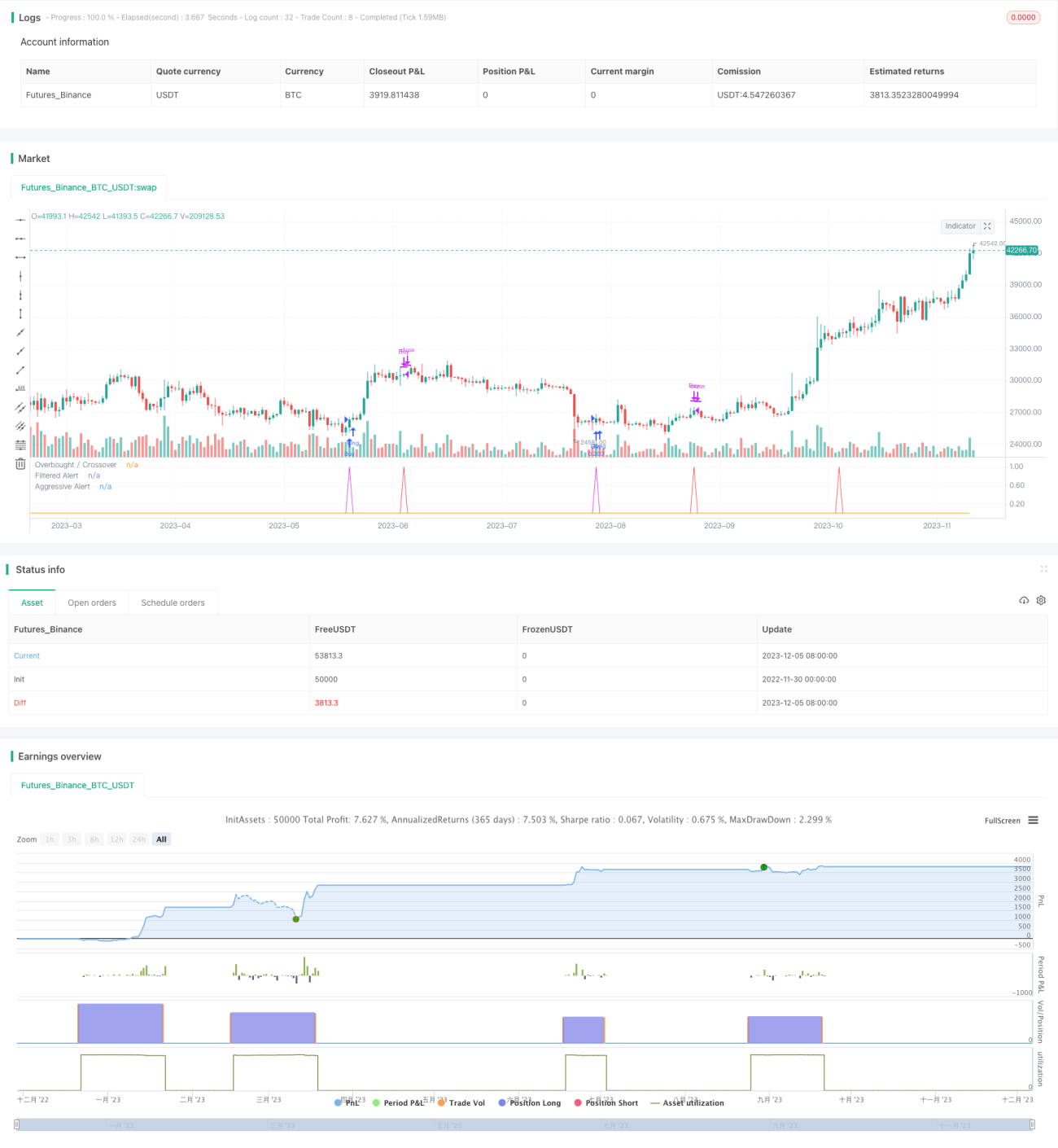
듀얼 인디케이터 매수 필터 매수 신호 전략


생성 날짜: 2023-12-07 10:43:01 마지막으로 수정됨: 2023-12-07 10:43:01
복사: 1 클릭수: 576
avatar of ChaoZhang ChaoZhang
1
집중하다
1619
수행원

듀얼 인디케이터 매수 필터 매수 신호 전략

개요

이중 지표 구매 필터 구매 신호 전략은 무작위 지수 평평한 이동 평균 ((Stochastic RSI) 과 브린 밴드 지표의 조합을 사용하여 잠재적인 구매 기회를 식별합니다. 이 전략은 가장 유리한 구매 지점을 구별하기 위해 여러 필터 조건을 사용합니다. 이것은 시장의 변동 환경에서 높은 확률의 구매 시기를 식별 할 수 있습니다.

전략 원칙

이 전략은 구매 기회를 식별하기 위해 두 가지의 지표를 사용합니다.

첫째, 그것은 무작위 지수 평행 이동 평균을 사용하여 시장이 과매매되었는지 여부를 판단한다. 이 지표는 무작위 지수와 그것의 평행 이동 평균을 결합하여, %K 라인이 낮은 지점에서 %D 라인을 통과하면, 과매매 신호로 간주된다. 여기에 기한이 설정되어 있으며, %K 라인이 20 이상일 때 과매매로 간주된다.

둘째, 이 전략은 부린 반지 지표를 사용하여 가격 변화를 식별한다. 부린 반지는 가격의 표준 격차에 따라 계산된다. 가격이 하향 궤도에 가까워지면 과매매 상태에 속한다. 이 전략은 여기서 2배 표준 격차의 파라미터를 설정하여 부린 반지 범위를 더 넓히고 더 많은 가짜 신호를 필터링한다.

이 전략은 상술한 두 가지 지표의 초과 판매 신호를 받은 후, 구매 시기를 추가적으로 식별하기 위해 여러 필터링 조건을 추가합니다.

  1. 이 가격도 부린의 하락을 막 뚫고 올라왔습니다.
  2. 현재 종결값은 N근 K선 전 종결값보다 높으며, 구매 입력 채널을 나타냅니다.
  3. 현재 종결 가격은 장기 또는 중기 회전 기간의 종결 가격보다 낮으며, 유리하게 조정됩니다.

종합 판단 후 식별된 구매 시기는 구매 신호를 발송한다.

우위 분석

이 두 가지 지표가 필터링되는 전략에는 다음과 같은 장점이 있습니다.

  1. 이중 지표 판단을 사용하여 구매 신호를 더욱 신뢰할 수 있게 하고, 가짜 신호를 피한다.
  2. 여러 가지 필터링 조건으로, 지진이 발생했을 때 자주 구매하는 것을 방지할 수 있습니다.
  3. 무작위 지수 지표와 결합하여 과매매 상태를 판단하고, 브린带 지표는 가격을 비정상적으로 판단한다.
  4. 가격 판단력을 높여서 충분한 구매자 확보를 보장합니다.
  5. 구매점의 신뢰성을 더욱 보장하기 위해 재조정 판단을 강화합니다.

전체적으로, 이 전략은 여러 가지 기술 지표와 필터링 방법을 통합하여 구매 시기를 더 정확하고 신뢰할 수 있게 만들고, 결과적으로 더 나은 거래 성과를 얻습니다.

위험 분석

이 두가지 지수 필터링 전략은 많은 장점들을 가지고 있지만, 몇 가지 위험도 있습니다.

  1. 잘못된 매개 변수 설정으로 인해 구매 신호가 너무 빈번하거나 보수적이어서 신중하게 테스트 및 최적화가 필요합니다.
  2. 여러 가지 필터링 조건으로 구매 기회를 놓칠 수도 있고, 빠른 흐름을 추적할 수 없습니다.
  3. 지표가 분산되면 잘못된 신호가 발생하고, 지표의 일관성에 주의해야 한다.
  4. 추세를 판단할 수 없고, 곰 시장에서 잘못된 신호가 발생하여 손실이 발생할 수 있습니다.

위와 같은 위험들에 대해, 이 전략은 다음과 같이 최적화될 수 있습니다.

  1. 지표 파라미터를 조정하여 필터링 조건의 감수성을 균형을 잡습니다.
  2. 트렌드 판단 지표의 도움으로 곰 시장에서 잘못된 신호를 피하십시오.
  3. 손해 방지 수단의 증대

최적화 방향

이 두 개의 지표 필터링 전략은 다음의 몇 가지 차원에서 더욱 최적화 될 수 있습니다.

  1. 더 많은 기술 지표의 조합을 테스트하여 더 나은 구매 시점을 판단하는 방법을 찾으십시오. VRSI, DMI 등등.
  2. 기계 학습 알고리즘을 추가하고, 자동으로 파라미터를 최적화한다.
  3. 자율적 인 손해 방지 장치를 추가하십시오. 이익이 일정 수준에 도달하면 점진적으로 손해 방지 선을 높여줍니다.
  4. 거래량 지표와 함께 충분한 구매력을 확보하기 위해
  5. 자금 관리 전략을 최적화하십시오. 동적 거래 수를 설정하여 단독 손실을 줄이십시오.

더 많은 첨단 기술과 방법을 도입하여 이중 지수 필터링 전략은 더 정확한 구매 시점 선택과 더 강력한 위험 제어 능력을 얻을 수 있습니다. 따라서 실전에서 더 안정적이고 신뢰할 수있는 수익을 얻을 수 있습니다.

요약하다

요약하자면, 이중 지표 구매 필터 구매 신호 전략은 Stochastic RSI와 브린 벨트와 같은 여러 가지 기술 지표를 사용하며, 가격 강도 및 회귀 판단과 같은 여러 가지 필터링 조건을 결합하여, 높은 확률의 신뢰할 수있는 구매 시기를 식별합니다. 파라미터 최적화, 스톱 손실 설정 등이 더 개선되면, 이 전략은 수익 안정의 정량 거래 전략 중 하나가 될 수 있습니다.

그것의 핵심 장점은 지표와 필터 조건의 효과적인 결합에 있다, 구매 시점을 판단하는 것을 더 정확하게한다. 위험과 최적화 방향도 제어할 수 있다. 전체적으로, 이것은 실제 실행할 수 있는 높은 효율의 계량화 전략이다.

전략 소스 코드
/*backtest
start: 2022-11-30 00:00:00
end: 2023-12-06 00:00:00
period: 1d
basePeriod: 1h
exchanges: [{"eid":"Futures_Binance","currency":"BTC_USDT"}]
*/

//@version=4
strategy("SORAN Buy and Close Buy", pyramiding=1, initial_capital=10000, default_qty_type=strategy.percent_of_equity, default_qty_value=10, overlay=false)

////Buy and Close-Buy messages
Long_message = input("")
Close_message = input("")

///////////// Stochastic Slow
Stochlength = input(14, minval=1, title="lookback length of Stochastic")
StochOverBought = input(80, title="Stochastic overbought condition")
StochOverSold = input(20, title="Stochastic oversold condition")
smoothK = input(3, title="smoothing of Stochastic %K ")
smoothD = input(3, title="moving average of Stochastic %K")
k = sma(stoch(close, high, low, Stochlength), smoothK)
d = sma(k, smoothD)

 
///////////// RSI 
RSIlength = input( 14, minval=1 , title="lookback length of RSI")
RSIOverBought = input( 70  , title="RSI overbought condition")
RSIOverSold = input( 30  , title="RSI oversold condition")
RSIprice = close
vrsi = rsi(RSIprice, RSIlength)

///////////// Double strategy: RSI strategy + Stochastic strategy

pd = input(22, title="LookBack Period Standard Deviation High")
bbl = input(20, title="Bolinger Band Length")
mult = input(2.0    , minval=1, maxval=5, title="Bollinger Band Standard Devaition Up")
lb = input(50  , title="Look Back Period Percentile High")
ph = input(.85, title="Highest Percentile - 0.90=90%, 0.95=95%, 0.99=99%")
new = input(false, title="-------Text Plots Below Use Original Criteria-------" )
sbc = input(false, title="Show Text Plot if WVF WAS True and IS Now False")
sbcc = input(false, title="Show Text Plot if WVF IS True")
new2 = input(false, title="-------Text Plots Below Use FILTERED Criteria-------" )
sbcFilt = input(true, title="Show Text Plot For Filtered Entry")
sbcAggr = input(true, title="Show Text Plot For AGGRESSIVE Filtered Entry")
ltLB = input(40, minval=20, maxval=99, title="Long-Term Look Back Current Bar Has To Close Below This Value OR Medium Term--Default=40")
mtLB = input(14, minval=1, maxval=40, title="Medium-Term Look Back Current Bar Has To Close Below This Value OR Long Term--Default=14")
str = input(3, minval=1, maxval=9, title="Entry Price Action Strength--Close > X Bars Back---Default=3")
//Alerts Instructions and Options Below...Inputs Tab
new4 = input(false, title="-------------------------Turn On/Off ALERTS Below---------------------" )
new5 = input(false, title="----To Activate Alerts You HAVE To Check The Boxes Below For Any Alert Criteria You Want----")
sa1 = input(false, title="Show Alert WVF = True?")
sa2 = input(false, title="Show Alert WVF Was True Now False?")
sa3 = input(false, title="Show Alert WVF Filtered?")
sa4 = input(false, title="Show Alert WVF AGGRESSIVE Filter?")

//Williams Vix Fix Formula
wvf = ((highest(close, pd)-low)/(highest(close, pd)))*100
sDev = mult * stdev(wvf, bbl)
midLine = sma(wvf, bbl)
lowerBand = midLine - sDev
upperBand = midLine + sDev
rangeHigh = (highest(wvf, lb)) * ph

//Filtered Bar Criteria
upRange = low > low[1] and close > high[1]
upRange_Aggr = close > close[1] and close > open[1]
//Filtered Criteria
filtered = ((wvf[1] >= upperBand[1] or wvf[1] >= rangeHigh[1]) and (wvf < upperBand and wvf < rangeHigh))
filtered_Aggr = (wvf[1] >= upperBand[1] or wvf[1] >= rangeHigh[1]) and not (wvf < upperBand and wvf < rangeHigh)

//Alerts Criteria
alert1 = wvf >= upperBand or wvf >= rangeHigh ? 1 : 0
alert2 = (wvf[1] >= upperBand[1] or wvf[1] >= rangeHigh[1]) and (wvf < upperBand and wvf < rangeHigh) ? 1 : 0
alert3 = upRange and close > close[str] and (close < close[ltLB] or close < close[mtLB]) and filtered ? 1 : 0
alert4 = upRange_Aggr and close > close[str] and (close < close[ltLB] or close < close[mtLB]) and filtered_Aggr ? 1 : 0

//Coloring Criteria of Williams Vix Fix
col = wvf >= upperBand or wvf >= rangeHigh ? #00E676 : #787B86

isOverBought = (crossover(k,d) and k > StochOverBought) ? 1 : 0
isOverBoughtv2 = k > StochOverBought ? 1 : 0
filteredAlert = alert3 ? 1 : 0
aggressiveAlert = alert4 ? 1 : 0

plot(isOverBought, "Overbought / Crossover", style=plot.style_line, color=#FF5252) 
plot(filteredAlert, "Filtered Alert", style=plot.style_line, color=#E040FB) 
plot(aggressiveAlert, "Aggressive Alert", style=plot.style_line, color=#FF9800)

if (filteredAlert or aggressiveAlert)
    strategy.entry("Buy", strategy.long, alert_message = Long_message)

if (filteredAlert or aggressiveAlert)
    alert("Buy Signal", alert.freq_once_per_bar)


if (isOverBought)
    strategy.close("Buy", alert_message = Close_message)